 TimelyScholar
Services › Systematic Reviews
End-to-end systematic review support, from a registrable protocol to a PRISMA 2020-compliant manuscript, led by PhD specialists who follow the Cochrane Handbook.
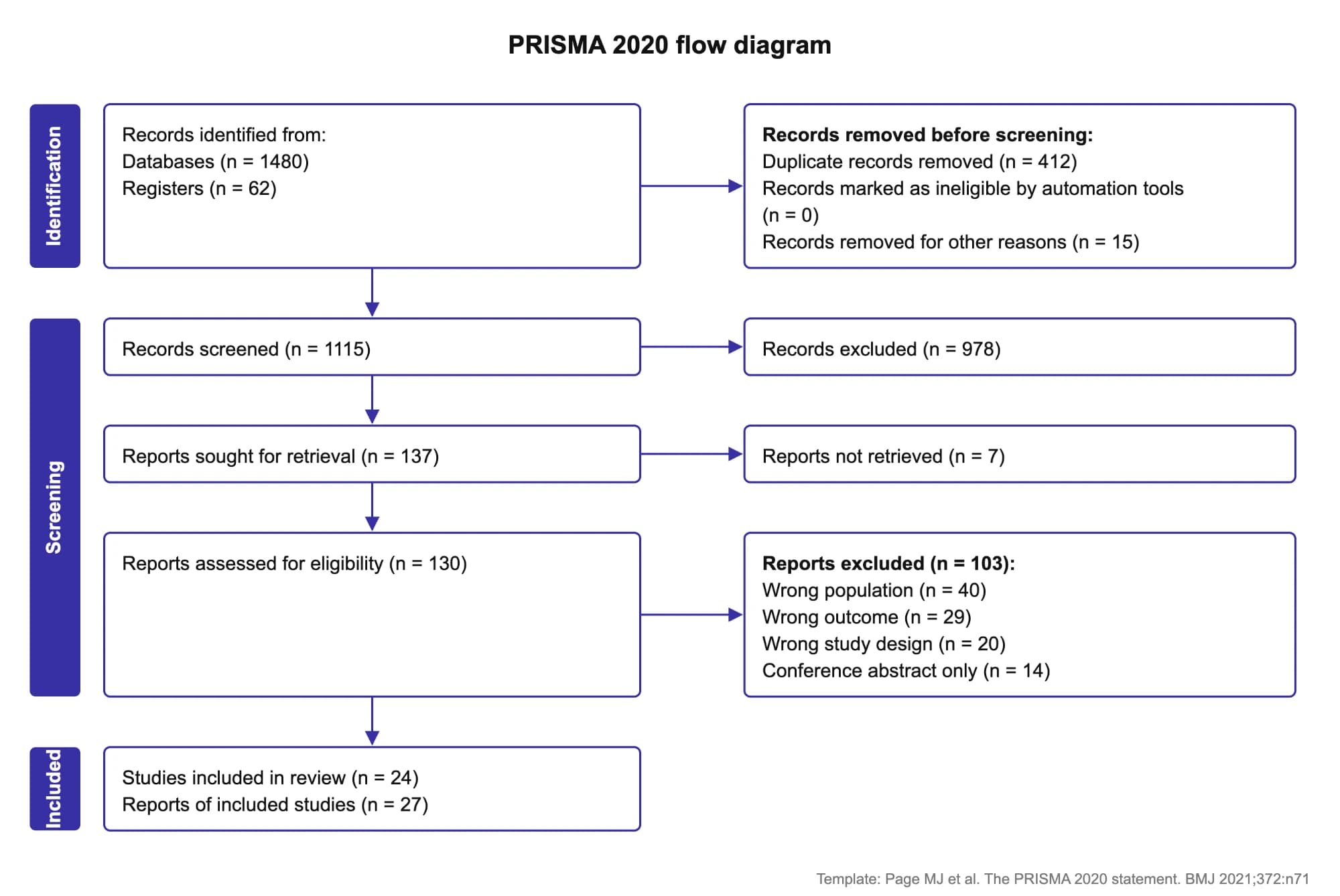
A systematic review answers a focused question by finding, appraising and synthesising all of the relevant studies using explicit, reproducible methods. Harvard Library's research guide notes that a well-conducted review can take dozens to hundreds of hours over several months, and that it needs subject expertise, statistical support and a carefully designed search.
Our systematic review help covers every stage: turning your topic into an answerable question, writing and registering the protocol, building the database search strategy, dual screening, data extraction, risk-of-bias assessment, narrative synthesis or meta-analysis, and reporting against the 27-item PRISMA 2020 checklist with a PRISMA flow diagram.
Whether you need a complete systematic review for a thesis or journal submission, or help with one stage such as the search or the risk-of-bias tables, you get a clear, itemised quote before any work begins.
A protocol that states your question, eligibility criteria, search plan and analysis in advance, ready to register in PROSPERO or publish.
Reproducible search strings for MEDLINE/PubMed, Embase, CINAHL, PsycINFO, Scopus and trial registers, with controlled vocabulary (MeSH) and full documentation.
Title/abstract and full-text screening against your inclusion criteria, with reasons for exclusion recorded for the flow diagram.
Piloted extraction forms capturing study design, population, interventions, comparators, outcomes and results.
Study-level appraisal with RoB 2 for randomised trials, ROBINS-I for non-randomised studies, or the appropriate JBI checklist.
Narrative synthesis or statistical pooling, with certainty of evidence rated using GRADE when appropriate.
A PRISMA 2020 flow diagram showing records identified, screened, excluded and included, with reasons.
A manuscript or thesis chapter mapped item by item to the PRISMA 2020 checklist, plus the completed checklist.
We refine your topic into a structured question (for example PICO) and agree the review type, scope and deadline.
We write the protocol and prepare it for PROSPERO registration so your methods are fixed before screening begins.
We run and document the database searches, remove duplicates and screen records in two stages.
We extract data, assess risk of bias and synthesise the findings narratively or with a meta-analysis.
You receive the PRISMA-compliant write-up, tables and figures, and can request refinements within the agreed scope.
Our methods follow published standards from recognised authorities, so your work holds up to supervisors, examiners and peer reviewers.
A review that uses explicit, pre-specified methods to find, appraise and synthesise all relevant studies on a focused question, so the results are transparent and reproducible. The Cochrane Handbook sets out the standard methods.
It depends on the question and the number of studies. Harvard Library's guide notes a well-done review can require dozens to hundreds of hours over several months. Your quote gives a timeline for your specific review.
We prepare the protocol and the registration content for PROSPERO. Registration is submitted under your name as the review author.
A systematic review is the whole process of finding and appraising studies. A meta-analysis is an optional statistical step within it that pools results from comparable studies.
Yes. Many clients ask for the search strategy, screening, risk-of-bias assessment or the PRISMA write-up only.
Yes. Your files are stored privately and only the people working on your project can open them. We sign a non-disclosure agreement on request.
Yes. After delivery you can request refinements within the agreed scope directly from your client dashboard.
Every project gets an itemised quote based on scope, complexity and deadline. You pay only after you accept the quote.
Request a free quote online, message us on WhatsApp or email us. A specialist will reply with an itemised quote within 2-4 business hours.
You remain the author. For publications, the ICMJE recommends acknowledging writing assistance and editing rather than listing it as authorship. For coursework, follow your institution's academic integrity policy.
Describe your project and a specialist will reply with an itemized quote within 2-4 business hours.
Prefer email? info@timelyscholar.com