 TimelyScholar
Services › Mixed-Methods Research Analysis
Qualitative and mixed methods analysis, from interview coding and thematic analysis to integrating qualitative and quantitative findings.
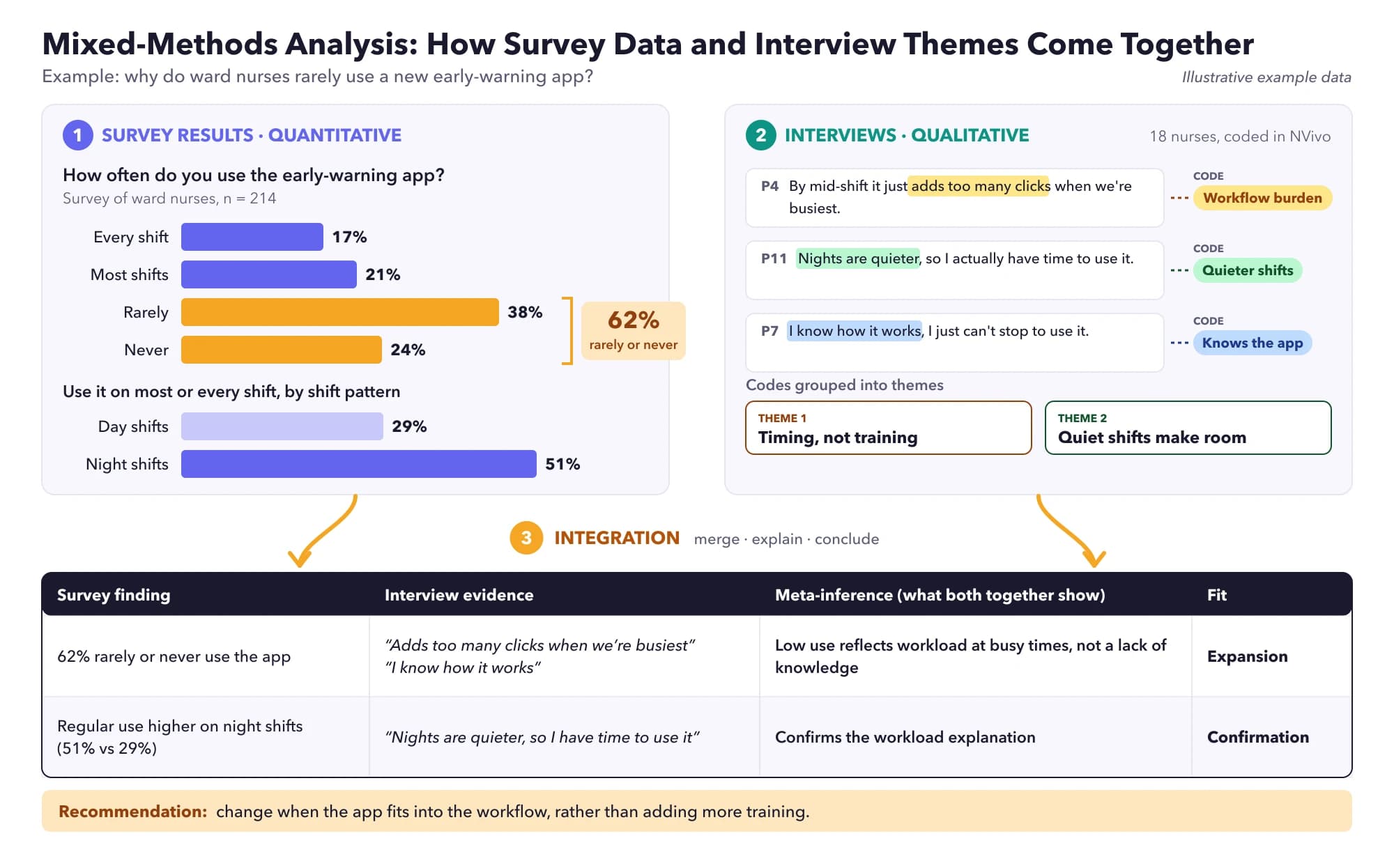
Qualitative data analysis turns interviews, focus groups and open-ended responses into credible, well-evidenced themes. Mixed methods research goes a step further and integrates those findings with quantitative results, so each strand explains the other.
We code transcripts in NVivo, ATLAS.ti or MAXQDA, develop codebooks, and carry out thematic analysis following Braun and Clarke's six-phase approach or content analysis, as your design requires. For mixed methods studies we apply recognised integration principles such as joint displays.
Systematic coding of transcripts, with an audit trail of how codes were developed.
Braun and Clarke-style thematic analysis, from familiarisation to defined, evidenced themes.
Qualitative or quantitative content analysis with clear coding rules.
Project set-up, coding, queries and exports in NVivo.
Coding and network views in ATLAS.ti.
Coding, memos and mixed methods tools in MAXQDA.
A codebook with definitions and examples that makes coding consistent.
Interpretation that links themes to your research questions and the literature.
Synthesis of published qualitative studies for reviews.
Integration of qualitative and quantitative results, including joint displays.
We confirm your questions, approach and the data you have.
We set up the software project and code the data.
We review, define and name themes with supporting quotations.
For mixed methods, we integrate strands and show how they relate.
You receive a findings chapter and the project files.
Our methods follow published standards from recognised authorities, so your work holds up to supervisors, examiners and peer reviewers.
| Standard | What it covers | Source |
|---|---|---|
| Thematic analysis | Braun and Clarke's widely used six-phase approach | Braun V, Clarke V. Using thematic analysis in psychology. Qual Res Psychol 2006;3:77-101 |
| COREQ | 32-item checklist for reporting interview and focus-group studies | Tong A, et al. COREQ: a 32-item checklist for interviews and focus groups. Int J Qual Health Care 2007;19:349-357 |
| APA JARS-Qual and JARS-Mixed | Reporting standards for qualitative and mixed methods research | Levitt HM, et al. APA reporting standards for qualitative and mixed methods research. Am Psychol 2018;73:26-46 |
| Mixed methods integration | Principles and practices for integrating qualitative and quantitative data | Fetters MD, et al. Achieving integration in mixed methods designs. Health Serv Res 2013;48:2134-2156 |
A method for identifying, analysing and reporting patterns (themes) in qualitative data. Braun and Clarke's 2006 paper describes the widely used six-phase approach.
Thematic analysis interprets patterns of meaning. Content analysis codes and often counts content against defined categories. We use the one that suits your question.
Yes, as well as ATLAS.ti and MAXQDA. You receive the project file.
A table or figure that places qualitative and quantitative results side by side to show how they relate, one of the integration practices described by Fetters and colleagues.
Yes. You receive the codebook and an audit trail so examiners or reviewers can follow how themes were developed.
Yes. Your files are stored privately and only the people working on your project can open them. We sign a non-disclosure agreement on request.
Yes. After delivery you can request refinements within the agreed scope directly from your client dashboard.
Every project gets an itemised quote based on scope, complexity and deadline. You pay only after you accept the quote.
Request a free quote online, message us on WhatsApp or email us. A specialist will reply with an itemised quote within 2-4 business hours.
You remain the author. For publications, the ICMJE recommends acknowledging writing assistance and editing rather than listing it as authorship. For coursework, follow your institution's academic integrity policy.
Describe your project and a specialist will reply with an itemized quote within 2-4 business hours.
Prefer email? info@timelyscholar.com