 TimelyScholar
Services › Scoping Reviews
Scoping reviews that map the evidence on your topic, built on JBI methodology and reported to the PRISMA-ScR checklist.
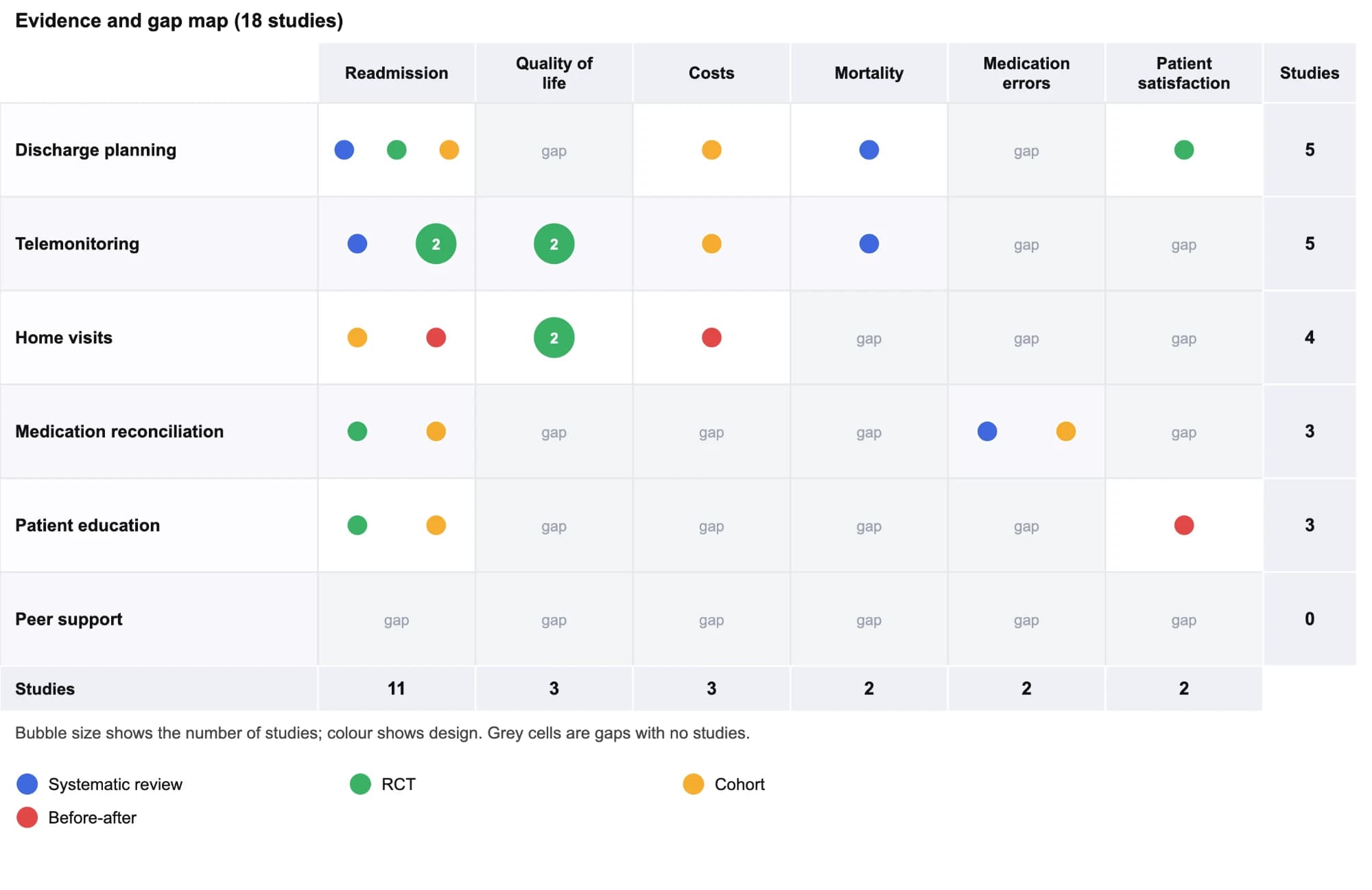
A scoping review maps the extent and nature of the evidence on a topic, identifies key concepts and reveals research gaps. It is often the right choice when a question is broad, the literature is diverse, or you need to know whether a full systematic review is feasible.
We follow the JBI methodology for scoping reviews, which frames the question with the Population, Concept and Context (PCC) mnemonic and builds on Arksey and O'Malley's original framework. Reporting follows PRISMA-ScR, which has 20 essential and 2 optional items.
Not sure whether you need a scoping review or a systematic review? We will recommend the review type that fits your question before you commit.
A complete scoping review conducted to JBI guidance and reported to PRISMA-ScR.
A clear, answerable scoping question and objectives that match your purpose.
Population, Concept and Context defined precisely, driving the eligibility criteria and search.
A documented strategy covering databases and grey literature, developed from your key terms.
Searches run and exported with dates, hits and de-duplication recorded.
Two-stage screening against the PCC criteria with reasons for exclusion.
A piloted charting form that captures the study details your question needs.
Tables and visual maps that summarise what exists, where and how it has been studied.
Flow diagram and completed PRISMA-ScR checklist.
A clear account of what is known, what is missing and what should be studied next.
We confirm the scoping question, objectives and PCC elements with you.
We write an a priori protocol following JBI guidance that you can share or publish.
We search databases and grey literature and screen records against the eligibility criteria.
We chart the data and present the evidence in tables, figures and a narrative summary.
You receive a PRISMA-ScR-compliant write-up and can request refinements within the agreed scope.
Our methods follow published standards from recognised authorities, so your work holds up to supervisors, examiners and peer reviewers.
| Standard | What it covers | Source |
|---|---|---|
| JBI scoping review methodology | Updated guidance for conducting scoping reviews, including the PCC framework | Peters MDJ, et al. Updated methodological guidance for the conduct of scoping reviews. JBI Evid Synth 2020;18:2119-2126JBI Manual for Evidence Synthesis |
| PRISMA-ScR | Reporting checklist with 20 essential and 2 optional items (an update is in development) | Tricco AC, et al. PRISMA Extension for Scoping Reviews (PRISMA-ScR). Ann Intern Med 2018;169:467-473PRISMA-ScR (official website) |
| Arksey and O'Malley framework | The original methodological framework for scoping studies | Arksey H, O'Malley L. Scoping studies: towards a methodological framework. Int J Soc Res Methodol 2005;8:19-32 |
| Review typology | How scoping reviews differ from systematic and other review types | Grant MJ, Booth A. A typology of reviews: 14 review types. Health Info Libr J 2009;26:91-108 |
A systematic review answers a focused question and usually appraises study quality to judge effectiveness. A scoping review maps the breadth of evidence on a broader question and identifies gaps. The JBI guidance and Grant and Booth's typology describe the differences.
PCC stands for Population, Concept and Context. JBI uses it to frame scoping review questions and eligibility criteria.
Critical appraisal is not usually required in a scoping review, because the aim is to map evidence rather than judge effectiveness. We can add it if your question or institution needs it.
It depends on the breadth of the question and the volume of literature. Your quote gives a timeline for your review.
PRISMA-ScR (Tricco et al., 2018). The PRISMA group is currently updating it, and we will apply the update once it is published.
Yes. Your files are stored privately and only the people working on your project can open them. We sign a non-disclosure agreement on request.
Yes. After delivery you can request refinements within the agreed scope directly from your client dashboard.
Every project gets an itemised quote based on scope, complexity and deadline. You pay only after you accept the quote.
Request a free quote online, message us on WhatsApp or email us. A specialist will reply with an itemised quote within 2-4 business hours.
You remain the author. For publications, the ICMJE recommends acknowledging writing assistance and editing rather than listing it as authorship. For coursework, follow your institution's academic integrity policy.
Describe your project and a specialist will reply with an itemized quote within 2-4 business hours.
Prefer email? info@timelyscholar.com