 TimelyScholar
Services › Psychology Research Methods & Data Analysis
One-to-one support for Research Methods and Data Analysis in Psychology I and II, from designing a study and choosing the right test to running it in SPSS, R or JASP and reporting it in APA style.
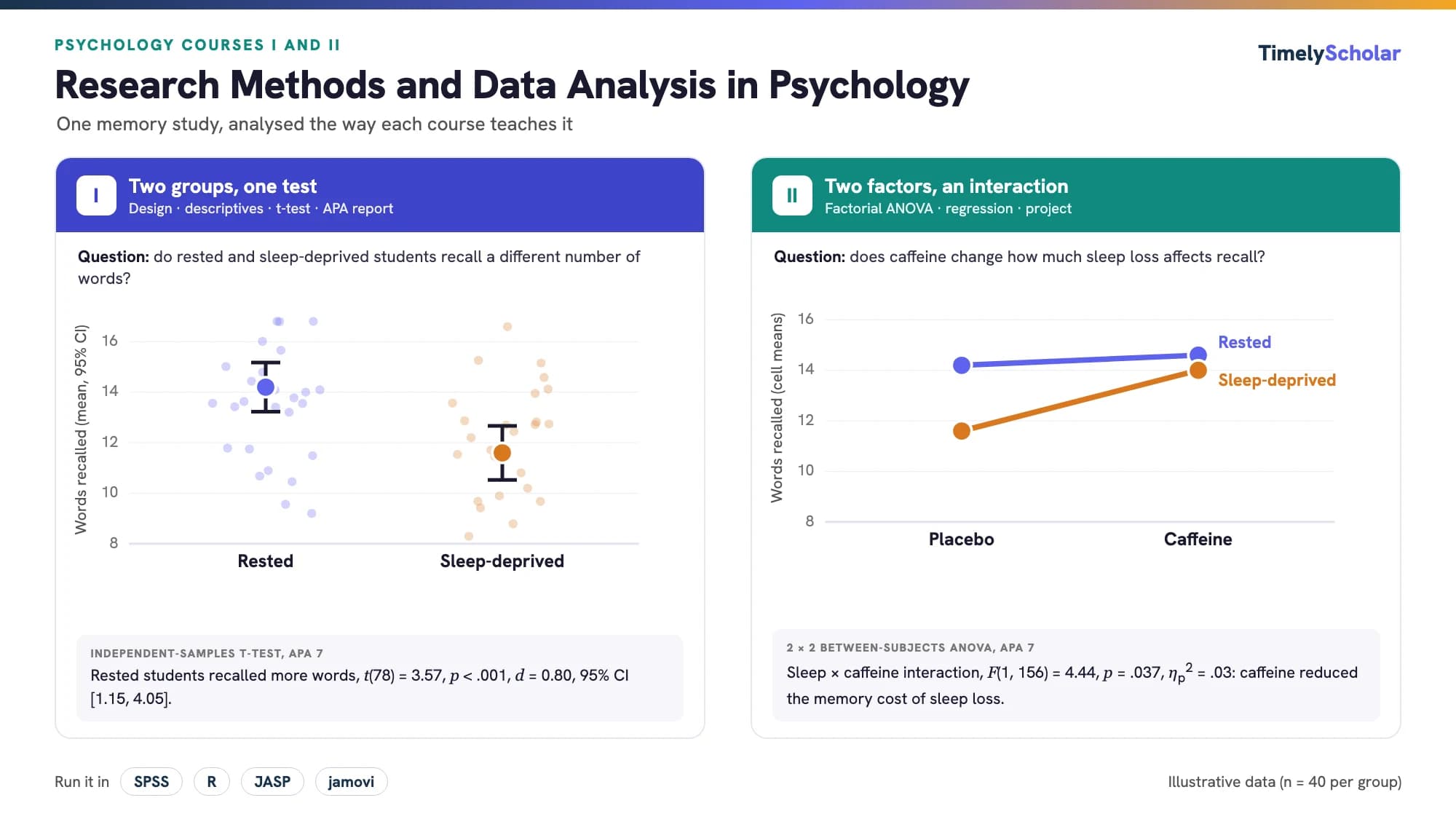
Research Methods and Data Analysis in Psychology I covers the foundations: the scientific method, and how qualitative, correlational and experimental studies are designed and analysed, building on an introductory statistics course. Part II moves on to traditional and quasi-experimental designs, factorial ANOVA and regression, with a strong emphasis on scientific writing in APA style.
Our psychology and quantitative methods specialists explain the concepts, show you how to run and read each analysis in SPSS, R or JASP, and give detailed feedback on your lab reports and proposals against APA 7 and the APA Journal Article Reporting Standards. You remain the author of your work, and everything we do follows your course's rules on outside help.
The foundations: the scientific method, and how qualitative, correlational and experimental studies are designed and analysed.
Advanced methods: traditional and quasi-experimental designs, the analyses that go with them, and scientific writing in APA style.
Help turning a research question into a design with clear variables, a suitable sample and an ethics plan.
Which test fits your design and data, and why, from t-tests to mixed ANOVA and regression.
Step-by-step guidance on running each analysis and reading every part of the output.
Checking normality, homogeneity and sphericity, and reporting effect sizes and confidence intervals.
Detailed comments on your results, tables, figures and discussion against APA 7 and JARS.
Feedback on your method, results and full research papers as you write them in stages, and on any proposal or ethics application.
Clear explanations of the ideas behind each method, to prepare you for class tests and exams.
Send your syllabus, assignment brief, rubric and any dataset or draft.
We agree which topics, analyses or drafts you want help with and the timeline.
Tutoring sessions, annotated analyses and written feedback on your drafts.
You finalise and submit your work, in line with your course's rules on outside help.
Our methods follow published standards from recognised authorities, so your work holds up to supervisors, examiners and peer reviewers.
| Standard | What it covers | Source |
|---|---|---|
| APA Journal Article Reporting Standards | What to report for quantitative, qualitative and mixed methods studies | APA Style: Journal Article Reporting Standards (JARS)Appelbaum M, et al. APA Journal Article Reporting Standards for quantitative research. Am Psychol 2018;73:3-25Levitt HM, et al. APA reporting standards for qualitative and mixed methods research. Am Psychol 2018;73:26-46 |
| APA Style: numbers and statistics | Formatting statistics, p-values and effect sizes in APA 7 | APA Style: Numbers and statistics |
| APA Ethics Code | Informed consent, deception, debriefing and confidentiality in research | American Psychological Association: Ethical Principles of Psychologists and Code of Conduct |
| BPS Code of Human Research Ethics | Ethics standards used by UK psychology departments | British Psychological Society: Code of Human Research Ethics |
The scientific method and the design and analysis of qualitative, correlational and experimental research: measurement, ethics, correlation, t-tests and chi-square, building on an introductory statistics course. We work from your syllabus.
Traditional and quasi-experimental designs and their analysis, including one-way and 2 × 2 factorial ANOVA, correlation and regression, with an emphasis on writing method and results sections and full papers in APA style.
SPSS, R (including RStudio), JASP and jamovi, plus Excel for basic analyses. We show you how to run each test and read the output.
Yes. We give detailed feedback on your method, results, tables and discussion against APA 7. You remain the author and write the final version yourself.
It depends on your research question, the number and type of variables, and whether groups are independent or repeated. We walk through that decision with you for each assignment.
No. We tutor you on the concepts so you can do them yourself, in line with your institution's academic integrity policy.
Yes. Your files are stored privately and only the people working on your project can open them. We sign a non-disclosure agreement on request.
Yes. After delivery you can request refinements within the agreed scope directly from your client dashboard.
Every project gets an itemised quote based on scope, complexity and deadline. You pay only after you accept the quote.
Request a free quote online, message us on WhatsApp or email us. A specialist will reply with an itemised quote within 2-4 business hours.
You remain the author. For publications, the ICMJE recommends acknowledging writing assistance and editing rather than listing it as authorship. For coursework, follow your institution's academic integrity policy.
Describe your project and a specialist will reply with an itemized quote within 2-4 business hours.
Prefer email? info@timelyscholar.com