 TimelyScholar
Services › Capstone Projects › DNP Scholarly Project
DNP scholarly and quality-improvement project support, from project ideas and design to statistical analysis and SQUIRE 2.0 reporting.
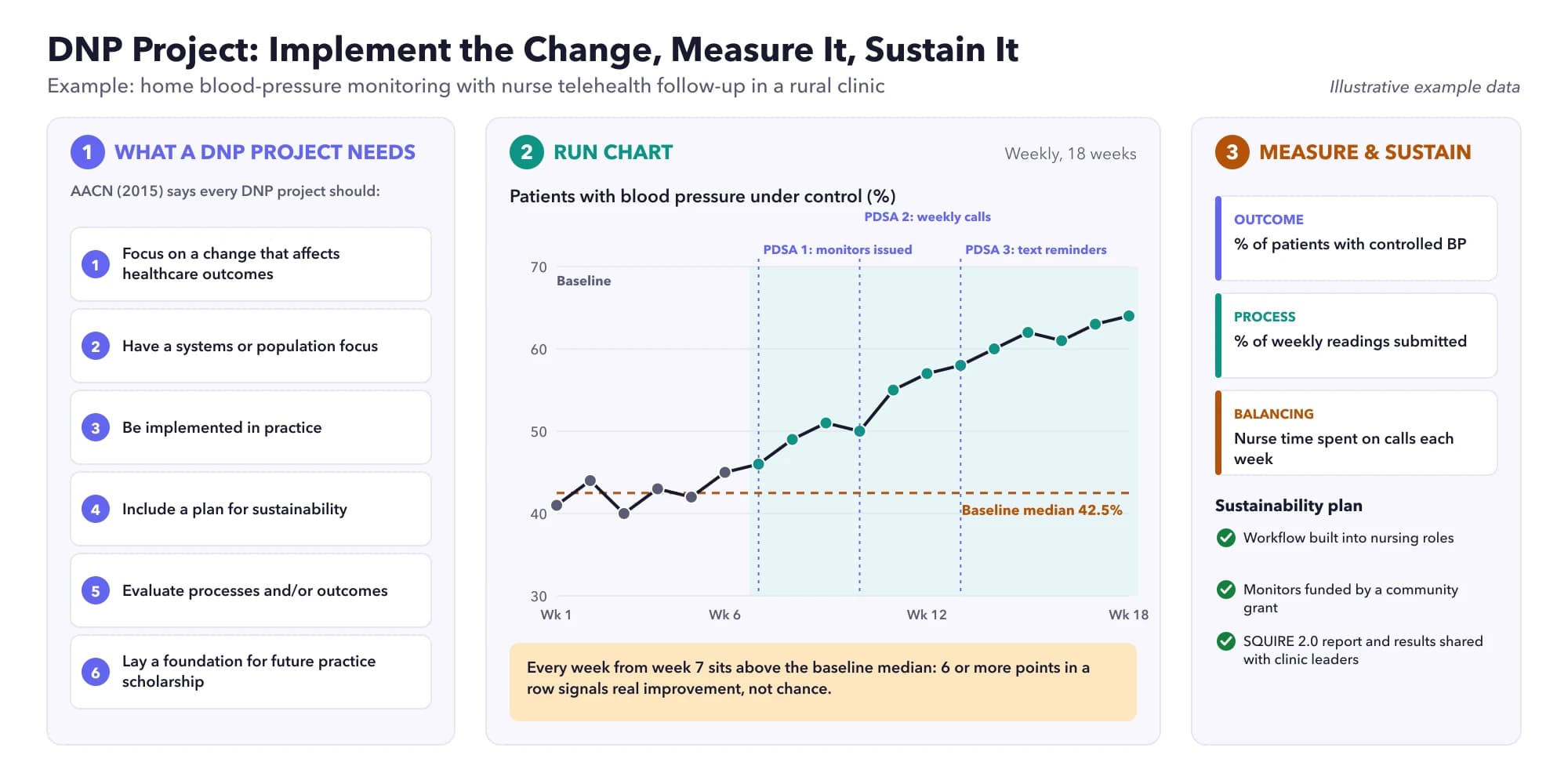
A DNP scholarly project translates evidence into practice to improve outcomes, and it draws on the doctoral competencies set out in the AACN Essentials. Many DNP projects are quality-improvement or evidence-based implementation projects, which the Institute for Healthcare Improvement's Model for Improvement and PDSA cycles are designed to support.
We help with DNP project ideas, the problem statement and PICOT question, the evidence synthesis, project design and measures, and statistical analysis of your project data as your DNP statistician. We also help with reporting to the SQUIRE 2.0 guidelines and preparing your manuscript, poster and defence.
Feasible project ideas for your specialty: FNP, PMHNP, acute care, nurse anesthesia, pediatrics or leadership.
Aims, change strategy, PDSA cycles and a logic model for your project.
Search, JBI appraisal and synthesis that justify the intervention.
Outcome, process and balancing measures with a data collection plan.
Pre/post analysis, run and control charts, and statistical testing, clearly interpreted.
Structuring your final paper to the SQUIRE 2.0 guidelines.
Feedback on your poster, manuscript and final defence.
We clarify the practice gap, setting and aims.
We support the evidence synthesis behind your intervention.
We help design the project, measures and PDSA cycles.
We analyse your data as your project statistician.
We help you report to SQUIRE 2.0 and prepare to defend.
Our methods follow published standards from recognised authorities, so your work holds up to supervisors, examiners and peer reviewers.
| Standard | What it covers | Source |
|---|---|---|
| AACN Essentials | Competencies for doctoral nursing education | AACN: The Essentials: Core Competencies for Professional Nursing Education |
| IHI Model for Improvement | Three fundamental questions and PDSA cycles | Institute for Healthcare Improvement: Model for Improvement and PDSA cycles |
| SQUIRE 2.0 | Reporting quality-improvement work | Ogrinc G, et al. SQUIRE 2.0 guidelines for quality improvement reporting. BMJ Qual Saf 2016;25:986-992 |
| GRADE and JBI tools | Rating and appraising the evidence behind the intervention | GRADE Working GroupJBI Critical Appraisal Tools |
A doctoral project that translates evidence into practice to improve outcomes, often through quality improvement or evidence-based implementation.
Projects tied to a measurable gap in your setting, for example depression screening in primary care, sepsis bundle compliance, fall prevention or opioid prescribing. We help you pick one you can complete.
Yes. We analyse your project data, commonly pre/post comparisons and run or control charts, and explain the results.
A project that tests changes in practice using a model such as the IHI Model for Improvement and PDSA cycles, and reports results with guidelines like SQUIRE 2.0.
We support, analyse and edit, but you remain the author, in line with your program's academic integrity policy.
Yes. Your files are stored privately and only the people working on your project can open them. We sign a non-disclosure agreement on request.
Yes. After delivery you can request refinements within the agreed scope directly from your client dashboard.
Every project gets an itemised quote based on scope, complexity and deadline. You pay only after you accept the quote.
Request a free quote online, message us on WhatsApp or email us. A specialist will reply with an itemised quote within 2-4 business hours.
You remain the author. For publications, the ICMJE recommends acknowledging writing assistance and editing rather than listing it as authorship. For coursework, follow your institution's academic integrity policy.
Describe your project and a specialist will reply with an itemized quote within 2-4 business hours.
Prefer email? info@timelyscholar.com