 TimelyScholar
Services › Capstone Projects › BSG Game
Coaching for the Business Strategy Game (BSG): understand the reports, build a coherent strategy and make better-informed decisions each year.
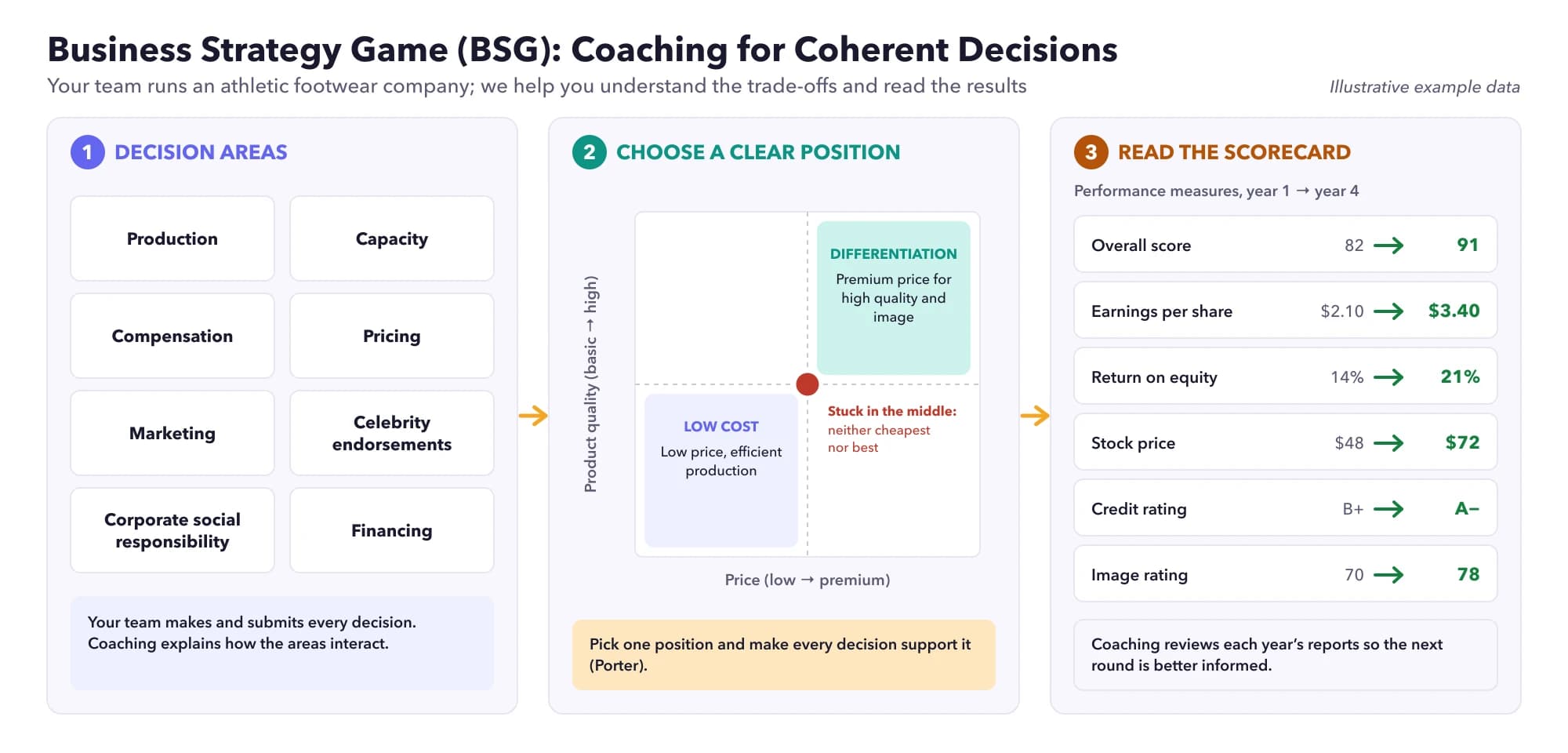
The Business Strategy Game is an online simulation in which teams run a company competing in a global marketplace. Doing well depends on a coherent strategy and on understanding how each decision affects performance.
We coach you on competitive strategy using Harvard Business School's frameworks on strategic positioning and the value chain, help you read and interpret the reports, and explain the trade-offs behind each decision area. You and your team make and submit your own decisions, in line with your course rules.
In the Business Strategy Game your team runs an athletic footwear company that starts level with every rival: same sales, market shares, costs and prices in all four regions (North America, Europe-Africa, Asia-Pacific and Latin America). Each decision round is one year, and demand per company is forecast to roughly double over the game, so capacity, cost and marketing choices compound year after year.
Your sales and market share in each region are decided by how your company compares with the all-company average on each competitive factor, not by any absolute level of effort. Below, the game is broken into the eight stages a team works through each round, with the main factors in each and the points that most often decide results.
Every round starts with the reports. They show where you out-competed rivals, where you fell short and which costs are out of line.
Labour decisions set productivity (how many workers you need) and reject rates (how many pairs fail inspection) at each plant.
Here you set the styling/quality (S/Q) rating buyers see, how many models you offer, and how many pairs each plant makes.
Capacity decisions take effect with a delay, so they need to be made ahead of demand.
Every pair ships from a plant to a regional warehouse, and the route you choose changes its landed cost.
Most of the competitive factors are set here, region by region, for sales through retailers and at your own website.
These optional areas can use spare capacity and build brand appeal, but each carries cost and risk.
Complete this page last, once every other entry is settled, because it shows the year-end cash position.
Buyers compare brands on 13 factors. Price, S/Q rating and model selection carry the most weight, but what matters in practice is the size of your lead or gap against the regional average: a big difference on a lower-weight factor can outweigh a tiny difference on a high-weight one.
| Competitive factor | Affects | Relative weight |
|---|---|---|
| Wholesale price to retailers | Wholesale only | Highest |
| Online price at your website | Online only | Highest |
| Styling/quality (S/Q) rating | Wholesale and online | Highest |
| Number of models and styles | Wholesale and online | Highest |
| Celebrity endorsement appeal | Wholesale and online | Middle |
| Brand advertising | Wholesale and online | Middle |
| Image rating and brand reputation | Wholesale and online | Middle |
| Search-engine advertising | Online only | Middle |
| Free shipping | Online only | Middle |
| Number of retail outlets | Wholesale only | Middle |
| Delivery time to retailers | Wholesale only | Lower |
| Mail-in rebates | Wholesale only | Lower |
| Retailer support | Wholesale only | Lower |
Run the most efficient plants and sell below rivals' prices while still earning good margins.
Stand out on S/Q rating, product range, celebrity appeal or image, and charge for it.
Offer a high S/Q rating and wide selection at a lower price than brands of similar quality, which requires a cost edge.
Aim to lead one channel, such as retail, online or private-label, rather than all of them.
Concentrate on the one or two regions where your plants give you a cost advantage.
Apply the same approach everywhere, or tailor it region by region to the rivals you face there.
The board sets five targets that rise every year: earnings per share, return on equity, stock price, credit rating and image rating. The image rating reflects your average S/Q rating, your global market share (branded and private-label) and your social responsibility record.
Your instructor weights the five measures and scores them two ways. The investor expectations standard rewards meeting or beating each year's targets. The best-in-industry standard compares you with the top company on each measure. Many instructors combine the two equally.
Because every result is relative to rivals, strong sales are not enough: profitable companies also keep costs in check and manage their finances prudently.
Summarised in our own words from The Business Strategy Game Player's Guide (2026 edition, GLO-BUS Software). Instructors can change some settings, such as tariffs, so always check the figures in your own industry.
Choosing and sticking to a clear position, such as low cost or differentiation.
How to interpret the reports the simulation provides to spot what is working.
How production, marketing, pricing and finance decisions interact.
What drives results at each decision stage, from workforce pay to finance, and what to check before you save.
Explaining the concepts tested, so you understand the reasoning.
Feedback on your strategy reports and presentations.
Tell us your course, team set-up and goals.
We help you choose and articulate a competitive strategy.
We explain the trade-offs and how to read results.
We help you learn from each year's results.
Our methods follow published standards from recognised authorities, so your work holds up to supervisors, examiners and peer reviewers.
| Standard | What it covers | Source |
|---|---|---|
| Strategic positioning | Harvard Business School: choosing a distinctive competitive position | Harvard Business School, Institute for Strategy & Competitiveness: Strategic Positioning |
| The value chain | Harvard Business School: how activities create competitive advantage | Harvard Business School, Institute for Strategy & Competitiveness: The Value Chain |
| Five Forces | Harvard Business School: industry structure and competition | Harvard Business School, Institute for Strategy & Competitiveness: The Five Forces |
| The Business Strategy Game | Official simulation website | The Business Strategy Game (official website) |
An online business simulation in which teams run companies competing in a global marketplace.
One that is coherent and consistent: pick a clear position, such as low cost or differentiation, and align every decision with it. We help you build and apply yours.
Yes, we coach you so you understand the strategy and concepts, and you and your team make your own decisions, in line with your course rules.
Yes. We give feedback on your strategy reports and presentations.
Yes. Your files are stored privately and only the people working on your project can open them. We sign a non-disclosure agreement on request.
Yes. After delivery you can request refinements within the agreed scope directly from your client dashboard.
Every project gets an itemised quote based on scope, complexity and deadline. You pay only after you accept the quote.
Request a free quote online, message us on WhatsApp or email us. A specialist will reply with an itemised quote within 2-4 business hours.
You remain the author. For publications, the ICMJE recommends acknowledging writing assistance and editing rather than listing it as authorship. For coursework, follow your institution's academic integrity policy.
Describe your project and a specialist will reply with an itemized quote within 2-4 business hours.
Prefer email? info@timelyscholar.com