 TimelyScholar
Services › Research Proposals
Research, dissertation and PhD proposals with a clear problem, sound methodology and a data analysis plan reviewers can trust.
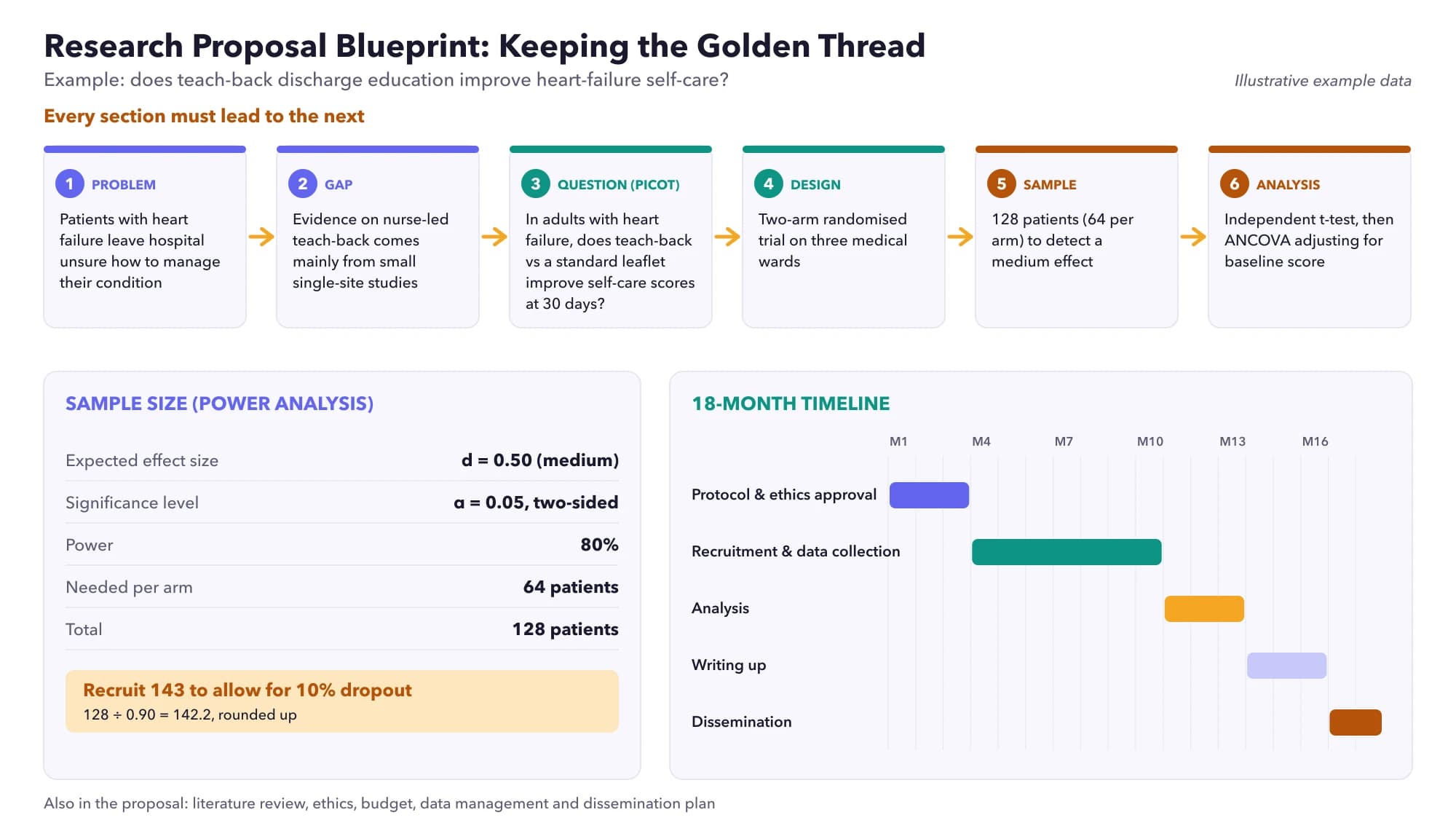
A research proposal has to convince a committee or funder that your question matters, that your methods can answer it and that you can deliver. The methodology section and the data analysis plan are usually where proposals succeed or fail.
We help with every part: developing the topic and problem statement, objectives and research questions or hypotheses, the literature review and conceptual framework, the methodology, sampling and sample size, data collection instruments and the analysis plan. For clinical trial protocols we follow SPIRIT 2025.
A focused, feasible topic that fits your field and timeline.
A concise, evidence-backed statement of the problem and its significance.
Specific, measurable objectives aligned with your questions.
Answerable questions that match your design.
Testable hypotheses for quantitative designs.
A review that establishes the gap your study will fill.
A framework or theory that connects your variables or concepts.
A justified design: quantitative, qualitative or mixed methods.
Sampling strategy and, where needed, a power-based sample size calculation.
Surveys, interview guides and validated measures.
The statistical or qualitative analyses matched to each question.
Accurate referencing in your required style.
We review your guidelines, template and deadline.
We agree the topic, questions and design.
We develop the literature review, framework and significance.
We detail sampling, instruments, ethics and the analysis plan.
You review the draft and request refinements within scope.
Our methods follow published standards from recognised authorities, so your work holds up to supervisors, examiners and peer reviewers.
| Standard | What it covers | Source |
|---|---|---|
| SPIRIT 2025 | 34 minimum items for clinical trial protocols | Chan A-W, et al. SPIRIT 2025 statement: updated guideline for protocols of randomised trials. Lancet 2025;405:e19-e27 |
| EQUATOR Network | Reporting guidelines for every major study design | EQUATOR Network: library of health research reporting guidelines |
| APA JARS | Reporting standards for quantitative, qualitative and mixed methods research | Appelbaum M, et al. APA Journal Article Reporting Standards for quantitative research. Am Psychol 2018;73:3-25Levitt HM, et al. APA reporting standards for qualitative and mixed methods research. Am Psychol 2018;73:26-46 |
| Review typology | Choosing the right literature review approach | Grant MJ, Booth A. A typology of reviews: 14 review types. Health Info Libr J 2009;26:91-108 |
Typically an introduction and problem statement, objectives and questions, a literature review, methodology, analysis plan, timeline and references. Always follow your institution's template.
State and justify the design, setting, sampling, instruments, procedures, ethics and analysis. We make sure each part links back to your research questions.
Yes. We use a power analysis based on the expected effect size, significance level and power.
We help with the research design, methods and analysis sections of grant proposals.
Yes. Your files are stored privately and only the people working on your project can open them. We sign a non-disclosure agreement on request.
Yes. After delivery you can request refinements within the agreed scope directly from your client dashboard.
Every project gets an itemised quote based on scope, complexity and deadline. You pay only after you accept the quote.
Request a free quote online, message us on WhatsApp or email us. A specialist will reply with an itemised quote within 2-4 business hours.
You remain the author. For publications, the ICMJE recommends acknowledging writing assistance and editing rather than listing it as authorship. For coursework, follow your institution's academic integrity policy.
Describe your project and a specialist will reply with an itemized quote within 2-4 business hours.
Prefer email? info@timelyscholar.com