
To win the BSG, your team needs a strategy that competes differently from rivals, not one that copies them. Since every company starts Year 11 in an identical position, you must pick a clear path: low-cost leadership, differentiation, best-cost value, a focused niche, or hard-to-copy capabilities. Then move meaningfully above or below the industry average on the factors buyers value most: price, S/Q rating, and model selection. Backed by strong execution, adjusted each round using the Competitive Intelligence Report, and costs kept under control to deliver the board's targets for EPS, ROE, stock price, credit rating, and image rating.
Playing the Business Strategy Game? Get coaching on strategy and the reports. Get a free quote →
Introduction: From Theory to the Boardroom
The Business Strategy Game (BSG) puts you in charge of an athletic footwear company competing head-to-head against rival companies run by your classmates across four geographic regions. Before you make a single decision, it helps to understand the theoretical foundations behind every move you will make, beginning with the most fundamental question any manager can ask: What is strategy, and why does it matter?
Core strategic management principles provide the conceptual backbone for everything that happens inside the BSG simulation. These principles define strategy as the coherent collection of competitive moves and business approaches that managers use to attract customers, compete against rivals, and achieve targeted performance outcomes. They also explain what competitive advantage really means, how strategies evolve over time, the ethical dimensions of strategic decision-making, and the connection between a company's strategy and its business model. Every one of these concepts finds direct expression in the BSG, making the simulation a living laboratory where strategy theory meets hands-on execution.
This article walks through the major themes of strategy and shows how each one applies concretely to the decisions and challenges you will face in the BSG. Whether you are preparing for your first decision round or reflecting on results after several rounds, this discussion will help you see the strategic logic behind the numbers and, hopefully, inspire you to think more deliberately about the strategy your management team is crafting.
What Is Strategy? Defining the Concept Through the BSG Lens
Strategic management starts with a deceptively simple definition: a company's strategy is the set of competitive moves and business approaches that managers employ to attract and please customers, compete successfully, grow the business, respond to changing market conditions, conduct operations, and achieve targeted financial and market performance. At first glance, this may sound abstract. But the moment you sit down at the BSG decision entry screen, the definition becomes intensely practical.
Consider the three central questions every manager must answer: What is our company's present situation? What should the company's future direction be, and what performance targets should we set? What is our plan for running the company and producing good results? In the BSG, these questions are not hypothetical exercises; they are the exact challenges you face every decision round.
Your company's present situation is laid out in the Year 10 Company Operating Reports, the Footwear Industry Report, and the Competitive Intelligence Reports that are available the first time you launch the Decisions/Reports Program. These reports tell you where your company stands on revenues, costs, market share, production capacity, and financial health. The second question about direction and targets is answered by the Board of Directors' five performance expectations: growing earnings per share, achieving return on equity targets, driving stock price appreciation, maintaining a strong credit rating, and building a healthy image rating. The third question is the plan for running the company your strategy itself- expressed through the 57 different types of decision entries and the competitive assumptions you set for each geographic region.
Strategy experts emphasize that crafting a strategy requires making clear-cut choices. Jack Welch's famous observation that "strategy means making clear-cut choices about how to compete" captures this idea well. In the BSG, you cannot pursue every competitive option simultaneously. You have to choose: Will you invest heavily in superior materials and styling to drive a high S/Q rating, or will you keep material costs low and compete on price? Will you broaden your product line to 400 or 500 models to attract diverse buyer segments, or will you keep the lineup tight at 100 to 200 models and minimize production run setup costs? Will you pursue aggressive celebrity endorsement contracts or redirect those funds toward advertising and retailer support? Every entry on every decision page represents one of these strategic choices, and together they form the pattern of actions and business approaches that define the essence of strategy.
Strategy Is About Competing Differently
One of the most important lessons in strategy is that copying successful rivals rarely works. The best strategies differ from competitors' strategies in at least some respects that matter to buyers. Strong strategies do things rivals don't do, or better still, can't do. They also stake out a market position that is not crowded with strong competitors.
The BSG is built to test this idea. Every company starts Year 11 in exactly the same position: equal market shares in all four regions, the same revenues of $432.6 million, the same net earnings of $40 million, and the same $2.00 earnings per share. No one has a head start. From that common starting line, the only thing that separates companies over time is the quality of their strategic choices.
The Player's Guide makes the same point in simulation terms. Sales and market share outcomes in every region are 100% competition-based. They depend on how your company's effort on each competitive factor compares with the all-company average. If every company charges the same price, price stops mattering, and the other factors decide the outcome. This means a copycat strategy produces average results at best. If your prices, S/Q rating, model count, and advertising all sit near the industry average, your market share will also sit near the average.
To stand out, a BSG company must deliberately move away from the average on the factors that buyers care about most. The guide identifies price, S/Q rating, and the number of models/styles as the three most influential factors. Celebrity appeal, brand advertising, search engine advertising, image, retail outlets, and free shipping come next. Delivery time, mail-in rebates, and retailer support carry the least weight. A team that wants to compete differently might, for example, build a clear lead in S/Q rating and model breadth while holding price close to the average. Another might accept an average S/Q rating but drive costs down far enough to sit well below the average price.
The guide also warns against following tips from past players or internet sources. This reinforces the principle of competing differently. A strategy that worked in another industry, against other rivals, is a borrowed strategy. It was built for a different competitive landscape. Your strategy has to be crafted for your industry and your rivals, using the Competitive Intelligence Reports as your primary evidence.
The Quest for Competitive Advantage
Competitive advantage is the heart of any strategy. A company has a competitive advantage when an attractive number of buyers choose its products over those of rivals. The advantage becomes sustainable when that buyer preference holds up despite rivals' efforts to cancel it out. Advantage is directly linked to profit: strong buyer preference leads to higher sales volume, the ability to charge a higher price, or both.
Strategy theory identifies five dependable routes to competitive advantage. The Player's Guide offers a closely matching menu of strategic options for a footwear company. The table below maps each one.
Strategic approach
| What it means | How it looks in the BSG | |
| Low-cost provider | Win on lower costs, then charge lower prices or earn higher margins | Raise worker productivity, cut reject rates, use best practices training to trim materials costs, add Option D robots, and price below the regional average |
| Differentiation | Win on quality, selection, styling, or other valued features | Push the S/Q rating above average with superior materials, styling spend, and TQM/Six Sigma; offer more models; sign high-appeal celebrities |
| Best-cost provider (more value for the money) | Match rivals on quality while beating them on price | The guide's "7-star footwear at lower prices than other 7-star brands" approach |
| Focused niche | Serve one segment better than anyone else | Lead in one segment (wholesale, internet, or private-label) or in one or two geographic regions |
| Valuable resources and capabilities | Build capabilities rivals can't easily copy | Cumulative TQM/Six Sigma spending, years of training, efficient facilities in key regions, and a strong image rating built over time |
The fifth route deserves special attention in the BSG. Rivals can usually copy a product's features, but they struggle to copy experience and know-how built over years. The simulation builds this into its formulas. Cumulative TQM/Six Sigma spending has a bigger effect on S/Q ratings than current-year spending. Best practices training gains in productivity are kept even if spending is later cut. Image ratings rise only through sustained performance on S/Q, market share, and social responsibility. A rival can match your price in one round. They cannot match five years of quality investment in one round.
Strategy experts also warn that being all things to all buyers is foolhardy. The BSG shows why. Adding models raises sales appeal but also raises setup costs, from $1 million for 50 models to $15 million for 500 models per facility. Superior materials raise S/Q but also raise materials costs. Every competitive edge has a cost, so a winning BSG team chooses which advantages to pursue and accepts trade-offs elsewhere. As the guide stresses, the simulation has no built-in bias toward any one strategy. Any of these routes can win if it is executed well and competes effectively against what your rivals actually do.
Why Strategy Evolves: Proactive and Reactive Elements
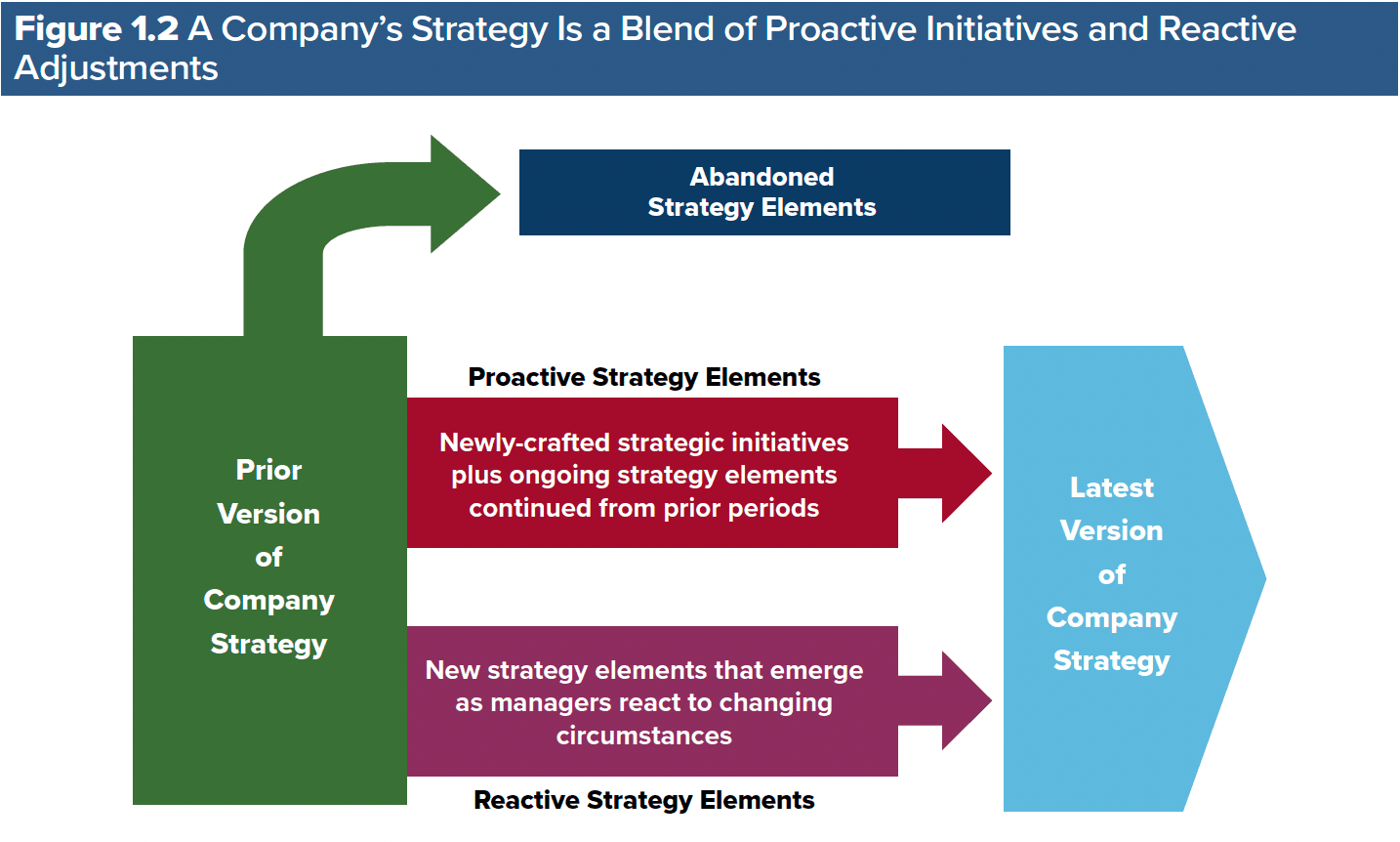
A company's strategy is never finished. It is always temporary and on trial. Strategy evolves as markets change, rivals make fresh moves, and managers learn what is and isn't working. Each version of a strategy is a blend of two parts. Proactive elements are deliberate initiatives managers launch to build an edge, plus earlier moves that are still working. Reactive elements are adjustments made on the fly in response to unexpected developments. Over time, managers also drop elements that have become obsolete.
The BSG's round-by-round structure is a direct model of this process. Each decision period represents one year, starting with Year 11. After each deadline, results arrive within about 15 minutes. The Footwear Industry Report, the Competitive Intelligence Report, and the Company Operating Reports then show how your strategy fared against rivals. Your team's next set of decisions becomes the "latest version" of your strategy.
Proactive strategy in the BSG includes choices like:
Building a new facility in Europe, Africa or Latin America to avoid tariffs and exchange rate swings, which takes a full year before the space can be equipped
Committing to a multi-year TQM/Six Sigma and best practices training program
Signing celebrity endorsers on 2- or 3-year contracts
Preparing a 3-Year Strategic Plan, which becomes available from Year 14
Reactive strategy shows up just as clearly:
Adjusting shipping patterns when exchange rate adjustments turn sharply favorable or unfavorable in a region
Responding when a rival cuts its wholesale price or raises its S/Q rating in a key market
Clearing leftover inventory when sales fall short of projections
Responding to instructor changes in tariffs or materials prices
The Competitive Assumptions entries on the Wholesale and Internet Marketing pages are where proactive and reactive thinking meet. The guide advises updating these regional averages before finalizing decisions, because rivals that performed poorly last year have strong reasons to compete harder. This is strategy evolution in practice: a good strategy anticipates change rather than simply reacting to it after the fact.
The guide also warns successful companies not to rest on their laurels. Weaker rivals will try to close the gap. A strategy that won last year is now on trial again, exactly as strategy theory predicts.
Strategy and Ethics: Passing the Test of Moral Scrutiny
Strategic management draws a clear distinction: a strategy is not ethical just because it is legal. To pass moral scrutiny, a strategy must avoid actions that are deceitful, unfair, harmful to others, disreputable, or unreasonably damaging to the environment. Unethical behavior also carries real business costs. Customers and suppliers walk away, good employees leave, and revenues and stock prices suffer.
The BSG reflects this in two ways. First, the Board of Directors sets ethical conduct as a formal constraint. Co-managers must comply with all legal and regulatory requirements and conduct business ethically. The board also forbids mergers with other companies. Ethics is therefore part of the mandate, not an optional extra.
Second, the simulation gives social responsibility a measurable link to performance through the Corporate Social Responsibility and Citizenship (CSRC) decision page. Teams can invest in recycled packaging, energy efficiency, charitable contributions, ethics training and enforcement, better working conditions, and a supplier code of conduct with compliance monitoring. According to the guide, meaningful and sustained CSRC spending can raise a company's image rating by as much as 20%. The gains are small unless the effort is comprehensive, more than a token amount, and sustained for at least 4 to 5 years.
This lines up neatly with strategy theory, which lists actions to strengthen public image through corporate social responsibility as one of the markers of a company's strategy. In the BSG, image rating is one of the five performance targets, so ethical and responsible conduct feeds directly into your score. The guide is honest that CSRC spending is voluntary and that a good image rating can be reached without it. Still, the simulation rewards teams that treat responsibility as a long-term commitment rather than an afterthought.
Some BSG decisions also carry an ethical flavor beyond the CSRC page. The supplier code of conduct mirrors the classic ethical dilemma of retailers sourcing from factories with substandard wages or unsafe conditions. Improving working conditions and compensation also connects to worker productivity, showing that treating people well can be both right and profitable.
Strategy and the Business Model
A business model is management's blueprint for delivering value to customers while earning enough revenue to cover costs and produce an attractive profit. It has two parts. The customer value proposition is how the company satisfies buyers at a price they see as good value. The profit formula is how the company generates enough revenue and controls costs so that both customers and shareholders are satisfied. The key test is whether the company can deliver its value proposition profitably.
In the BSG, your company's business model is already partly set when you take over. It is a manufacturer that makes its own shoes in company-operated facilities rather than outsourcing. It sells through three channels: wholesale to about 60,000 independent retailers worldwide, online direct to consumers, and private-label contracts with large chain retailers. Each channel has its own value proposition and profit formula.
Wholesale: The value proposition rests on S/Q rating, model selection, price, advertising, delivery times, rebates, and retailer support. The profit formula depends on volume, wholesale price, and costs such as boxing and shipping fees of $2 to $4 per pair.
Internet: Online buyers respond to retail price, search engine ads, and free shipping. Shipping and handling cost $12.50 per pair, so free shipping usually requires a higher online price. The guide warns that an online price less than 40% above the wholesale price creates channel conflict and drives retailers away.
Private label: Chain retailers award contracts to the lowest bidders that meet their S/Q and model specifications. The value proposition is low price; the profit formula is using spare capacity to spread fixed costs over more pairs, provided the bid price covers direct costs.
The guide's statement that good sales are necessary but not sufficient is the profit formula in plain terms. A BSG team can win market share by slashing prices and spending heavily on marketing, yet still miss its EPS and ROE targets if costs run out of control. A company whose revenues comfortably exceed its costs has what strategists call a "proven" business model. A company that keeps losing money has a questionable one and needs to rethink it.
Strategy experts also observe that successful business models are quickly imitated. In the BSG, rivals can see your prices, S/Q ratings, and model counts in the Competitive Intelligence Report. If your approach works, expect others to copy it. That is why the resource-based advantages discussed earlier, which take years to build, are so valuable.
What Makes a Strategy a Winner? The Three Tests in the BSG
Strategy theory offers three tests for judging any strategy. Each one maps cleanly onto how the BSG measures and rewards your company.
1. The Fit Test. A winning strategy must fit both the external situation (industry and competitive conditions) and the internal situation (resources and capabilities). It must also keep fitting as conditions change. In the BSG, external fit means responding to regional growth rates, which are higher in Asia-Pacific and Latin America (9% to 11% for branded footwear in Years 11-15) than in North America and Europe-Africa (5% to 7%). It also means accounting for tariffs of $4 to $10 per pair and exchange rate shifts. Internal fit means matching strategy to your facilities, equipment, and cash. A premium differentiation strategy does not fit a company running on refurbished equipment with high reject rates unless it invests to fix them. To judge external fit systematically, work through our BSG industry analysis guide, which applies Porter's five forces, PESTEL, driving forces and strategic group mapping to the footwear industry.
2. The Competitive Advantage Test. A winning strategy must help build a sustainable competitive advantage. In the BSG, the Comparative Competitive Efforts page of the Competitive Intelligence Report shows exactly where you stand against every rival on each factor. If your company is above average on the factors that matter and stays there round after round, you have an advantage. If rivals keep catching up, your advantage is temporary.
3. The Performance Test. A winning strategy must produce strong, not merely better, results. The signs are clear: revenue growth, market share gains, rising profitability, an upward-trending stock price, healthy finances, and a good credit rating. The BSG's Board of Directors measures almost exactly these.
Board target
| Year 10 starting point | Year 11 target | Year 20 target | |
| Earnings per share | $2.00 | $2.50 | $10.00 |
| Return on equity | 20% | 21% | 30% |
| Stock price | $30 | $40 | $250 |
| Credit rating | B | B+ or higher | A or higher |
| Image rating | 70 | 70 or higher | 80 |
Your score combines two standards. The Investor Expectations score rewards meeting or beating these targets, up to a maximum of 120. The Best-in-Industry score compares you with the top performer on each measure. Together, they are the BSG's version of the performance test.
Good Strategy + Good Execution = Good Management
A brilliant strategy means little without strong execution. Good strategy plus good execution is the most reliable sign of good management. The BSG makes this vivid. A team may choose a sound differentiation strategy, yet fail to produce enough pairs, leave inventory shortfalls, overdraw its cash account, or let reject rates climb. The strategy was right, but execution failed.
The guide's closing advice echoes this principle: stay on top of changing conditions, avoid being outmaneuvered, price and market effectively, operate cost-efficiently, and manage finances soundly. When the exercise ends, the guide notes that the only difference between the best and weakest companies is the caliber of each team's strategies and decisions. The software simply referees the contest.
Conclusion
Strategic management gives you the vocabulary of strategy; the BSG gives you the arena to use it. In the simulation, every decision entry is a strategic choice, every round is a test of competitive advantage, and every set of results is a verdict on both strategy and execution. Carry the three tests of a winning strategy into every decision round, and you will be thinking like the managers the board wants running the company.
Frequently asked questions
Your company's Competitive Intelligence Report shows that your S/Q rating, model count, and wholesale price in Europe-Africa all sit almost exactly at the regional average. Your market share there is also almost exactly average. Based on the principles of strategy, what does this tell you about your strategy in that region, and what should you do next?
It tells you that you have no competitive advantage in Europe-Africa. Strategy is about competing differently, and the Player's Guide confirms that sales and market share in the BSG are 100% competition-based: a company close to the average on every factor gets an average result. To improve, your team must choose one or more factors buyers value most (price, S/Q rating, or model breadth) and move meaningfully above or below the average, while keeping costs in check so that the move still passes the performance test.
What is strategy, and how does it apply in the BSG?
Strategy is the set of competitive moves and business approaches managers use to attract customers, compete, grow, respond to change, run operations, and hit performance targets. In the BSG, that strategy is expressed through your decision entries each round, from pricing and S/Q rating to facilities, marketing, and finance.
Is there one "best" strategy that always wins the BSG?
No. The Player's Guide states that the simulation has no built-in bias toward any strategy. Because results are 100% competition-based, how well a strategy performs depends on what rival companies in your industry do.
Which of the five routes to competitive advantage can I use in the BSG?
All of them. You can pursue low-cost leadership, differentiation, a best-cost (more value for the money) approach, a focused strategy on one segment or region, or build hard-to-copy capabilities such as cumulative quality and training investments.
What are the most important competitive factors in the BSG?
The guide identifies price, S/Q rating, and number of models/styles as the three most influential. However, the size of your difference from the regional average matters more than the factor's general importance.
How do proactive and reactive strategies show up in the game?
Proactive moves include building new facilities, multi-year quality programs, and celebrity contracts. Reactive moves include adjusting shipments for exchange rate changes, responding to rivals' price cuts, and clearing leftover inventory.
Does ethics or social responsibility affect my BSG score?
Yes, indirectly. The board requires ethical, legal conduct, and sustained, comprehensive CSRC spending can raise your image rating by up to 20%. Image rating is one of the five scored performance targets.
What is the business model of a BSG company?
It is a footwear manufacturer that makes shoes in its own facilities and sells through three channels: wholesale to retailers, online sales, and private-label contracts. Each channel has its own value proposition and profit formula.
How do the three tests of a winning strategy relate to BSG scoring?
The fit test applies to matching your strategy to market and internal conditions. The competitive advantage test shows up in the Competitive Intelligence Report. The performance test is measured by the board's targets for EPS, ROE, stock price, credit rating, and image rating.
Why shouldn't I follow tips from students who played the BSG before?
Their advice comes from a different industry with different rivals. Good strategy must be tailored to your own situation, and the guide says your industry's Competitive Intelligence Report is the most reliable source.
What is the best way to start applying these strategy principles before my first decision round?
Study the Year 10 reports to understand your company's present situation, review the board's five performance targets, and agree as a team on how you intend to compete differently from rivals. Then use the practice rounds to test how your decision entries affect projected results.
Sources
- Thompson, A. A., Stappenbeck, G. J., Reidenbach, M. A., Thrasher, I. F., & Harms, C. C. (2026). The Business Strategy Game Player's Guide: Competing in a Global Marketplace (2026 ed.). GLO-BUS Software, Inc.; McGraw-Hill Education.
- Thompson, A. A. (2025). What Is Strategy and Why Is It Important? In Strategy: Core Concepts and Analytical Approaches (8th ed., 2025–2026). McGraw Hill LLC.
- Harvard Business School, Institute for Strategy & Competitiveness: Strategic Positioning