
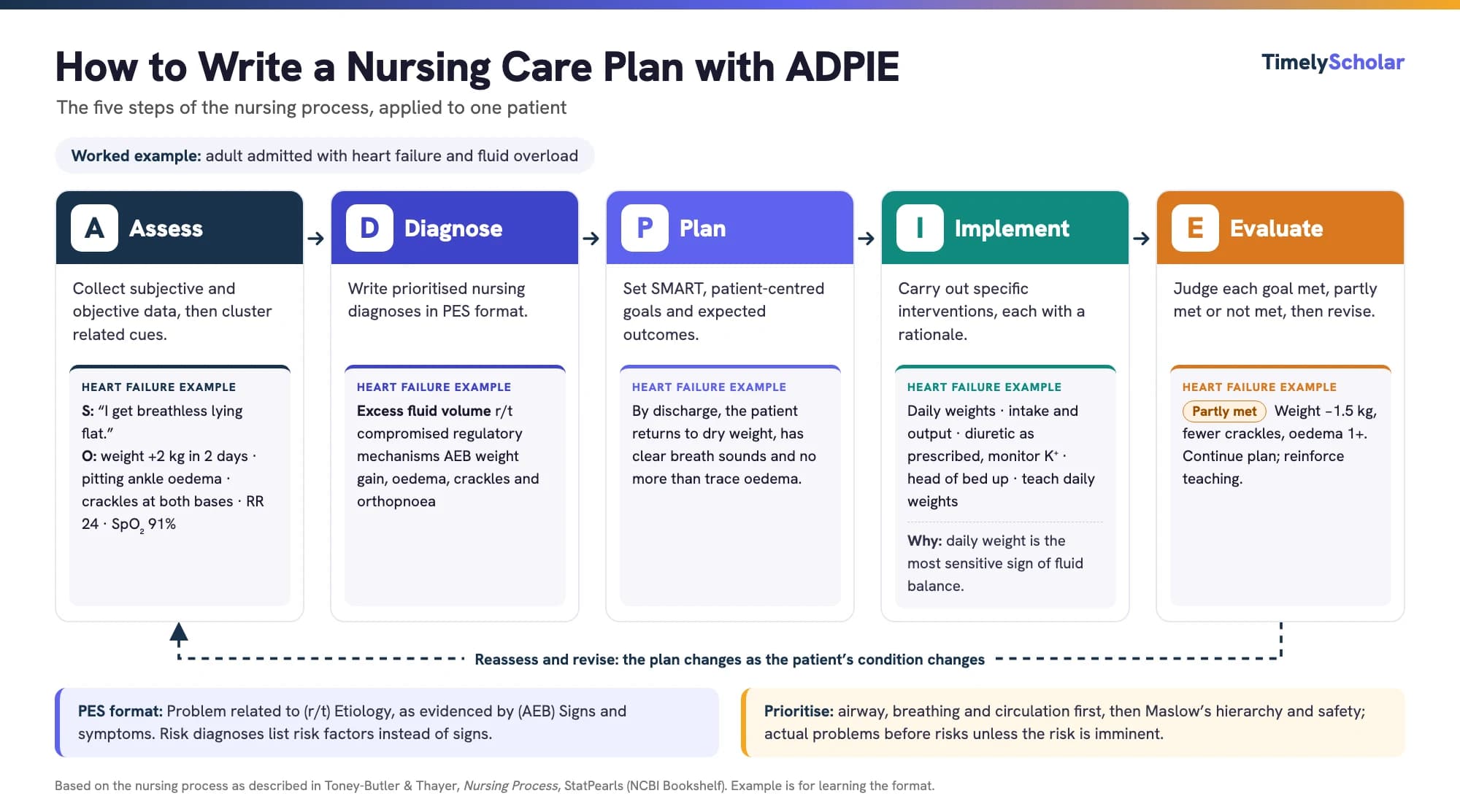
To write a nursing care plan, follow the five steps of the nursing process (ADPIE): (1) Assess the patient, collecting subjective and objective data; (2) Diagnose by writing prioritised nursing diagnoses, usually in the format "problem related to cause as evidenced by signs and symptoms"; (3) Plan SMART patient goals and expected outcomes; (4) Implement specific nursing interventions, each with a rationale; and (5) Evaluate whether each goal was met, partly met or not met, and revise the plan. Prioritise diagnoses using the ABCs (airway, breathing, circulation), Maslow's hierarchy and safety.
Building an evidence-based practice project? A specialist can guide you through it. Get a free quote →
What is a nursing care plan?
A nursing care plan is a written, individualised plan that identifies a patient's nursing problems, sets goals, and lists the nursing interventions that will help achieve them. In practice, care plans guide consistent care across shifts and disciplines. In nursing school, they teach you to think like a nurse: to connect assessment data to clinical judgements, goals, actions and evaluation.
Care plans are built on the nursing process, which Toney-Butler and Thayer (2023) describe as a systematic approach to care using critical thinking, patient-centred treatment, goal-oriented tasks and evidence-based practice. Its five steps are assessment, diagnosis, planning, implementation and evaluation, often remembered as ADPIE. Care plans also support communication, documentation and continuity of care.
The standard care plan format
Most student care plans use a table with five columns, one row per nursing diagnosis, in priority order:
- Assessment data (subjective and objective cues)
- Nursing diagnosis
- Goals and expected outcomes
- Interventions with rationales
- Evaluation
Some programmes add columns for evidence-based references or for NOC outcomes and NIC interventions, the standardised classifications that are often used alongside NANDA-I diagnoses.
Step 1: Assessment
Collect complete, accurate data about the patient. There are two types:
| Type | What it is | Examples |
|---|---|---|
| Subjective | What the patient or family tells you | "I can't catch my breath when I walk to the bathroom"; pain rated 7/10; "I'm worried about going home" |
| Objective | What you observe or measure | Respiratory rate 26/min; SpO₂ 88% on room air; bilateral ankle oedema; weight up 2 kg in two days; lab results |
Use a systematic approach, such as head-to-toe or body systems, and include vital signs, a focused assessment of the main problem, relevant history, medications, laboratory and diagnostic results, functional status, psychosocial and cultural factors, and the patient's own goals. Then cluster related cues together; clusters point to nursing diagnoses.
Step 2: Nursing diagnosis
A nursing diagnosis is a clinical judgement about a person's, family's or community's response to actual or potential health problems. It differs from a medical diagnosis: "heart failure" is a medical diagnosis; "excess fluid volume" and "activity intolerance" describe the patient's responses that nurses treat.
Most programmes use the standardised diagnoses published by NANDA International (NANDA-I). Labels are updated between editions, so use the edition your programme specifies.
Types of nursing diagnoses
| Type | Format | Example |
|---|---|---|
| Problem-focused (actual) | Problem related to (r/t) cause, as evidenced by (AEB) signs and symptoms | Acute pain r/t surgical incision AEB pain rating of 7/10, guarding and grimacing |
| Risk | Risk for problem, with the risk factors present (no signs yet, because it has not happened) | Risk for infection, with risk factors of a surgical wound and an indwelling urinary catheter |
| Health promotion | Readiness for enhanced…, AEB the patient's expressed desire | Readiness for enhanced health self-management AEB the patient asking how to monitor blood glucose at home |
| Syndrome | A cluster of diagnoses that occur together | Chronic pain syndrome |
This three-part format for problem-focused diagnoses is often called PES: Problem, Etiology (the related factor), and Signs and Symptoms.
Prioritising nursing diagnoses
- ABCs first: airway, breathing and circulation problems take priority.
- Maslow's hierarchy: physiological needs, then safety and security, then love and belonging, self-esteem and self-actualisation. Toney-Butler and Thayer (2023) note that physiological and safety needs form the basis for nursing care.
- Actual before risk, unless the risk is severe and imminent.
- Acute and unstable before chronic and stable.
- The patient's priorities matter too; ask what concerns them most.
Step 3: Planning goals and outcomes
For each diagnosis, write one or more patient-centred goals. Toney-Butler and Thayer (2023) recommend goals that are SMART: specific, measurable, attainable, realistic and timely.
Weak: Patient will have less pain.
SMART: Patient will report pain of 3/10 or less on the 0–10 numeric scale within 1 hour of receiving analgesia and before ambulating, during this shift.
Weak: Patient will understand diet.
SMART: Before discharge, the patient will state three high-sodium foods to avoid and plan a day's low-sodium meals using teach-back.
Short-term goals are usually achievable within hours to days (by the end of a shift or before discharge); long-term goals span weeks or months. Write goals about the patient, not the nurse: "Patient will ambulate 50 metres with a walker", not "Nurse will ambulate the patient".
Step 4: Implementation (nursing interventions and rationales)
List specific nursing interventions for each goal, and for student care plans, a rationale explaining why each intervention works, ideally with a reference to current evidence or a nursing textbook.
- Assessment interventions: monitor, assess, measure (for example "Assess pain using the 0–10 scale every 4 hours and 30–60 minutes after analgesia, per policy").
- Therapeutic interventions: positioning, wound care, administering prescribed medications and oxygen, mobilisation.
- Education: teaching the patient and family, using teach-back to confirm understanding.
- Collaborative interventions: coordinating with physicians, dietitians, physiotherapists, pharmacists or social workers.
Interventions should be specific enough that another nurse could follow them: what, how often, how much, and by whom. Independent nursing interventions (which nurses can initiate) are distinguished from dependent ones (which require a prescriber's order, such as administering a diuretic).
Step 5: Evaluation
Evaluation asks whether each goal was met, partially met or not met, based on new assessment data. Toney-Butler and Thayer (2023) emphasise that reassessment should follow every intervention and that the plan of care may be adapted based on new data.
Goal: Patient will report pain ≤3/10 within 1 hour of analgesia.
Evaluation: Goal met. Patient reported pain of 2/10 45 minutes after oral analgesia and walked to the bathroom with minimal guarding. Continue plan.
If a goal is not met, ask why: was the diagnosis correct, was the goal realistic, were the interventions carried out and appropriate? Then revise the plan.
Example nursing care plan: heart failure
| Component | Content |
|---|---|
| Assessment | Subjective: "My ankles are swollen and I get breathless lying flat." Objective: weight up 2 kg in 2 days; bilateral pitting ankle oedema; crackles in both lung bases; RR 24/min; SpO₂ 91% on room air. |
| Nursing diagnosis | Excess fluid volume r/t compromised regulatory mechanisms (reduced cardiac output) AEB weight gain, oedema, crackles and orthopnoea. |
| Goal | By discharge, patient will return to baseline (dry) weight, have clear breath sounds and no more than trace oedema. |
| Interventions | Weigh daily at the same time on the same scale; monitor intake and output; assess lung sounds, oedema and respiratory status every 4 hours; maintain fluid and sodium restriction as prescribed; administer diuretics as prescribed and monitor potassium and renal function; elevate head of bed; teach daily weights and when to call the clinic. |
| Rationales | Daily weight is the most sensitive indicator of fluid balance; diuretics promote fluid excretion but can cause electrolyte imbalance; upright positioning reduces pulmonary congestion and eases breathing; education supports early recognition of fluid gain at home. |
| Evaluation | Partially met: weight down 1.5 kg, crackles reduced, oedema 1+. Continue plan; reinforce teaching. |
More examples: impaired gas exchange and falls risk
| Component | Content |
|---|---|
| Nursing diagnosis | Impaired gas exchange r/t ventilation-perfusion imbalance AEB SpO₂ 86% on room air, dyspnoea, use of accessory muscles and restlessness. |
| Goal | Within 24 hours, patient will maintain SpO₂ within the prescribed target range and report reduced breathlessness. |
| Interventions | Monitor SpO₂, respiratory rate and work of breathing; position upright or leaning forward; give oxygen as prescribed to the target saturation range; administer prescribed bronchodilators; teach pursed-lip breathing; cluster care to allow rest. |
| Evaluation | Goal met: SpO₂ within target on prescribed oxygen, RR 20/min, patient using pursed-lip breathing independently. |
| Component | Content |
|---|---|
| Nursing diagnosis | Risk for adult falls, with risk factors of age over 65, new diuretic therapy, nocturia, unsteady gait and unfamiliar environment. |
| Goal | Patient will remain free from falls throughout the hospital stay. |
| Interventions | Complete a validated falls risk assessment on admission and each shift; keep bed low and locked with call bell in reach; purposeful hourly rounding including toileting; non-slip footwear; night lighting; review medications with the pharmacist; teach the patient to call for help before getting up. |
| Evaluation | Goal met to date: no falls; patient calls for assistance at night. |
| Component | Content |
|---|---|
| Nursing diagnosis | Acute pain r/t surgical incision AEB pain rated 7/10, guarding of the abdomen, grimacing and reluctance to cough or mobilise. |
| Goal | Within 1 hour of intervention, patient will report pain at or below their acceptable level (3/10) and will cough, deep-breathe and walk to the chair. |
| Interventions | Assess pain location, character and intensity with the 0–10 scale; administer prescribed analgesia, including scheduled non-opioid analgesics; reassess after each dose per policy; teach splinting of the incision with a pillow when coughing; offer repositioning, cold therapy or relaxation; time mobilisation to coincide with peak analgesic effect. |
| Evaluation | Goal met: pain 3/10, patient walked to the chair and performed deep breathing with splinting. |
These examples are for learning the format. Always base a real care plan on your own patient's assessment, current guidelines and your facility's policies.
Care plans vs concept maps
Many nursing programmes also use concept maps, which show the same information visually: the medical diagnosis at the centre, linked to assessment data, nursing diagnoses, interventions and outcomes, with lines showing relationships. Concept maps are useful for patients with several interacting problems, because they show how, for example, reduced mobility, pain and constipation affect each other. The underlying thinking is the same nursing process.
Common care plan mistakes
- Using a medical diagnosis as the nursing diagnosis ("Pneumonia r/t…").
- Writing the related factor as a medical diagnosis without explaining the mechanism, or making it something nurses cannot address.
- Adding "as evidenced by" to a risk diagnosis; risk diagnoses have risk factors, not signs.
- Vague goals without measurable criteria or time frames.
- Nurse-centred goals instead of patient-centred ones.
- Generic interventions copied from a textbook that do not match your patient.
- Missing rationales or evaluation.
- Poor prioritisation, such as putting knowledge deficit before impaired gas exchange.
Building evidence-based care plans
Rationales are strongest when they cite current evidence, such as clinical guidelines or systematic reviews, rather than older textbooks alone. Our guide to the levels of evidence pyramid explains how to judge sources, and how to write a PICOT question shows how to turn a clinical problem into a searchable question. For help synthesising evidence for clinical practice, see our healthcare evidence synthesis service.
Frequently asked questions
What are the 5 steps of a nursing care plan?
Assessment, diagnosis, planning, implementation and evaluation, often abbreviated as ADPIE. These are the five steps of the nursing process.
How do you write a nursing diagnosis?
For a problem-focused diagnosis, use the PES format: the problem (a NANDA-I label), related to the cause, as evidenced by the signs and symptoms. For example: Acute pain related to surgical incision as evidenced by pain rated 7/10 and guarding.
What is the difference between a nursing diagnosis and a medical diagnosis?
A medical diagnosis names a disease, such as heart failure. A nursing diagnosis describes the patient's response to a health problem that nurses can treat, such as excess fluid volume or activity intolerance.
How do you prioritise nursing diagnoses?
Use the ABCs (airway, breathing, circulation), Maslow's hierarchy of needs, safety, and the acuity of the problem, while considering the patient's own priorities.
What makes a good nursing care plan goal?
Good goals are patient-centred and SMART: specific, measurable, attainable, realistic and timely. For example, the patient will walk 50 metres with a walker twice daily by day 3.
Do risk nursing diagnoses have 'as evidenced by'?
No. A risk diagnosis describes a problem that has not happened yet, so it lists risk factors rather than signs and symptoms.