
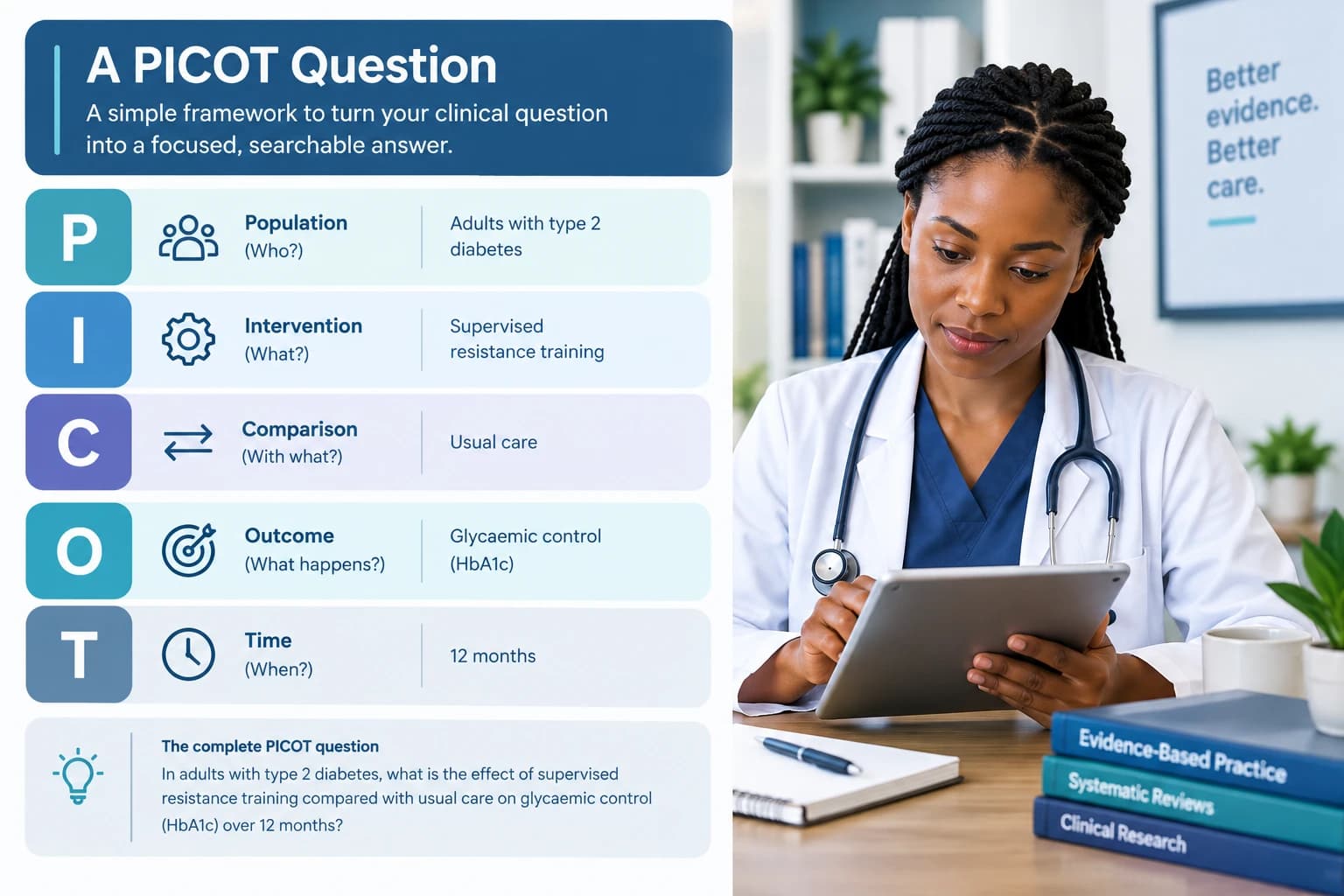
A PICOT question is a structured clinical question with five parts: Population (who), Intervention or issue of interest (what you are testing), Comparison (the alternative, often usual care), Outcome (what you will measure) and Time (over what period). To write one, name a specific patient group, one intervention and one comparison, pick a measurable outcome and a realistic time frame, then combine them into a single sentence, for example: "In adults with type 2 diabetes (P), does a nurse-led education programme (I) compared with usual care (C) reduce HbA1c (O) over six months (T)?"
Building an evidence-based practice project? A specialist can guide you through it. Get a free quote →
What is a PICOT question?
PICOT is a framework for turning a broad clinical problem into a focused, answerable question. It grew out of the "well-built clinical question" described by Richardson et al. (1995), which proposed that a good question names the patient or problem, the intervention, a comparison and the outcomes. Nursing and evidence-based practice educators later added T for time (Riva et al., 2012), and the format became the standard starting point for capstone projects, evidence-based practice (EBP) papers and systematic reviews.
A clear PICOT question does three jobs at once. It tells readers exactly what you are asking; it gives you the keywords for your literature search; and it defines what evidence counts, so you know which studies to include and which to exclude.
The image at the top of this article shows the idea in practice: each letter narrows the question, from "does exercise help diabetes?" to adults with type 2 diabetes, supervised resistance training versus usual care, HbA1c, over 12 months.
The five PICOT elements explained
| Element | Ask yourself | Weak | Stronger |
|---|---|---|---|
| P: Population / problem | Who exactly? Age, condition, setting, stage? | Patients | Adults over 65 admitted to acute medical wards |
| I: Intervention / issue | What will be done, given or exposed? | Education | A nurse-led discharge education session with teach-back |
| C: Comparison | What is the alternative? | Nothing | Standard discharge information leaflet |
| O: Outcome | What change will you measure, and how? | Better outcomes | 30-day hospital readmission rate |
| T: Time | Over what period will the outcome be measured? | Soon | Within 30 days of discharge |
P: Population or patient problem
Describe the group precisely enough that a reader could tell whether a given study fits: age range, diagnosis, severity, and setting (for example community, ICU, long-term care). Avoid making the population so narrow that no research exists, for example "left-handed men aged 40 to 42 in one hospital".
I: Intervention or issue of interest
This is the treatment, test, exposure, nursing action or programme you want to evaluate. Name one intervention; comparing several at once makes a question hard to answer. For non-intervention questions, the I becomes an issue or exposure, for example smoking or night-shift work.
C: Comparison
The comparison is often usual or standard care, a placebo, or another intervention. It is sometimes left out, for example in questions about meaning or experience, which is acceptable as long as the question is still clear.
O: Outcome
Choose an outcome that can be measured and matters to patients or the service: rates of falls, pressure injuries, infections or readmissions; pain scores; HbA1c; length of stay; patient satisfaction. If your project will collect data, name the measurement tool as well, such as a validated pain scale.
T: Time
Time states when the outcome is measured or how long the intervention runs: "during hospitalisation", "over 12 weeks", "at six months". Not every question needs a time element, but for capstone and DNP projects it makes the evaluation plan concrete.
PICOT question templates for different question types
Evidence-based practice textbooks group clinical questions into several types. Each has its own template, and each is best answered by a different kind of study:
| Question type | Template | Best study designs |
|---|---|---|
| Intervention / therapy | In ___ (P), how does ___ (I) compared with ___ (C) affect ___ (O) within ___ (T)? | Randomised controlled trials; systematic reviews of RCTs |
| Prognosis / prediction | In ___ (P), how does ___ (I) compared with ___ (C) influence or predict ___ (O) over ___ (T)? | Cohort studies |
| Diagnosis | Are/is ___ (I) more accurate in diagnosing ___ (P) compared with ___ (C) for ___ (O)? | Diagnostic accuracy studies (cross-sectional) |
| Etiology / harm | Are ___ (P) who have ___ (I) at increased or decreased risk for ___ (O) compared with ___ (C) over ___ (T)? | Cohort and case-control studies |
| Meaning / experience | How do ___ (P) with ___ (I) perceive ___ (O) during ___ (T)? | Qualitative studies; qualitative evidence syntheses |
Matching the question type to the right study design is the link between PICOT and the levels of evidence pyramid: the "best" evidence for a diagnosis question is not a randomised trial but a well-designed diagnostic accuracy study.
PICOT question examples for nursing and healthcare
Falls (intervention): In hospitalised adults aged 65 and over (P), does hourly purposeful rounding (I) compared with standard nursing checks (C) reduce the fall rate (O) over three months (T)?
Pressure injuries (intervention): In ICU patients on mechanical ventilation (P), does a prophylactic multilayer foam sacral dressing (I) compared with standard pressure care alone (C) reduce the incidence of sacral pressure injuries (O) during the ICU stay (T)?
CAUTI (intervention): In adult medical-surgical inpatients with indwelling urinary catheters (P), does a nurse-driven catheter removal protocol (I) compared with physician-ordered removal (C) reduce catheter-associated urinary tract infection rates (O) over six months (T)?
Diabetes (intervention): In adults with type 2 diabetes attending primary care (P), does a nurse-led telephone coaching programme (I) compared with usual care (C) lower HbA1c (O) at six months (T)?
Mental health (intervention): In nurses working 12-hour night shifts (P), does a mindfulness programme (I) compared with no programme (C) reduce burnout scores (O) after eight weeks (T)?
Prognosis: In adults after hip fracture surgery (P), does delirium during admission (I) compared with no delirium (C) predict one-year mortality (O)?
Diagnosis: In older adults presenting to the emergency department (P), is the 4AT (I) more accurate than clinical judgement alone (C) for detecting delirium (O)?
Meaning: How do family caregivers of people with advanced dementia (P) experience decision-making about feeding tubes (I, O) during end-of-life care (T)?
How to write a PICOT question step by step
- Start with a practice problem. What have you noticed on the unit or in your placement: rising falls, delayed discharges, missed medication doses? Check local data if you can.
- Write the problem as a sentence. For example: "Older patients on our ward fall at night."
- Fill in each element. Population: adults aged 65 and over on an acute medical ward. Intervention: bed and chair alarms. Comparison: standard care. Outcome: number of falls per 1,000 patient days. Time: three months.
- Check feasibility. Could you actually find studies on this, or collect the data within your project timeline?
- Combine into one question using the template for your question type.
- Test it with a quick search. If PubMed returns thousands of results, narrow the population or setting; if it returns none, broaden the intervention or outcome.
- Refine with your preceptor or supervisor, and keep the final version consistent throughout your paper or project.
From PICOT to a literature search
Your PICOT question is also your search plan. Each element (usually P, I and O; C and T are rarely searched directly) becomes a concept, and each concept becomes a group of synonyms and subject headings combined with OR. The groups are then combined with AND (Lefebvre et al., 2025).
P: ("Aged"[MeSH] OR elderly OR "older adult") AND (inpatient OR hospitali*)
I: ("hourly rounding" OR "intentional rounding" OR "purposeful rounding")
O: ("Accidental Falls"[MeSH] OR fall OR falls)
Combined: P AND I AND O
PICO, PICOS, PICOT, PCC, SPIDER and PEO: which framework?
| Framework | Stands for | Best for |
|---|---|---|
| PICO | Population, Intervention, Comparison, Outcome | Effectiveness questions in systematic reviews |
| PICOT | PICO + Time | Nursing EBP, capstone and DNP projects |
| PICOS | PICO + Study design | Systematic review eligibility criteria |
| PCC | Population, Concept, Context | Scoping reviews (recommended by JBI; Peters et al., 2020) |
| PEO | Population, Exposure, Outcome | Etiology and qualitative questions |
| SPIDER | Sample, Phenomenon of Interest, Design, Evaluation, Research type | Qualitative and mixed methods evidence searches |
Cooke et al. (2012) developed SPIDER because PICO fits qualitative and mixed methods questions poorly. When Methley et al. (2014) later tested the tools on a qualitative review, PICO searches were the most sensitive and SPIDER searches the most specific. They recommended PICO for a fully comprehensive search, a modified PICOS where time and resources are limited, and cautioned against relying on SPIDER alone because of the risk of missing relevant papers. SPIDER is still useful for framing a qualitative question, even if you search more broadly.
Is your PICOT question a good one? Test it with FINER
A PICOT question can be perfectly structured and still be a poor choice for a project. The FINER criteria, widely used in clinical research training and summarised by Farrugia et al. (2010), give a quick check:
| Criterion | Ask yourself |
|---|---|
| Feasible | Can I find enough studies, or collect enough data, within my timeline, access and skills? |
| Interesting | Does it matter to me, my preceptor, my unit or my readers? |
| Novel | Does it confirm, extend or challenge what is known, or apply it to a new setting? |
| Ethical | Could it be carried out without undue risk, and would it get any approvals it needs? |
| Relevant | Would the answer change practice, policy or future research? |
For a capstone, feasibility and relevance usually matter most: pick a question tied to a real problem on your unit, with outcomes you can actually obtain.
Common PICOT mistakes and how to fix them
- Too broad: "Does education help patients?" Fix: name the population, the specific education, and a measurable outcome.
- Several interventions at once: "Do exercise, diet and medication reduce HbA1c?" Fix: pick one intervention, or compare two.
- Unmeasurable outcome: "improved wellbeing". Fix: name a validated scale or a clinical indicator.
- The answer is built in: "How much does hand hygiene reduce infection?" assumes it does. Fix: ask whether it changes the outcome, compared with an alternative.
- A research question disguised as a practice question: for a DNP or MSN project that implements change, the question should be about implementing evidence, not generating new knowledge.
- Mismatched elements: the outcome in the question differs from the outcome you actually measure in the project. Keep them identical.
Getting help with your PICOT question or EBP project
A strong PICOT question makes every later step of a capstone or evidence review easier. If you want an experienced nurse researcher to refine your question, plan your search or synthesise the evidence, our healthcare evidence synthesis service can help, and we also support BSN capstone, MSN capstone and DNP projects. Looking for a topic first? Browse our BSN capstone project ideas.
Frequently asked questions
What does PICOT stand for?
PICOT stands for Population or patient problem, Intervention or issue of interest, Comparison, Outcome and Time.
What is an example of a PICOT question?
In hospitalised adults aged 65 and over (P), does hourly purposeful rounding (I) compared with standard nursing checks (C) reduce the fall rate (O) over three months (T)?
What is the difference between PICO and PICOT?
PICOT adds a time element to PICO, stating when the outcome is measured or how long the intervention runs. PICO is common in systematic reviews; PICOT is standard in nursing evidence-based practice projects.
Does every PICOT question need a comparison?
No. Questions about meaning or experience often have no comparison. For intervention questions, the comparison is usually standard care.
Which framework should I use for a qualitative question?
PEO or SPIDER usually fit qualitative questions better than PICO. For scoping reviews, JBI recommends PCC (Population, Concept, Context; Peters et al., 2020).
How long should a PICOT question be?
One sentence. If you need two sentences or several interventions to state it, the question is probably too broad for a single project.
How do I use my PICOT question to search databases?
Turn each key element (usually P, I and O) into a list of synonyms and subject headings joined with OR, then combine the elements with AND.
Sources
- Richardson WS, Wilson MC, Nishikawa J, Hayward RS. The well-built clinical question: a key to evidence-based decisions. ACP J Club 1995;123:A12
- Riva JJ, Malik KMP, Burnie SJ, Endicott AR, Busse JW. What is your research question? An introduction to the PICOT format for clinicians. J Can Chiropr Assoc 2012;56(3):167-171
- Cooke A, Smith D, Booth A. Beyond PICO: the SPIDER tool for qualitative evidence synthesis. Qual Health Res 2012;22(10):1435-1443
- Methley AM, Campbell S, Chew-Graham C, McNally R, Cheraghi-Sohi S. PICO, PICOS and SPIDER: a comparison study of specificity and sensitivity in three search tools for qualitative systematic reviews. BMC Health Serv Res 2014;14:579
- Peters MDJ, Marnie C, Tricco AC, et al. Updated methodological guidance for the conduct of scoping reviews. JBI Evid Synth 2020;18:2119-2126
- Farrugia P, Petrisor BA, Farrokhyar F, Bhandari M. Research questions, hypotheses and objectives. Can J Surg 2010;53:278-281
- Lefebvre C, Glanville J, Briscoe S, et al. Chapter 4: Searching for and selecting studies. In: Higgins JPT, Thomas J, Chandler J, et al., editors. Cochrane Handbook for Systematic Reviews of Interventions version 6.5.1. Cochrane; 2025

Aisha has 14 years of experience in nursing, clinical research, healthcare education, and evidence-based practice. She supports nursing and healthcare learners as they turn practice questions into focused, answerable projects backed by a structured appraisal of the evidence. Areas of expertise BSN and MSN capstones…