
Strong BSN capstone project ideas address a real, measurable problem in patient care and can be answered with published evidence in one semester. Popular areas include patient safety (falls, pressure injuries, medication errors), infection prevention (CAUTI, CLABSI, hand hygiene), chronic disease management (diabetes, heart failure, hypertension), mental health, maternal and child health, pain management, patient education and nurse well-being. Choose a topic linked to your clinical placement, frame it as a PICOT question, and make sure you can find recent evidence and a clear outcome to measure or propose.
Working on your BSN capstone? A nursing specialist can support you at every stage. Get a free quote →
What is a BSN capstone project?
A BSN capstone project is the culminating project of a Bachelor of Science in Nursing programme. Most take the form of an evidence-based practice (EBP) project: you identify a clinical problem, search and appraise the research, and propose (or sometimes pilot) a practice change with a plan to evaluate it. Some programmes use a quality improvement proposal, a teaching project or a literature review instead.
Capstones pull together the competencies in the American Association of Colleges of Nursing (AACN) Essentials (AACN, 2021), which organise nursing education around 10 domains, including knowledge for nursing practice, person-centred care, population health, scholarship for the nursing discipline, quality and safety, and informatics, and 8 featured concepts, such as clinical judgement, evidence-based practice and social determinants of health. A good capstone topic lets you demonstrate several of these at once.
How to choose a BSN capstone topic
- Start in your clinical placement. What problems do nurses on the unit talk about? Falls at night, missed pain reassessments, delayed discharges, alarm fatigue?
- Check it matters. Is it linked to patient outcomes, safety, cost or a national priority such as infection prevention?
- Check the evidence exists. Run a quick database search. You need enough recent studies (often within five to seven years) to appraise.
- Keep it nurse-sensitive and within scope. The intervention should be something nurses can initiate or influence.
- Make it measurable. Choose an outcome such as fall rate, infection rate, pain scores or patient knowledge.
- Keep it narrow. "Improving diabetes care" is a field; "teach-back for insulin self-administration before discharge" is a project.
- Talk to your preceptor and faculty before committing; they know what is feasible on the unit.
Patient safety capstone ideas
- Hourly or purposeful rounding to reduce falls in older adult inpatients.
- Bed and chair alarms versus sitters for fall prevention in patients with delirium.
- Post-fall huddles and their effect on repeat falls.
- Pressure injury prevention bundles in ICU patients.
- Prophylactic foam dressings to prevent sacral pressure injuries.
- Barcode medication administration and medication error rates.
- Reducing interruptions during medication administration (for example "do not disturb" vests or zones).
- Structured handoff tools (such as SBAR or I-PASS) and communication errors at shift change.
- Alarm fatigue: customising monitor alarm limits on telemetry units.
- Early warning scores and rapid response team activation for deteriorating patients.
- Nurse-driven sepsis screening in the emergency department.
- Patient identification practices before blood transfusion.
Infection prevention capstone ideas
- Nurse-driven protocols for early removal of urinary catheters to reduce CAUTI, drawing on the CDC's CAUTI prevention guideline (Gould et al., 2009).
- Bladder scanner use before catheterisation.
- Chlorhexidine bathing to reduce central line-associated bloodstream infections (CLABSI).
- Central line maintenance bundles and scrub-the-hub compliance.
- Hand hygiene compliance: feedback, reminders or observation programmes.
- Oral care protocols to prevent hospital-acquired pneumonia in non-ventilated patients.
- Preoperative skin preparation and surgical site infection.
- Isolation precautions and patient experience.
- Antimicrobial stewardship: the nurse's role in culture collection and IV-to-oral switches.
Chronic disease management capstone ideas
- Teach-back education for heart failure patients before discharge and 30-day readmissions.
- Daily weight monitoring education in heart failure.
- Nurse-led diabetes self-management education and HbA1c.
- Hypoglycaemia protocols in hospitalised patients with diabetes.
- Home blood pressure monitoring and hypertension control.
- Pulmonary rehabilitation referrals for COPD patients.
- Inhaler technique education in asthma and COPD.
- Medication reconciliation at discharge for older adults with polypharmacy.
- Telehealth follow-up after discharge for chronic conditions.
- Smoking cessation counselling by nurses in hospital.
Mental health and psychiatric nursing capstone ideas
- Suicide risk screening in emergency departments or medical units.
- De-escalation training and violence against nurses in psychiatric units.
- Reducing restraint and seclusion use.
- Delirium screening (for example with CAM-ICU or 4AT) and non-pharmacological prevention in older adults.
- Depression screening in primary care or antenatal settings.
- Mindfulness or peer support for patients with anxiety.
- Stigma reduction among nursing staff caring for patients with substance use disorders.
Maternal, newborn and paediatric capstone ideas
- Skin-to-skin contact after caesarean birth and breastfeeding initiation.
- Breastfeeding education and exclusive breastfeeding at discharge.
- Postpartum haemorrhage recognition: quantitative blood loss measurement.
- Safe sleep education for parents of newborns.
- Postpartum depression screening and referral.
- Non-pharmacological pain relief for infants during heel sticks or vaccinations (sucrose, swaddling, breastfeeding).
- Distraction techniques, including virtual reality, for children's procedural pain.
- Family-centred rounds in paediatric units.
Pain management, patient education and older adult ideas
- Pain reassessment compliance after PRN analgesia.
- Non-pharmacological pain management (music, cold therapy, positioning) after surgery.
- Multimodal analgesia education to reduce opioid use after surgery.
- Early mobilisation after surgery and length of stay.
- Discharge education using teach-back and patient understanding of medications.
- Health literacy screening and plain-language materials.
- Advance care planning conversations led by nurses.
- Dementia-friendly care and agitation in hospitalised patients.
- Hearing and vision aids to prevent delirium in older adults.
Nurse well-being, workforce and leadership ideas
- Burnout and self-care programmes for new graduate nurses.
- Nurse residency programmes and first-year retention.
- Twelve-hour shifts, fatigue and patient safety.
- Mentorship programmes for nursing students.
- Bullying and incivility among nurses: prevention strategies.
- Simulation training and confidence in managing emergencies.
- Interprofessional teamwork training and communication.
- Electronic health record documentation burden and time at the bedside.
Critical care, emergency, perioperative and oncology ideas
Critical care
- Daily sedation interruption and spontaneous breathing trials: the nurse's role.
- Head-of-bed elevation compliance and ventilator-associated events.
- ICU diaries and post-intensive care syndrome in patients and families.
- Early mobility protocols for mechanically ventilated patients.
- Family presence during resuscitation.
Emergency department
- Triage accuracy training and under-triage of older adults.
- Nurse-initiated pain protocols and time to first analgesia.
- Boarding and patient safety for admitted patients waiting in the ED.
Perioperative
- Preoperative carbohydrate loading and fasting times.
- Warming to prevent perioperative hypothermia.
- Surgical safety checklist compliance.
- Enhanced recovery after surgery (ERAS) education for patients.
Oncology
- Oral care protocols to prevent chemotherapy-induced mucositis.
- Symptom self-reporting tools for patients receiving chemotherapy.
- Neutropenic fever education and time to antibiotics.
- Exercise interventions for cancer-related fatigue.
Community and public health capstone ideas
- Vaccine hesitancy education in community settings.
- School nurse-led obesity prevention programmes.
- Hypertension screening in faith-based or community organisations.
- Food insecurity screening in primary care.
- Health education for people experiencing homelessness.
- Social determinants of health screening at hospital discharge.
From idea to capstone: a worked example
| Stage | Example |
|---|---|
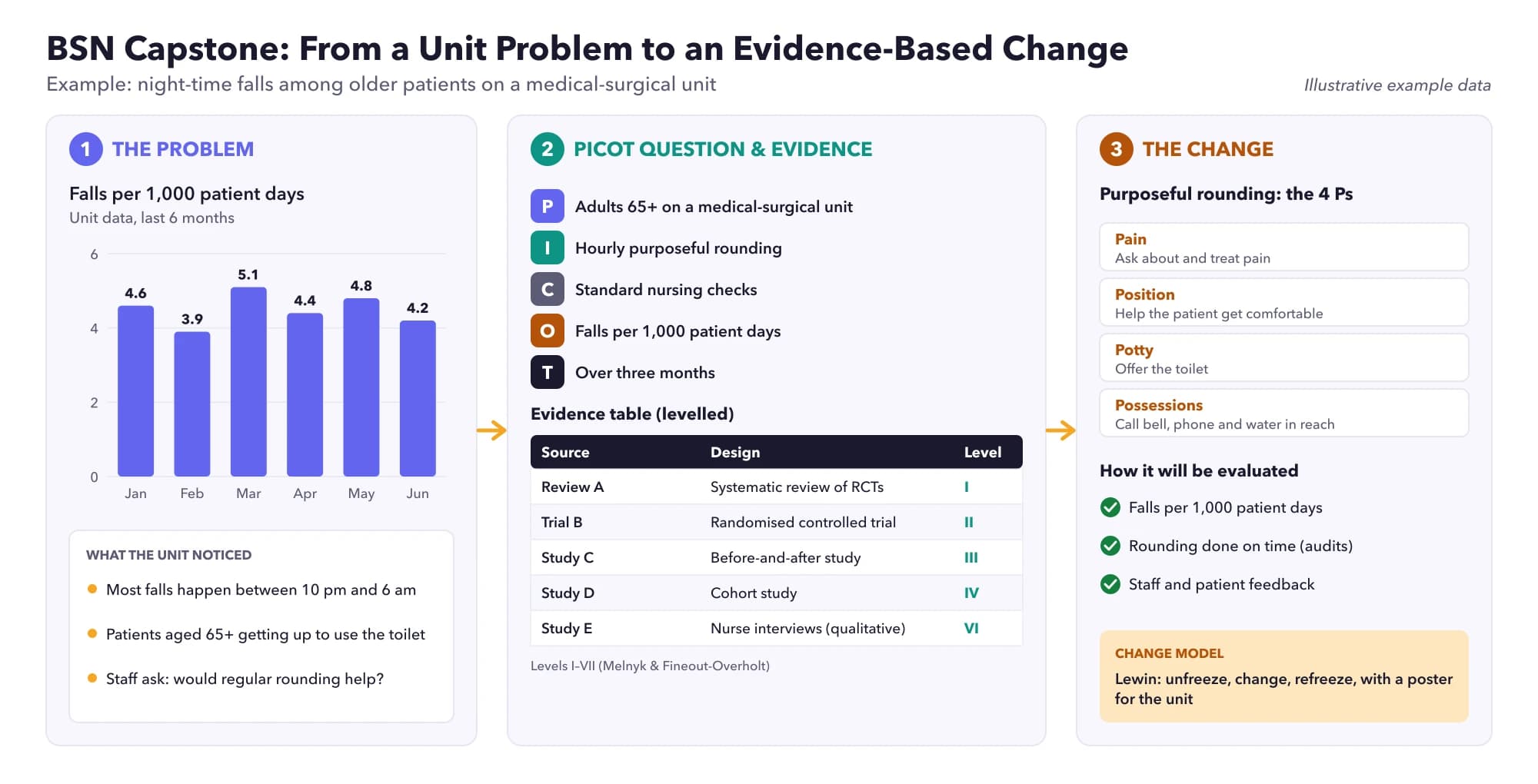
| Problem | Falls on a medical-surgical unit are clustered at night among older patients going to the toilet. |
| PICOT question | In hospitalised adults aged 65 and over (P), does hourly purposeful rounding with a toileting focus (I) compared with standard care (C) reduce falls per 1,000 patient days (O) over three months (T)? |
| Evidence | Search CINAHL and PubMed for rounding and falls; appraise and level each study; summarise in an evidence table. |
| Proposed change | A rounding protocol covering the "4 Ps" (pain, position, potty, possessions), with staff education. |
| Implementation | Use a change model such as the IHI Model for Improvement (Institute for Healthcare Improvement, n.d.) with small Plan-Do-Study-Act cycles. |
| Evaluation | Falls per 1,000 patient days, rounding compliance audits, staff feedback. |
Finding evidence for your capstone topic
Most BSN capstones are built on a focused search of nursing and medical databases. CINAHL is the core nursing database; PubMed/MEDLINE covers biomedical research; the Cochrane Library holds systematic reviews; and professional organisations and government agencies publish clinical practice guidelines. Combine subject headings with keywords for each PICOT element, limit to recent peer-reviewed research, and keep a record of your searches, because many rubrics ask you to describe the search strategy.
Typical BSN capstone paper structure
- Introduction and problem statement, with local and national significance.
- PICOT question.
- Literature search strategy: databases, keywords, limits and results.
- Literature review and evidence synthesis, with levels of evidence.
- Proposed practice change or intervention.
- Theoretical framework or change model (for example Lewin's change theory, the IHI Model for Improvement (Institute for Healthcare Improvement, n.d.), or the Iowa or Johns Hopkins EBP models).
- Implementation plan, including stakeholders, resources and barriers.
- Evaluation plan with measurable outcomes.
- Conclusion and implications for nursing practice.
Always follow your programme's rubric. Some require a poster presentation as well as, or instead of, a paper.
Presenting your capstone as a poster
Many programmes end the capstone with a poster presentation to faculty, preceptors and peers. A clear poster follows the same logic as the paper, in far fewer words:
- A title that states the problem and intervention.
- Background: the problem and why it matters, in two or three sentences.
- Your PICOT question, displayed prominently.
- A short summary of the evidence, often as a small table with levels of evidence.
- The proposed change, implementation steps and evaluation measures, ideally as a flowchart.
- Implications for practice and key references.
Use large fonts, plenty of white space and one or two simple figures. Practise a two-minute verbal summary for visitors who stop at your poster. For design principles, see how to make figures for a scientific paper.
Common capstone topic mistakes
- Choosing a topic that is too broad to answer in one semester.
- Choosing an intervention that requires a prescriber, not a nurse.
- An outcome that cannot be measured or is not linked to the intervention.
- Relying on outdated or non-peer-reviewed sources.
- A PICOT question that changes between sections of the paper.
- Ignoring barriers to implementation, such as staffing or cost.
Getting support with your BSN capstone
If you want an experienced nurse researcher to help you narrow a topic, build a PICOT question, find and level the evidence or plan implementation and evaluation, our BSN capstone support service can guide you through each stage while the project stays yours. Moving on to graduate study? See our MSN capstone ideas and DNP project ideas.
Frequently asked questions
What is a good BSN capstone topic?
A good topic addresses a real, measurable problem in patient care that nurses can influence, has enough recent evidence, and can be completed in one semester. Falls prevention, CAUTI reduction, discharge teaching and pain management are popular examples.
How do I choose a nursing capstone project?
Start with a problem from your clinical placement, check it matters and has evidence, make sure the intervention is within nursing scope, choose a measurable outcome, and frame it as a PICOT question, which builds on the PICO format of Richardson et al. (1995).
What is the difference between a BSN capstone and an MSN capstone?
BSN capstones usually propose an evidence-based practice change on a unit. MSN capstones are typically more advanced, focusing on a specialty role such as education, leadership, informatics or advanced practice, often with a larger implementation or evaluation component.
How many sources do I need for a BSN capstone?
It depends on your programme. Many ask for a set number of recent peer-reviewed studies, often published within the last five to seven years. Check your rubric.
Can I use a literature review as my capstone?
Some programmes accept an evidence-based literature review or integrative review as the capstone. Others require a practice change proposal or quality improvement project. Check your programme guidelines.
Do I have to implement my BSN capstone project?
Not always. Many BSN programmes ask for a proposal with an implementation and evaluation plan rather than a full implementation. Some include a small pilot. Your rubric and clinical site will set the expectations.
What change models are used in nursing capstones?
Common choices include Lewin's change theory, the IHI Model for Improvement (Institute for Healthcare Improvement, n.d.) with PDSA cycles, and EBP models such as the Iowa Model and the Johns Hopkins Nursing EBP model.
Sources
- American Association of Colleges of Nursing. The Essentials: Core Competencies for Professional Nursing Education. 2021
- Gould CV, Umscheid CA, Agarwal RK, Kuntz G, Pegues DA; Healthcare Infection Control Practices Advisory Committee. Guideline for prevention of catheter-associated urinary tract infections. Centers for Disease Control and Prevention; 2009 (updated 2019)
- Institute for Healthcare Improvement. Model for Improvement. n.d.
- Richardson WS, Wilson MC, Nishikawa J, Hayward RS. The well-built clinical question: a key to evidence-based decisions. ACP J Club 1995;123:A12