
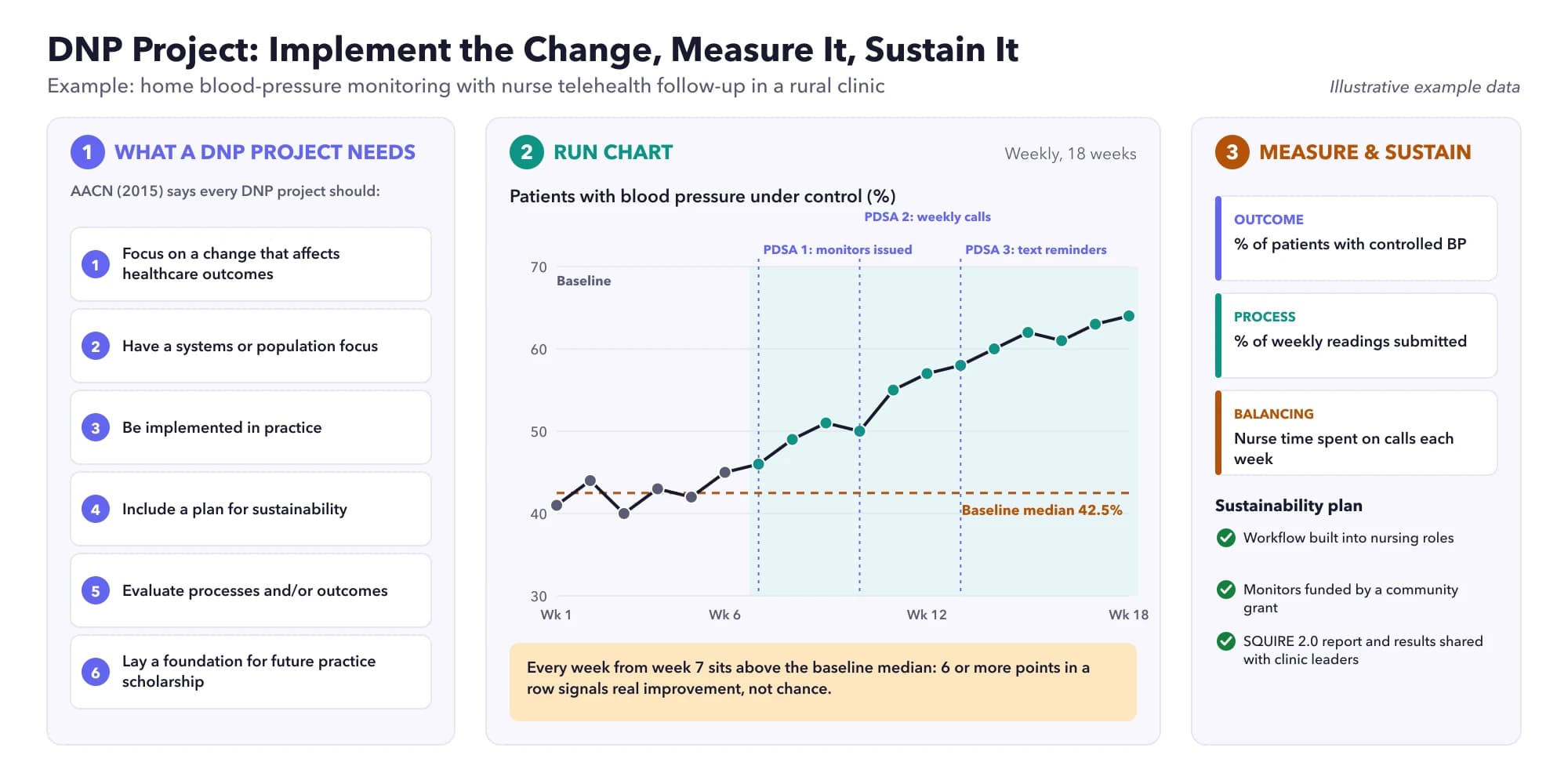
A strong DNP project idea tackles a real practice or systems problem at your site, translates existing evidence into a practice change, and can be implemented and evaluated within your programme. AACN (2015) guidance says every DNP project should focus on a change that affects healthcare outcomes, have a systems or population focus, be implemented in practice, include a sustainability plan, evaluate processes or outcomes, and provide a foundation for future scholarship. Popular areas include quality improvement and patient safety, chronic disease management, mental health integration, care transitions, population health, informatics, workforce well-being and health policy.
Working on your DNP scholarly project? A doctoral specialist can support you. Get a free quote →
What is a DNP project?
The DNP project is the final scholarly project of a Doctor of Nursing Practice programme. Unlike a PhD dissertation, it does not aim to generate new, generalisable knowledge through original research. Instead, it translates existing evidence into practice to improve outcomes in a specific setting or population.
The American Association of Colleges of Nursing (AACN) clarified expectations in its white paper, The Doctor of Nursing Practice: Current Issues and Clarifying Recommendations (AACN, 2015). It recommended calling the final work the DNP Project, not a capstone or dissertation, and stated that the project should include planning, implementation and evaluation components.
AACN's six criteria for a DNP project
According to the white paper (AACN, 2015), all DNP projects should:
- focus on a change that affects healthcare outcomes, through direct or indirect care;
- have a systems (micro-, meso- or macro-level) or population/aggregate focus;
- demonstrate implementation in the appropriate area of practice;
- include a plan for sustainability, grounded in financial, systems or political realities rather than theory alone;
- include an evaluation of processes and/or outcomes, formative or summative;
- provide a foundation for future practice scholarship.
The task force also stated that an integrative or systematic review alone is not a DNP project, and that a portfolio is not a DNP project. It emphasised that clinical significance is as important for guiding practice as statistical significance is for research.
How to choose a DNP project topic
- Start with a gap in your organisation. Look at quality dashboards, incident reports, patient complaints, readmission data or regulatory findings.
- Confirm the gap with local data. A baseline measurement strengthens your problem statement and becomes your pre-implementation comparison.
- Check the evidence. Is there enough high-quality evidence, ideally systematic reviews or guidelines, for an intervention to implement?
- Secure a site and stakeholders. Identify a site mentor, leadership support and the people whose practice will change.
- Check feasibility. Can you implement and collect data within your programme's timeline, typically over several semesters?
- Match your specialty and career goals. A family nurse practitioner, nurse anaesthetist, psychiatric NP or nurse executive will each find different projects valuable.
- Plan for approval early. Determine whether the project is quality improvement or research, as this affects ethics review.
Quality improvement and patient safety DNP project ideas
- Implementing a nurse-driven sepsis screening and early antibiotic protocol in the emergency department.
- A standardised early warning score with escalation pathway on medical-surgical units.
- Reducing CAUTI with a nurse-driven catheter removal protocol and daily necessity checks.
- A CLABSI prevention bundle with compliance audits in ICU.
- A multifactorial falls prevention programme in a long-term care facility.
- Deprescribing to reduce potentially inappropriate medications in older adults.
- Standardised I-PASS handoffs between ED and inpatient units.
- Antimicrobial stewardship for urinary tract infections in urgent care or long-term care.
- Reducing alarm fatigue through individualised alarm parameters.
- Improving time to first analgesia with nurse-initiated pain protocols.
Chronic disease and primary care DNP project ideas
- A nurse practitioner-led diabetes self-management programme and HbA1c in a federally qualified health centre.
- Home blood pressure monitoring with telehealth follow-up for uncontrolled hypertension.
- Heart failure transitional care clinics to reduce 30-day readmissions.
- Implementing guideline-based COPD action plans in primary care.
- Obesity management using motivational interviewing in primary care.
- Chronic kidney disease screening in patients with diabetes and hypertension.
- Shared medical appointments for diabetes or hypertension.
- Implementing statin therapy guidelines for eligible patients.
- Remote patient monitoring for patients with multiple chronic conditions.
Mental health DNP project ideas
- Integrating depression screening (for example PHQ-9) with a referral pathway in primary care.
- Collaborative care for depression and anxiety in primary care.
- Suicide risk screening and safety planning in emergency or outpatient settings.
- Medication for opioid use disorder initiated in the emergency department.
- Metabolic monitoring for patients taking antipsychotics.
- Trauma-informed care training for staff in community mental health.
- Reducing restraint and seclusion in inpatient psychiatric units.
- Postpartum depression screening in paediatric well-child visits.
Population health, equity and community DNP project ideas
- Social determinants of health screening with community resource referrals.
- Food insecurity screening and partnerships with food pantries.
- Vaccine uptake in underserved communities through community health worker outreach.
- Cancer screening (colorectal, cervical, breast) navigation programmes.
- Health literacy interventions for patients with limited English proficiency.
- Chronic disease management for older adults in correctional facilities.
- School-based programmes on vaping prevention, immunisations or healthy eating.
- Disaster preparedness planning with community organisations.
AACN's (2015) white paper lists examples of settings beyond traditional hospitals, including community agencies, schools, prisons, long-term care, urgent care and organisational systems leadership, provided each project includes planning, implementation and evaluation.
Care transitions and acute care DNP project ideas
- Structured discharge education with teach-back and post-discharge phone calls.
- Medication reconciliation by nurse practitioners at transitions of care.
- Early mobility protocols to reduce ICU length of stay.
- Delirium prevention bundles for older surgical patients.
- Enhanced recovery after surgery (ERAS) pathway implementation.
- Advance care planning in primary care or oncology.
- Palliative care consultation triggers in ICU.
- Reducing ED boarding times through patient flow redesign.
Informatics, workforce and policy DNP project ideas
Informatics
- Clinical decision support alerts for sepsis, VTE prophylaxis or drug interactions.
- Reducing EHR documentation burden for nurses.
- Patient portal activation among older adults.
- Telehealth implementation and evaluation in rural clinics.
Workforce and leadership
- Nurse burnout and resilience programmes with validated measures.
- Nurse residency programmes and first-year turnover.
- Workplace violence prevention training.
- Shared governance implementation and nurse engagement.
Health policy
- Developing an evidence-based organisational policy, such as post-fall provider notification or geriatric trauma triage criteria.
- Evaluating and revising nurse practitioner scope-of-practice policies within an organisation.
- Analysing policy to expand access to care for uninsured populations.
Frameworks and methods for DNP projects
| Purpose | Frameworks |
|---|---|
| Evidence-based practice | Iowa Model, Johns Hopkins Nursing EBP Model, ACE Star Model, Stetler Model |
| Quality improvement | IHI Model for Improvement with Plan-Do-Study-Act (PDSA) cycles (Institute for Healthcare Improvement, n.d.), Lean, Six Sigma |
| Implementation science | Consolidated Framework for Implementation Research (CFIR), RE-AIM, PARIHS |
| Change management | Lewin's change theory, Kotter's eight-step model, Rogers' diffusion of innovations |
| Nursing theory | Orem's self-care deficit theory, Pender's health promotion model, and others that fit the project |
Evaluation usually compares pre- and post-implementation data. Common analyses include paired t-tests or Wilcoxon tests for continuous outcomes, chi-square or McNemar tests for proportions, and run charts or statistical process control charts to show change over time. Report process measures (such as protocol adherence) as well as outcome measures.
Choosing measures: outcome, process and balancing
Quality improvement projects usually track three kinds of measures, an approach promoted by the Institute for Healthcare Improvement (n.d.):
| Measure | Question it answers | Sepsis protocol example |
|---|---|---|
| Outcome | Are patients better off? | Sepsis mortality; ICU transfers |
| Process | Is the change being carried out as planned? | Percentage of eligible patients screened; time from triage to antibiotics |
| Balancing | Is the change causing problems elsewhere? | Antibiotic use in patients later found not to have infection; triage times for other patients |
Process measures are especially important in short DNP timelines, because outcomes such as mortality may not change measurably within a few months, while adherence to the new process can.
Worked example: a DNP project from problem to evaluation
| Component | Example |
|---|---|
| Problem | A rural primary care clinic finds that only a minority of adults with hypertension have blood pressure controlled below target. |
| PICOT | In adults with uncontrolled hypertension at a rural clinic (P), does home blood pressure monitoring with nurse telehealth follow-up (I) compared with usual care (C) improve the proportion with controlled blood pressure (O) after 12 weeks (T)? |
| Evidence | Guidelines and systematic reviews supporting self-measured blood pressure with clinical support. |
| Frameworks | Iowa Model for EBP; IHI Model for Improvement with PDSA cycles; Pender's health promotion model. |
| Implementation | Validated home monitors, patient teaching with teach-back, weekly telehealth check-ins, medication titration by the provider. |
| Measures | Outcome: BP control. Process: percentage of weekly readings submitted. Balancing: telehealth staff time. |
| Analysis | Pre/post comparison of BP control with McNemar's test; paired t-test for mean systolic BP; run chart of weekly control rates. |
| Sustainability | Workflow embedded in nursing roles; monitors funded through a community grant; results presented to clinic leadership. |
Typical DNP project structure
- Problem identification and needs assessment, with local baseline data.
- PICOT question and project aims.
- Evidence review: search strategy, appraisal and synthesis, often with levels of evidence.
- Theoretical and implementation frameworks.
- Methods: setting, population, intervention, measures, data collection and analysis plan.
- Ethical considerations and approval (QI determination or IRB review).
- Implementation with timeline, stakeholders and resources.
- Evaluation and results.
- Sustainability plan and budget.
- Dissemination.
Many programmes ask students to report their final project using SQUIRE 2.0 (Standards for QUality Improvement Reporting Excellence; Ogrinc et al., 2016), which emphasises the use of theory, the context of the work, and the study of the intervention.
AACN (2015) recommends that, at a minimum, an executive summary or written report is shared beyond the academic setting. Other options include journal publication, poster or podium presentations, grand rounds and presentations to organisational leadership.
A typical DNP project timeline
Programmes differ, but many spread the project across three to five semesters:
- Semester 1: identify the problem, secure a site, collect baseline data and draft the PICOT question.
- Semester 2: complete the evidence review, choose frameworks, write the proposal and gain approvals.
- Semester 3: implement the change and collect data, adjusting through PDSA cycles.
- Semester 4: analyse and interpret results, write the final report and plan sustainability.
- Final stage: present and disseminate to the site, faculty and wider professional audiences.
Common DNP project mistakes
- Designing a research study to generate new knowledge instead of translating existing evidence.
- Proposing a project that ends with a literature review and no implementation.
- Choosing a problem without local baseline data.
- Measuring only knowledge or satisfaction when the aim is a clinical or systems outcome.
- No plan for sustaining the change after the student leaves.
- Underestimating the time needed for site approvals and data access.
Getting support with your DNP project
DNP projects require skills in evidence appraisal, implementation science, data analysis and scholarly writing, often while working full time. Our DNP project support service can help you refine the problem and PICOT question, synthesise the evidence, choose frameworks, plan the evaluation and analyse pre- and post-implementation data, with the project and its conclusions remaining your own.
Frequently asked questions
What is a DNP project?
A DNP project is the final scholarly project of a Doctor of Nursing Practice programme. It translates existing evidence into a practice change in a specific setting or population, with planning, implementation and evaluation.
What are good DNP project ideas?
Popular ideas include sepsis screening protocols, CAUTI or CLABSI reduction, heart failure transitional care, depression screening in primary care, social determinants of health screening, telehealth for chronic disease, and nurse burnout programmes.
Is a systematic review a DNP project?
According to AACN's (2015) white paper, an integrative or systematic review alone is not considered a DNP project, because it does not include implementation and evaluation in practice.
What is the difference between a DNP project and a PhD dissertation?
A PhD dissertation generates new, generalisable knowledge through original research. A DNP project translates existing evidence into practice to improve outcomes in a specific setting.
Does a DNP project need IRB approval?
It depends on the institution. Many DNP projects are classed as quality improvement and receive a determination rather than full IRB review, but some require review. Follow your university and site policies.
How many practice hours are required for a DNP?
AACN (2015) guidance states that DNP students should complete a minimum of 1,000 post-baccalaureate practice hours as part of a supervised academic programme.
Sources
- American Association of Colleges of Nursing. The Doctor of Nursing Practice: Current Issues and Clarifying Recommendations (2015)
- Ogrinc G, Davies L, Goodman D, et al. SQUIRE 2.0 (Standards for QUality Improvement Reporting Excellence): revised publication guidelines from a detailed consensus process. BMJ Qual Saf 2016;25:986-992
- Institute for Healthcare Improvement. Model for Improvement. n.d.