
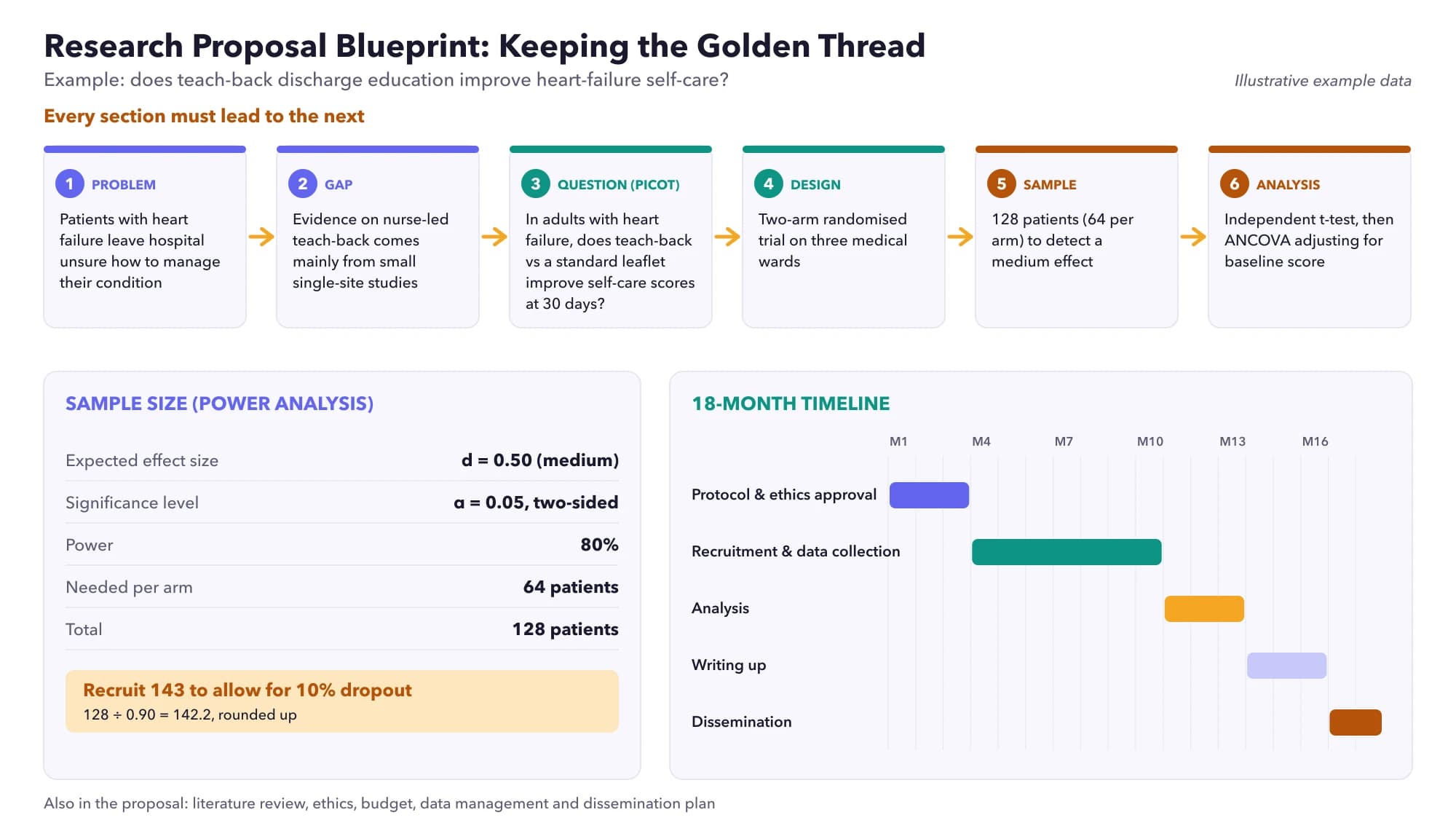
A research proposal explains what you plan to study, why it matters and how you will do it. Most proposals include: a title; an abstract; an introduction with the problem and its significance; a literature review that identifies the gap; aims, research questions or hypotheses; methods (design, participants and sampling, data collection, analysis); ethical considerations; a timeline; a budget if required; and references. A strong proposal makes a clear, feasible, well-justified case that your question is worth answering and that your methods can answer it.
Writing a research proposal? A specialist can help you tighten the question, methods and analysis plan. Get a free quote →
What is a research proposal, and who reads it?
A research proposal is a structured plan for a study. You write one to be accepted onto a PhD or master's programme, to get approval for a dissertation or thesis, to secure funding, or to obtain ethics approval. The reader changes, but the question they ask is the same: is this question worth answering, and can this person answer it with these methods, in this time, with these resources?
| Proposal type | Typical reader | What they focus on |
|---|---|---|
| PhD application | Prospective supervisors and admissions panels | Originality, fit with the department, feasibility in three to four years, your preparation |
| Dissertation / thesis proposal | Supervisor and committee | A focused question, sound methods, realistic timeline |
| Grant application | Funders and peer reviewers | Significance, innovation, team expertise, value for money, impact |
| Ethics application | Research ethics committee or IRB | Participant protection, consent, risk, data handling |
Always check the specific guidance you have been given: word limits, required headings and referencing style vary widely, and following them exactly is the easiest way to make a good first impression.
Research proposal structure: the standard sections
- Title: concise and informative, naming the topic, population and approach.
- Abstract or summary: usually 150 to 300 words covering the problem, aim, methods and expected contribution.
- Introduction and background: the problem, its context and why it matters now.
- Literature review: what is known, what is contested, and the specific gap your study addresses.
- Aims, objectives, research questions or hypotheses.
- Methodology and methods: design, setting, participants, sampling, data collection, analysis.
- Ethical considerations.
- Timeline (often as a Gantt chart) and resources or budget.
- Expected outcomes, significance and dissemination.
- References and any appendices (for example draft questionnaires or interview guides).
Writing the title and abstract
Reviewers often read only the title and abstract before deciding how carefully to read the rest. A good title signals the topic, population and design, for example: "Nurse-led telephone coaching for glycaemic control in adults with type 2 diabetes: a mixed methods feasibility study". Avoid vague or clever titles that hide what you will actually do.
Write the abstract last. In a few sentences each, state the problem, the gap, your aim, your design and methods, and what the study will contribute.
Introduction and problem statement
The introduction should move quickly from the broad area to your specific problem. A useful pattern is: context (what is the issue?), problem (what is going wrong or unknown?), consequence (why does that matter, and to whom?), and purpose (what will this study do about it?). Use current data from authoritative sources to show the size of the problem.
Context: Hospital readmissions within 30 days are costly and often preventable.
Problem: Discharge education varies widely, and evidence on nurse-led teach-back in heart failure is limited to small single-site studies.
Consequence: Patients may leave hospital without understanding their medications or warning signs.
Purpose: This study will evaluate the feasibility and preliminary effects of a structured teach-back programme across three wards.
The literature review section
In a proposal, the literature review is shorter and more targeted than in a thesis. Its job is to show that you know the key work, and to build a logical path to your gap. Organise it by themes, finish with a clear statement of what is missing, and make sure the gap leads directly to your research question.
For detailed guidance, including how to use a synthesis matrix, see how to write a literature review. If your proposal is for a systematic review, your "methods" will be a review protocol; see how to do a systematic review and our PROSPERO registration template.
Aims, objectives, research questions and hypotheses
These terms are often confused:
- Aim: the overall purpose, in one sentence. "To evaluate the effect of teach-back discharge education on 30-day readmissions in adults with heart failure."
- Objectives: specific, measurable steps to achieve the aim. "To compare readmission rates between…"; "To explore nurses' experiences of delivering…"
- Research questions: the questions your data will answer, often one per objective.
- Hypotheses: testable predictions for quantitative studies, stated as a null and alternative hypothesis.
Good research questions are focused, answerable with your chosen methods, and worth answering. Farrugia et al. (2010) recommend checking them against the FINER criteria: Feasible, Interesting, Novel, Ethical and Relevant. For clinical questions, structure them with PICO or PICOT; see how to write a PICOT question.
Methodology and methods
This is usually the section reviewers scrutinise most. Justify every choice: not just what you will do, but why it is the best way to answer your question.
Research design
Name the design (for example randomised controlled trial, cohort study, cross-sectional survey, qualitative interview study, mixed methods design, systematic review) and explain why it fits your question. If relevant, state your philosophical position (for example positivist, interpretivist, pragmatist).
| Approach | Answers questions like | Typical designs | Typical data |
|---|---|---|---|
| Quantitative | How many? How much? Is there a difference or relationship? Does it work? | Experiments and RCTs, quasi-experiments, cohort studies, cross-sectional surveys | Measurements, scores, counts, questionnaires with fixed responses |
| Qualitative | How? Why? What is it like? What does it mean to people? | Interview and focus group studies, ethnography, phenomenology, grounded theory, case studies | Interview and focus group transcripts, observation notes, documents |
| Mixed methods | Both, where one strand explains, builds on or corroborates the other | Convergent, explanatory sequential, exploratory sequential | Both, deliberately integrated (Fetters et al., 2013) |
| Secondary / evidence synthesis | What does the existing evidence show? | Systematic, scoping and literature reviews; secondary analysis of existing datasets | Published studies or existing data |
Your approach should follow from your question, not the other way round. A question beginning "Does…" or "What is the effect of…" usually points to quantitative methods; one beginning "How do…experience…" points to qualitative methods.
Setting, participants and sampling
Describe where the study will take place, who is eligible (inclusion and exclusion criteria), how participants will be recruited, and how many you need. For quantitative studies, justify the sample size with a power calculation, stating the expected effect size, alpha and power (Cohen, 1992). For qualitative studies, justify the sample by the aims, the richness of the data expected and the approach.
Data collection
Explain what data you will collect, with which instruments, when and by whom. Name validated questionnaires and report their reliability and validity. For interviews, describe the format and include a draft guide in an appendix.
Data analysis
Link each research question or hypothesis to a specific analysis. For quantitative data, name the tests and software; our guide on which statistical test to use can help. For qualitative data, name the approach, such as thematic analysis. Mention how you will handle missing data.
| Research question | Data | Analysis |
|---|---|---|
| Does teach-back reduce 30-day readmission? | Readmission (yes/no) by group | Chi-square test; logistic regression adjusting for age and severity |
| Does teach-back improve heart failure knowledge? | Knowledge scores before and after | Paired t-test, or Wilcoxon signed-rank if not normally distributed |
| How do nurses experience delivering teach-back? | Semi-structured interviews | Reflexive thematic analysis |
Rigour, validity and limitations
Show that you have anticipated problems: bias, confounding, low response rates, recruitment difficulties, and threats to validity or trustworthiness. Say what you will do about them. Acknowledging limitations honestly strengthens a proposal.
If your proposal is a clinical trial protocol
Trial protocols should follow the SPIRIT guideline (Chan et al., 2025). The updated SPIRIT 2025 statement contains a checklist of 34 minimum items to address in a randomised trial protocol, plus a diagram of the schedule of enrolment, interventions and assessments. Notable additions include a new open science section, more emphasis on harms and on describing interventions and comparators, and a new item on how patients and the public will be involved in trial design, conduct and reporting.
Ethical considerations
- Which ethics committee or IRB will review the study, and whether approval has been sought.
- How informed consent will be obtained and recorded, including for people who may lack capacity.
- Risks and burdens to participants and how they will be minimised.
- Confidentiality, anonymisation, data storage, retention and compliance with data protection law.
- How incidental findings or distress during data collection will be handled.
- Conflicts of interest and funding sources.
Timeline and budget
A timeline shows that the project is feasible. Break it into phases (ethics approval, recruitment, data collection, analysis, writing) and allow time for delays; recruitment and ethics approval nearly always take longer than planned. A Gantt chart is the clearest format.
Months 1–3: finalise protocol, ethics approval
Months 4–9: recruitment and data collection
Months 10–12: quantitative analysis; interviews
Months 13–15: qualitative analysis and integration
Months 16–18: writing up and dissemination
For funded proposals, itemise costs (staff time, participant payments, equipment, software, transcription, travel, open access fees) and justify each one.
Significance, impact and dissemination
End by stating clearly what the study will contribute to knowledge, practice or policy, and who will benefit. Describe how you will share the findings: journal articles, conferences, reports to partner organisations, and summaries for participants and the public. Funders increasingly expect a plan for open access and data sharing.
Tips for a proposal that gets approved
- Be specific. Replace "patients" with the exact population and setting; replace "analyse the data" with named tests.
- Keep the golden thread. The problem, gap, question, methods and analysis should line up exactly.
- Show feasibility. Access to participants, skills, time and support.
- Write for a busy reader. Use headings, short paragraphs and a clear statement of the aim early on.
- Follow the instructions. Word limits, headings and formatting matter.
- Get feedback early from your supervisor or a colleague outside your field.
- Proofread and reference carefully. Typos and inconsistent citations suggest carelessness; check them with a reference checker.
Getting help with your research proposal
A proposal is easier to get right with a second pair of expert eyes. Our research proposal service helps you sharpen the question, build a focused literature review, choose and justify methods, plan sample size and analysis, and prepare a realistic timeline, so you submit with confidence.
Frequently asked questions
What are the main parts of a research proposal?
Title, abstract, introduction and problem statement, literature review, aims and research questions or hypotheses, methods, ethical considerations, timeline, budget if required, significance, and references.
How long is a research proposal?
It depends on the purpose. PhD application proposals are often a few pages, while dissertation, grant and trial protocols can be much longer. Always follow the word limit you are given.
What is the difference between an aim and an objective?
The aim is the overall purpose of the study in one sentence. Objectives are specific, measurable steps that together achieve the aim.
How do I justify my sample size?
For quantitative studies, use a power calculation based on the expected effect size, significance level and desired power. For qualitative studies, justify it by the aims, approach and expected richness of the data.
What makes a good research question?
A good question is focused, answerable with your methods, and worth answering. The FINER criteria (Feasible, Interesting, Novel, Ethical, Relevant; Farrugia et al., 2010) are a useful check.
Should a research proposal be written in the future tense?
Yes. Describe what you will do in the future tense ("Participants will be recruited…"), and use the present or past tense when describing existing literature.
What is SPIRIT 2025?
SPIRIT 2025 is the updated guideline for protocols of randomised trials, with a checklist of 34 minimum items and a diagram of the schedule of enrolment, interventions and assessments.
Sources
- Farrugia P, Petrisor BA, Farrokhyar F, Bhandari M. Research questions, hypotheses and objectives. Can J Surg 2010;53:278-281
- Chan AW, Boutron I, Hopewell S, et al. SPIRIT 2025 statement: updated guideline for protocols of randomised trials. BMJ 2025;389:e081477
- Cohen J. A power primer. Psychol Bull 1992;112:155-159
- Fetters MD, Curry LA, Creswell JW. Achieving integration in mixed methods designs: principles and practices. Health Serv Res 2013;48:2134-2156