
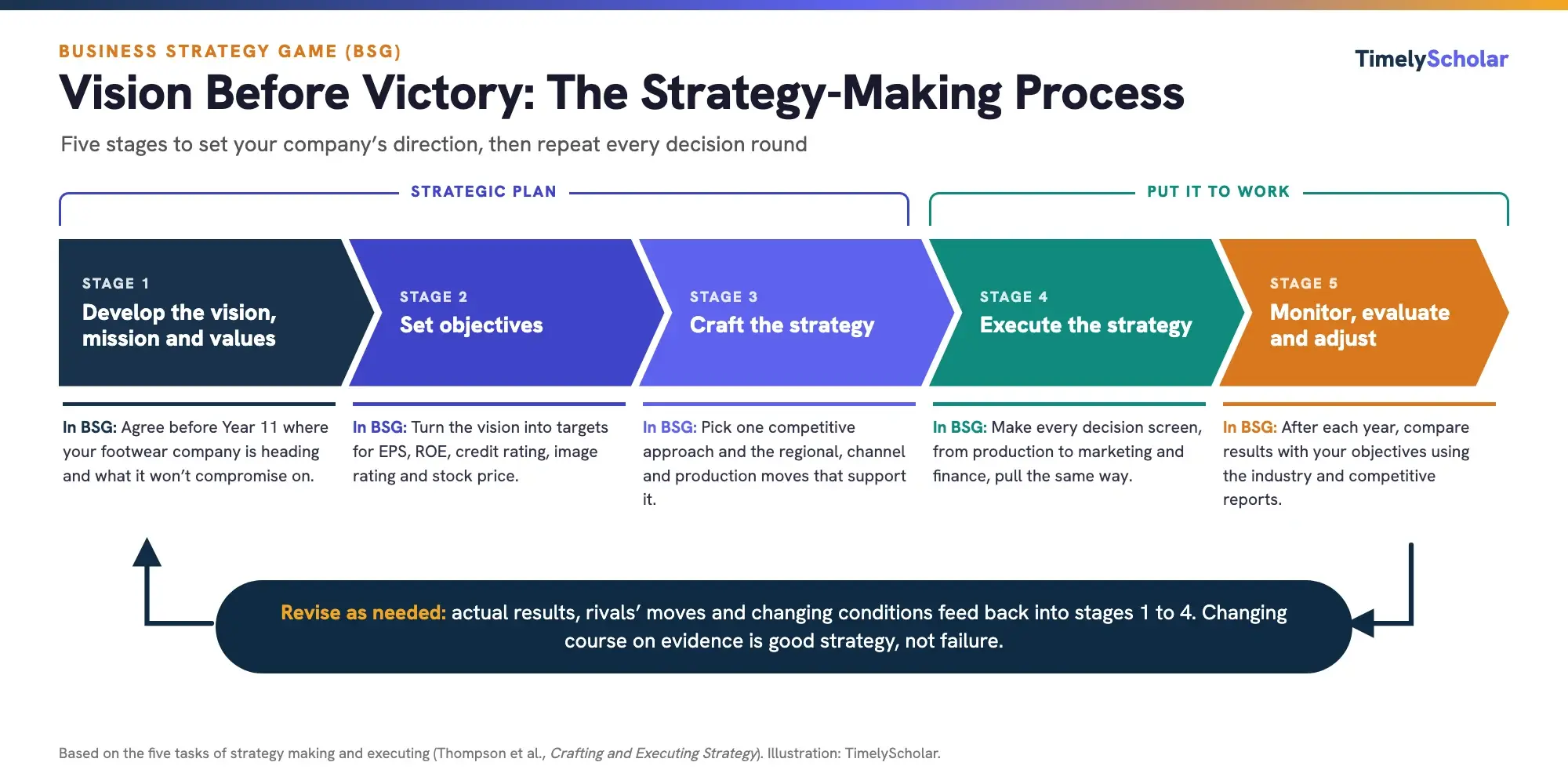
Winning companies (1) set a clear strategic vision, (2) define their mission and core values, (3) translate both into specific financial and strategic objectives, (4) craft a strategy at every level of the organization, and (5) execute, monitor and adjust. In BSG, that means choosing a competitive approach for your footwear company, setting targets against the five investor expectations (EPS, ROE, credit rating, image rating and stock price), aligning every decision screen to that plan and reviewing results after each year to correct course.
Playing the Business Strategy Game? Get coaching on strategy and the reports. Get a free quote →
Introduction: Why Most BSG Teams Lose Before Year 11 Even Ends
Most teams in The Business Strategy Game (BSG) do not lose because of one bad pricing decision. They lose because they never decided where the company was going. Co-managers tweak wholesale prices one round, chase celebrity endorsements the next, then slash marketing when earnings dip. The result is a company with no identity, no direction and a scorecard that slides every year.
The fix is a clear strategic direction. Winning companies decide where they are headed, turn that direction into measurable targets, and organize every decision around a single strategy. BSG is the perfect lab for those ideas, because every decision round rewards or punishes how well you follow them. This guide walks through each of these concepts and shows exactly how to apply it in BSG, with examples, a step-by-step plan and answers to the questions students ask most.
Key Takeaways
Vision first: a BSG team needs a one-sentence picture of where its footwear company will be by the final year before it touches a single decision screen.
Mission and values set boundaries: they define which markets you serve, how you compete and what you will not do, such as compromising on corporate social responsibility.
Objectives must be measurable: BSG scores you on EPS, ROE, credit rating, image rating and stock price, so your targets should be written in those terms.
Balance the scorecard: chasing short-term EPS by cutting quality or marketing usually hurts image rating and future market share.
Strategy works at four levels: corporate, business, functional and operating decisions in BSG must all point the same way.
Strategy is a loop: every BSG year is a chance to monitor results, compare against objectives and adjust.
The Building Blocks of Strategic Direction in BSG
Strategic direction answers one core question: how does a company decide where it is headed and how it will get there? Strong strategists treat it as an ongoing managerial process rather than a one-time plan. The building blocks are:
Why a clear, well-communicated strategic vision matters
How a mission statement and core values shape behavior
Why companies need both financial and strategic objectives
How the balanced scorecard and stretch objectives drive performance
How strategy is crafted at corporate, business, functional and operating levels
How the five stages of strategic management connect
What role the board of directors plays in corporate governance
In BSG, your team takes over an athletic footwear company that competes in four regions: North America, Latin America, Europe-Africa and Asia-Pacific. You sell through branded wholesale, branded online (internet) and private-label channels. Each decision round represents one year, and your instructor grades you against investor expectations and against rival teams.
That structure makes these ideas practical rather than theoretical. A team without a vision makes inconsistent decisions. A team without objectives cannot tell whether a year went well. A team without an aligned strategy hierarchy ends up with a premium marketing budget and a bargain-basement product. BSG exposes all three problems quickly, often within the first two decision rounds.
Building a Strategic Vision for Your BSG Company
A strategic vision describes management's aspirations for the company's future and the course it will take to get there. A good vision is forward-looking, specific enough to guide decisions, and easy to communicate. A vague vision such as "be the best footwear company in the world" fails because it does not rule anything out.
What makes a BSG vision effective
Effective visions share seven traits. Here is how each one translates into the game:
Vision trait
| What it means in BSG | |
| Graphic | Paints a picture: "the top-rated premium brand in North America and Europe-Africa" |
| Directional | Says where you are headed over the remaining years of the simulation |
| Focused | Specific enough to guide pricing, quality and marketing calls |
| Flexible | Leaves room to adjust when rivals change tactics |
| Feasible | Achievable given your plant capacity, cash and credit rating |
| Desirable | Appeals to "shareholders" (your instructor's scoring) |
| Easy to communicate | Every co-manager can say it in one breath |
Sample BSG vision statements
Differentiation: "By Year 20, we will be the industry's most admired branded footwear company, known for the highest S/Q rating and strongest image rating in every region."
Low cost: "We will be the lowest-cost producer of quality branded and private-label footwear, winning on price in every region while keeping a solid investment-grade credit rating."
Focused or best-cost: "We will offer above-average quality at below-average prices, targeting the price-sensitive internet and wholesale segments in Asia-Pacific and Latin America."
The best visions in BSG name a competitive approach, the regions or channels you will prioritize, and the outcome you expect. Write yours before Year 11 decisions and pin it at the top of your team's shared notes. Communicating the vision matters just as much: a short slogan such as "Premium quality, everywhere" keeps co-managers aligned when debates get heated.
Writing a Mission Statement and Core Values for BSG
Where the vision looks forward, the mission statement describes the present. A strong mission identifies the company's products or services, the customer needs it serves, and what sets it apart, so that it gives the company its own identity. In short, it answers "Who are we, what do we do, and why are we here?"
A BSG mission statement template
"[Company name] designs, produces and markets [quality level] athletic footwear for [target customers] across [regions] through [channels], competing on [basis of advantage] while [commitment to stakeholders]."
Example: "Stride Athletics designs and markets high-performance athletic footwear for serious athletes in all four regions, through branded wholesale and online channels. We compete on superior quality, wide model selection and strong retailer support, while operating ethically and investing in our workers and communities."
Note what the example does. It names the quality level, the customers, the regions, the channels and the competitive edge. Each phrase links to real BSG decisions: S/Q rating, models offered, retailer support, regional marketing and corporate citizenship spending.
Core values in BSG
Core values are the beliefs and behavioral norms a company commits to as it pursues its vision and mission. In BSG, they show up in concrete choices:
Ethics and social responsibility: decisions on workplace conditions, supplier codes of conduct and energy-efficiency or community investments can lift your image rating.
Customer focus: consistent investment in quality, delivery time and retailer support.
Financial discipline: a commitment to protect your credit rating rather than borrow recklessly.
Teamwork: an agreed rule that no co-manager changes a decision screen without discussing it first.
Values only matter if they shape behavior. A team that claims to value quality but cuts materials spending every year to hit EPS targets is running on empty words, and BSG's ratings will show it.
Setting Objectives Around BSG Investor Expectations
Objectives turn the vision into specific performance targets. Objectives must be quantifiable, include a deadline and stretch the organization. "Grow profits" is a wish; "raise EPS to $4.00 by Year 14" is an objective.
Financial vs. strategic objectives
There are two kinds of objectives, and BSG measures both:
Type
| Definition | BSG examples | |
| Financial objectives | Outcomes tied to financial performance | EPS, ROE, stock price, credit rating, net profit, dividends |
| Strategic objectives | Outcomes that strengthen market standing and competitive position | Image rating, S/Q rating, market share by region, number of models, celebrity appeal |
BSG's scoring is built on five investor expectations: earnings per share (EPS), return on equity (ROE), credit rating, image rating and stock price. Your instructor chooses how much each one counts. Scores also blend two standards: meeting or beating investor expectations, and how you rank against the best-performing rival in each metric. Check the Players Guide and your course settings, because weights and targets can differ by class.
Writing SMART objectives for BSG
Use your team's three-year strategic plan to commit to numbers. Good BSG objectives look like this:
Raise EPS above the investor expectation every year from Year 12 onward.
Reach an image rating of 80 or higher by Year 13 through S/Q and marketing investments.
Keep an A- credit rating or better while funding plant upgrades.
Hold at least 20% branded market share in North America and Europe-Africa by Year 14.
Grow ROE every year while paying a steady, rising dividend.
The balanced scorecard
Strategists recommend the balanced scorecard, which pairs financial measures with strategic ones so short-term profit never crowds out long-term position. In BSG, that balance is built into the scoring. A team that dumps advertising and quality to spike EPS in one year usually sees image rating, market share and future earnings fall. Track both columns of the table above at every review.
Stretch objectives and short vs. long term
Stretch objectives push teams beyond what feels comfortable, which tends to produce stronger performance. In BSG, set at least one target above the investor expectation, such as beating the EPS benchmark by 20%. It also helps to separate short-term objectives (next year's results) from long-term objectives (where you will be in three to five years). Your annual decisions should hit near-term goals without mortgaging the final years of the game.
The Strategy-Making Hierarchy on BSG Decision Screens
Strategy is not made only at the top. In a diversified company, it is crafted at four levels, and each level must support the one above it. Your BSG company is a single-business firm, so corporate and business strategy largely merge, but the hierarchy still maps neatly onto the game.
Level
| Who owns it | BSG application | |
| Corporate strategy | CEO and senior executives | Which regions and channels to compete in; whether to build or close plants; overall financing approach |
| Business strategy | General manager of the business | Your competitive approach: low cost, differentiation, best-cost or focused |
| Functional strategies | Heads of production, marketing, finance and HR | Plant operations and S/Q, workforce compensation, pricing and advertising, celebrity endorsements, debt and dividends |
| Operating strategies | Front-line managers | Fine-grained choices: models per region, delivery time, shipping, retailer support, online pricing |
The lesson of the hierarchy is strategic fit. If your business strategy is differentiation, your functional strategies must deliver premium quality, strong advertising and wide model selection. If your business strategy is low cost, production must chase economies of scale, efficient plants and lean compensation, while marketing stays focused on price.
A common BSG trap is a split-personality company: one co-manager prices like a discounter while another spends like a luxury brand. Assign each co-manager a functional area, but review every screen against the agreed business strategy before submitting decisions.
The Five-Stage Strategic Management Process, One BSG Year at a Time
At the heart of strategic management is a five-stage process for crafting and executing strategy. Stages 1 to 3 make up the strategic plan; stages 4 and 5 put it to work and keep it current. In BSG, the whole loop repeats with every decision round.
Develop a strategic vision, mission and core values. Before Year 11, agree on where the company is headed and what it stands for.
Set objectives. Translate the vision into targets for EPS, ROE, credit rating, image rating, stock price and market share, using the three-year strategic plan.
Craft a strategy to achieve the objectives. Choose your competitive approach and the regional, channel and production moves that support it.
Execute the strategy. Enter decisions on every screen, from production and labor to marketing, online sales, celebrity contracts, CSR and finance, and make sure they fit together.
Monitor developments, evaluate performance and make corrective adjustments. After each year, study the Footwear Industry Report, the Company Operating Report and the Competitive Intelligence pages. Compare actual results to your objectives, then decide whether to fine-tune or rethink.
Stage 5 feeds straight back into stages 1 to 4. A company may revise its vision, objectives or strategy when conditions change. In BSG, if a rival has locked up the premium segment in Europe-Africa, the smart move may be to shift resources toward Asia-Pacific rather than fight a costly price war. Revising the plan in response to evidence is good strategy, not failure.
Remember, too, that strategy is partly deliberate (planned in advance) and partly emergent (adapted as events unfold). Your Year 11 plan is deliberate. Your response to a competitor's surprise price cut in Year 13 is emergent. Strong BSG teams plan carefully but stay ready to adapt.
Corporate Governance and Team Roles in BSG
In real companies, the board of directors plays a key role in the strategy process. The board's job is to oversee the company's direction, evaluate the strategic leadership of senior executives, hold management accountable, and make sure executive pay rewards real performance rather than short-term tricks.
In BSG, your instructor effectively sits in the boardroom, and the scoring system plays the shareholders. You can still borrow the governance mindset inside your team:
Appoint a CEO or team lead who owns the vision and breaks deadlocks.
Assign functional owners for production, marketing, online sales and finance, mirroring the strategy hierarchy.
Hold a short board review after each year. Compare results to objectives, record what worked, and agree on corrections before the next deadline.
Protect the long term. Act like an independent director and challenge any decision that boosts this year's EPS at the expense of image rating, credit rating or capacity for future years.
Keep records. A shared log of decisions and rationale makes the BSG strategic plan and any end-of-course report far easier to write.
Good governance also keeps BSG ethical. Accurate reporting, fair treatment of workers in your plants, and honest teamwork all reflect the core values your mission promised.
Common Strategic Direction Mistakes BSG Teams Make
Mistake
| Why it hurts | Fix | |
| Skipping the vision | Decisions drift round to round | Agree on a one-sentence vision before Year 11 |
| Copying a generic mission | Gives no guidance on channels, regions or quality | Name your customers, regions, channels and edge |
| Vague objectives | Cannot tell whether a year succeeded | Set numeric targets for all five investor expectations |
| Chasing EPS only | Image rating and market share erode | Use the balanced scorecard every year |
| Misaligned functions | Premium marketing paired with low S/Q wastes cash | Check each screen against the business strategy |
| Never revising the plan | Teams keep losing in a crowded segment | Run a stage 5 review after every year |
Step-by-Step Action Plan: Setting Your BSG Company's Direction
Read the Players Guide and Year 10 results to understand your starting position, plant capacity and cash.
Pick a competitive approach (low cost, differentiation, best cost or focused) that fits your strengths.
Write your strategic vision in one or two sentences and create a short team slogan.
Draft a mission statement using the template above and list three to five core values.
Set SMART objectives for EPS, ROE, credit rating, image rating, stock price and regional market share.
Fill in the three-year strategic plan so your targets are on record.
Assign functional owners and align every decision screen with the business strategy.
Run the decision support projections before submitting, and check that projected results move toward your objectives.
Review results after each year using the industry and competitive reports, then adjust.
Document lessons learned for your final report or presentation.
Conclusion: Direction Is Your First Competitive Advantage
The lesson is simple but powerful: companies that know where they are going, measure progress honestly and align every decision with one strategy outperform those that improvise. The Business Strategy Game rewards exactly that discipline. Set a clear vision, anchor it in a specific mission and real values, commit to measurable objectives across the balanced scorecard, align every decision screen, and review your results every year.
Do that, and you stop reacting to rivals and start forcing them to react to you. That is how you climb the BSG leaderboard and how real companies build lasting advantage.
Next step: gather your co-managers, draft your vision and mission today, and set your three-year objectives before the next decision deadline. Then read our guide to BSG industry analysis with the five forces, PESTEL and key success factors to sharpen how you read the footwear industry.
Frequently asked questions
What does strategic direction mean for a company?
Strategic direction is how managers set a strategic vision, mission and core values, translate them into financial and strategic objectives, craft strategy at every organizational level and execute and adjust it through a five-stage process overseen by the board.
How do vision, mission and objectives apply to The Business Strategy Game?
BSG puts every one of these concepts into practice. Your team sets a vision for its footwear company, writes objectives around the five investor expectations, aligns production, marketing and finance decisions with one competitive strategy, and reviews results each year to adjust.
What are the five investor expectations in BSG?
BSG scores companies on earnings per share (EPS), return on equity (ROE), credit rating, image rating and stock price. Your instructor sets the weight of each one, and scores combine meeting investor expectations with ranking against the best-performing company.
How do I write a strategic vision for my BSG company?
State where your company will be by the final year, how it will compete and which markets it will prioritize. For example: "By Year 20, we will be the highest-rated premium footwear brand in North America and Europe-Africa." Keep it specific, feasible and easy to repeat.
What is the difference between a vision and a mission in BSG?
The vision describes your future destination, such as industry leadership in image rating. The mission describes your current business: the footwear you make, the customers and regions you serve, the channels you use, and how you compete today.
What is a stretch objective in BSG?
A stretch objective is a target set above what feels comfortably achievable, such as beating the EPS investor expectation by 20% or reaching an image rating above 85. Stretch objectives push teams toward stronger performance.
Can a BSG team change its strategy mid-game?
Yes. Stage 5 of the strategic management process calls for corrective adjustments. If competitors crowd your chosen segment or results miss targets, revising your objectives or competitive approach is a sound strategy, provided the change is deliberate and agreed upon by the whole team.
Sources
- The Business Strategy Game (official website)
- Harvard Business School, Institute for Strategy & Competitiveness: Strategic Positioning
- Thompson, A. A., Peteraf, M. A., Gamble, J. E., & Strickland, A. J. Crafting and Executing Strategy: The Quest for Competitive Advantage. McGraw Hill.