
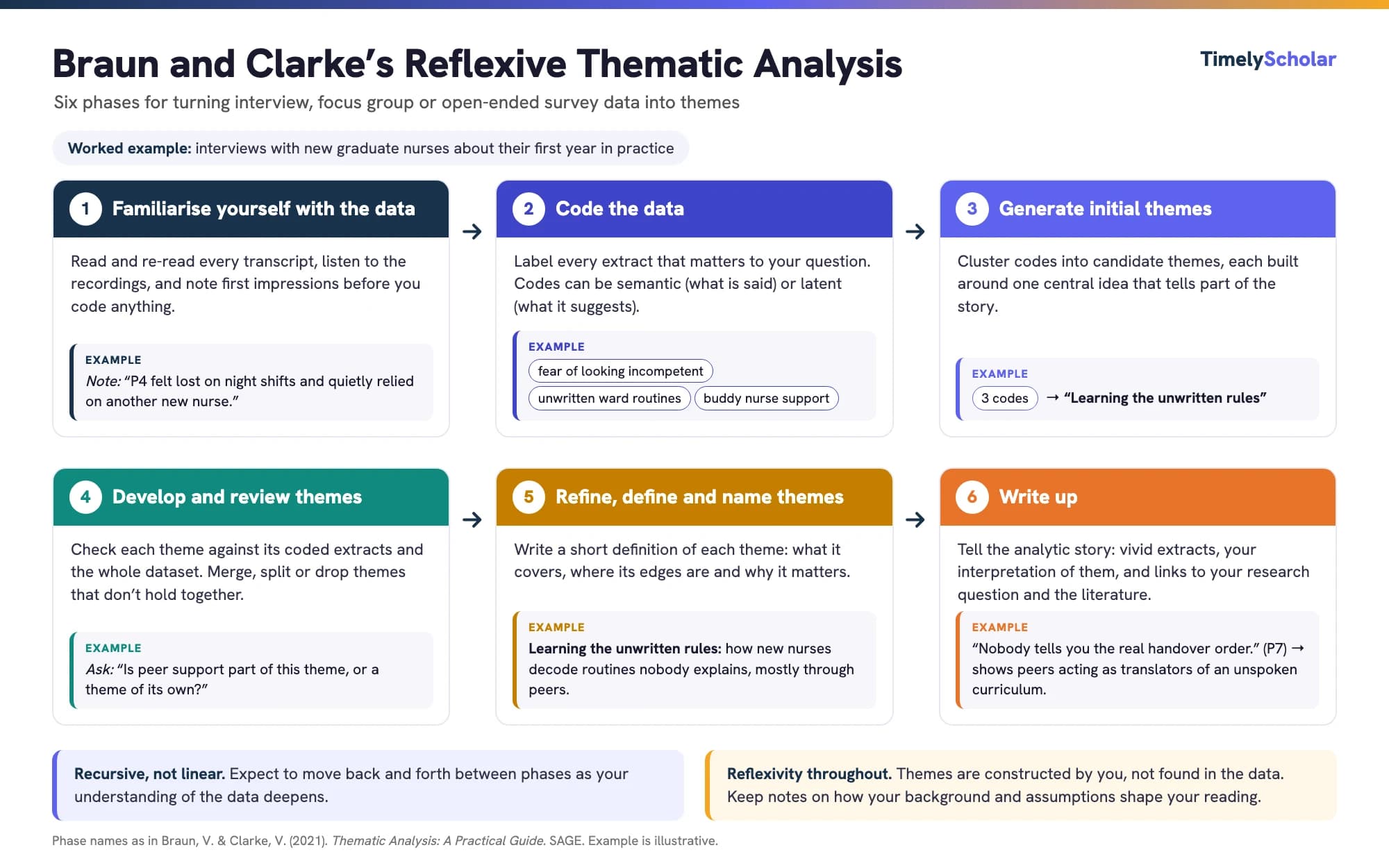
Thematic analysis is a method for finding, analysing and reporting patterns of meaning (themes) in qualitative data such as interviews, focus groups or open survey answers. Braun and Clarke's (2006) widely used approach has six phases: (1) familiarise yourself with the data; (2) generate codes; (3) generate initial themes; (4) develop and review themes; (5) refine, define and name themes; and (6) write up. The process is recursive: you move back and forth between phases rather than completing each once.
Combining numbers and interviews? Our specialists can help you analyse and integrate them. Get a free quote →
What is thematic analysis?
Thematic analysis (TA) is one of the most widely used methods in qualitative research across psychology, health, nursing, education, business and the social sciences. In their widely cited paper, Braun and Clarke (2006) described it as a method for identifying, analysing and reporting patterns within data, and argued that it should be recognised as a method in its own right.
Its appeal is flexibility. Thematic analysis is not tied to one theory, so it can be used with different research questions, data types and sample sizes, and it is accessible to researchers new to qualitative work. That flexibility is also a risk: without clear decisions about approach, TA can become a vague summary of what participants said. This guide explains the decisions and the six phases so your analysis is rigorous and defensible.
Types of thematic analysis: reflexive, codebook and coding reliability
Braun and Clarke (2021a) later emphasised that "thematic analysis" is really a family of methods with different assumptions. In that paper on quality practice they distinguish three broad types:
| Approach | Key features | Quality is judged by |
|---|---|---|
| Reflexive TA (Braun & Clarke, 2006, 2021a) | Coding is organic and open; themes are actively constructed by the researcher; researcher subjectivity is a resource | Depth, reflexivity, coherence and theoretical sophistication |
| Codebook TA (e.g. template or framework analysis) | A structured codebook or framework, often partly developed in advance; common in applied and team research | Transparent, systematic application of the framework |
| Coding reliability TA | Themes often defined early; several coders apply a fixed codebook; agreement is measured | Inter-rater reliability statistics such as Cohen's kappa |
Choose one and describe it clearly in your methods. A frequent criticism of published studies is that they cite Braun and Clarke's (2006, 2021a) reflexive approach while reporting inter-rater reliability or data saturation, concepts that come from different assumptions.
Decisions to make before you start
- Inductive or deductive? Inductive (bottom-up) analysis builds codes from the data; deductive (top-down) analysis uses existing theory or concepts to guide coding. Many analyses combine both.
- Semantic or latent? Semantic codes capture the explicit, surface meaning of what participants say; latent codes interpret underlying ideas, assumptions and meanings.
- Experiential or critical orientation? Are you trying to capture participants' own perspectives and experiences, or to interrogate how meaning is constructed through language and social context?
- Theoretical framework: state your assumptions about knowledge and reality (for example critical realist or constructionist), as they shape what counts as a theme.
Phase 1: Familiarise yourself with the data
Immerse yourself in the dataset. If you conducted the interviews, transcribing them yourself is an excellent start. Read and re-read every transcript, listen to recordings, and make brief notes of initial ideas, surprises and questions. You are not coding yet; you are getting to know the data as a whole.
Phase 2: Generate codes
A code is a short label that captures something interesting about a segment of data in relation to your research question. Work systematically through the whole dataset, giving full and equal attention to each item, and code for as many potential patterns as possible. One extract can have several codes.
Extract: "By the end of a night shift I'm running on autopilot. I double-check everything now because I don't trust my own brain at 5 a.m."
Semantic codes: fatigue on night shift; double-checking work.
Latent codes: self-monitoring as a safety strategy; loss of trust in own judgement.
Codes should be concise but meaningful on their own. "Tired" is less useful than "fatigue undermining confidence in decisions". Collate all extracts for each code as you go.
Phase 3: Generate initial themes
A theme captures a broader pattern of shared meaning, organised around a central idea or concept, that tells you something important about the data in relation to your question. Group related codes into candidate themes and sub-themes, and collate the relevant extracts.
Braun and Clarke (2021a) stress that themes do not simply "emerge" from data; the researcher actively constructs them. A common weakness is presenting "topic summaries" as themes, for example a theme called "Night shifts" that lists everything participants said about night shifts. A true theme has a central organising concept, such as "Working against the body clock: managing risk when tired".
Worked example: from codes to a theme
Here is how several codes from different participants in the night-shift study might come together into one candidate theme. For a full published walk-through of all six phases on real interview data, see Byrne (2022).
| Code | Participants | Example extract |
|---|---|---|
| Double-checking work | P2, P4, P7, P9 | "I double-check everything now." |
| Loss of trust in own judgement | P4, P6 | "I don't trust my own brain at 5 a.m." |
| Asking a colleague to verify | P1, P7, P10 | "I'll get someone to look over the drip rate with me." |
| Avoiding complex tasks late in the shift | P3, P9 | "I try to do the hard stuff before 3." |
Each code on its own is descriptive. Together they point to a shared central idea: nurses actively manage the risk created by their own fatigue. That central organising concept becomes the theme, "Self-monitoring as a safety strategy". Notice that not every participant needs to contribute to every theme; what matters is that the pattern is meaningful for the research question, not how often it occurs.
Phase 4: Develop and review themes
Check your candidate themes at two levels:
- Against the coded extracts: do the extracts in each theme form a coherent pattern? If not, rework the theme, move extracts, or discard it.
- Against the whole dataset: does the set of themes capture the most important and relevant patterns across the data, in relation to your question?
Themes may be merged, split, renamed or dropped. It is normal to go back to earlier phases, recoding data as your understanding deepens.
Phase 5: Refine, define and name themes
Write a short definition for each theme: what it is about, its central organising concept, its boundaries, and how it relates to the other themes and to your question. If you cannot describe a theme in a couple of sentences, it probably needs more work.
Names should be concise, informative and ideally engaging; a short participant quotation can make a memorable theme name, as long as it captures the theme's meaning.
Theme 1: "I don't trust my own brain": self-monitoring as a safety strategy
Theme 2: Invisible costs: the effect of night work on family life
Theme 3: Support that fits the shift: what helps and what doesn't
Phase 6: Write up
The write-up tells the analytic story of your data. For each theme, present a clear argument, supported by well-chosen extracts, and interpret what they mean; do not just paraphrase quotes. Extracts illustrate your analysis; they are not the analysis.
- Start the results with an overview of themes, often in a table or thematic map.
- Use extracts from a range of participants, with identifiers (for example P4, ICU nurse, 12 years' experience).
- Balance description and interpretation: say what the pattern is, why it matters, and how it connects to your question and the literature.
- In the methods, describe your approach (type of TA, orientation, inductive or deductive, semantic or latent), the phases, and how you addressed reflexivity.
How to ensure quality and trustworthiness
Quality criteria depend on which type of TA you use. For reflexive TA, Braun and Clarke (2021a) emphasise reflexivity, thorough engagement with the data, and a coherent fit between theory, method and analysis. They have also argued that data saturation is not a coherent concept for reflexive TA (Braun & Clarke, 2021b), and that sample-size decisions should instead be justified by the richness of the data and the aims of the study.
Nowell et al. (2017) show how Lincoln and Guba's (1985, as cited in Nowell et al., 2017) trustworthiness criteria (credibility, transferability, dependability and confirmability) can be applied to each phase of thematic analysis, for example through prolonged engagement with the data, an audit trail of coding decisions, peer debriefing and thick description.
If you are using coding reliability TA, you can calculate agreement between coders with our Cohen's kappa calculator. Do not report kappa for reflexive TA, where different coders are expected to bring different insights.
Software for thematic analysis
You can do thematic analysis with paper and highlighters, a word processor, or a spreadsheet. Qualitative data analysis software such as NVivo, ATLAS.ti or MAXQDA, or the free, open-source Taguette, makes it easier to manage large datasets, retrieve coded extracts and keep an audit trail. Software organises your data; it does not do the analysis, and none of these tools can generate meaningful themes for you.
Thematic analysis vs other qualitative methods
| Method | Focus | Choose it when |
|---|---|---|
| Thematic analysis | Patterns of meaning across a dataset | You want a flexible, accessible method not tied to one theory |
| Interpretative phenomenological analysis (IPA) | In-depth individual lived experience | Small, homogeneous samples and an idiographic focus |
| Grounded theory | Developing a theory from data | You aim to build an explanatory theory, with theoretical sampling |
| Qualitative content analysis | Systematic categorisation, sometimes with counts | You need a more descriptive, structured approach |
| Discourse analysis | How language constructs meaning and power | Your question is about language itself |
When qualitative themes are combined with quantitative results in one study, you are doing mixed methods research; see our guide to mixed methods research design for how to integrate the two.
Common thematic analysis mistakes
- Using interview questions as themes.
- Presenting topic summaries rather than themes with a central organising concept.
- Too many themes (a dozen or more) with thin evidence for each.
- Quotes with little or no interpretation.
- Mixing incompatible quality practices, such as reflexive TA with inter-rater reliability.
- Claiming themes "emerged" without describing how you constructed them.
- No statement of theoretical assumptions or the type of TA used.
Getting help with your qualitative analysis
Qualitative analysis is time-consuming and easy to second-guess. Our mixed methods and qualitative analysis service can review your coding, help develop and define themes, or write up the methods and results with a clear audit trail, while the interpretation stays yours.
Frequently asked questions
What are the six phases of thematic analysis?
Familiarise yourself with the data, generate codes, generate initial themes, develop and review themes, refine, define and name themes, and write up. Braun and Clarke (2006) describe the process as recursive rather than linear.
What is the difference between a code and a theme?
A code labels a single interesting feature of the data. A theme is a broader pattern of shared meaning, built from several codes and organised around a central concept.
Is thematic analysis inductive or deductive?
It can be either, or both. Inductive analysis builds codes from the data; deductive analysis is guided by existing theory or concepts.
How many participants do I need for thematic analysis?
There is no fixed number. Justify sample size by the richness of your data, the aims of your study and your approach, rather than relying on saturation, which Braun and Clarke (2021b) argue does not fit reflexive TA.
How many themes should I have?
There is no fixed rule. Aim for a small number of well-developed themes that answer your research question; a long list of thin themes usually means codes are being presented as themes.
Should I calculate inter-rater reliability in thematic analysis?
Only in coding reliability approaches. In reflexive thematic analysis, coding reflects the researcher's interpretation, so agreement statistics are not appropriate.
Can I use NVivo for thematic analysis?
Yes. NVivo, ATLAS.ti, MAXQDA and the free Taguette help you organise and retrieve coded data, but you still do the analysis and theme development yourself.
Sources
- Braun V, Clarke V. Using thematic analysis in psychology. Qual Res Psychol 2006;3:77-101
- Braun V, Clarke V. One size fits all? What counts as quality practice in (reflexive) thematic analysis? Qual Res Psychol 2021a;18:328-352
- Braun V, Clarke V. To saturate or not to saturate? Questioning data saturation as a useful concept for thematic analysis and sample-size rationales. Qual Res Sport Exerc Health 2021b;13(2):201-216
- Nowell LS, Norris JM, White DE, Moules NJ. Thematic analysis: striving to meet the trustworthiness criteria. Int J Qual Methods 2017;16(1)
- Byrne D. A worked example of Braun and Clarke's approach to reflexive thematic analysis. Qual Quant 2022;56:1391-1412