
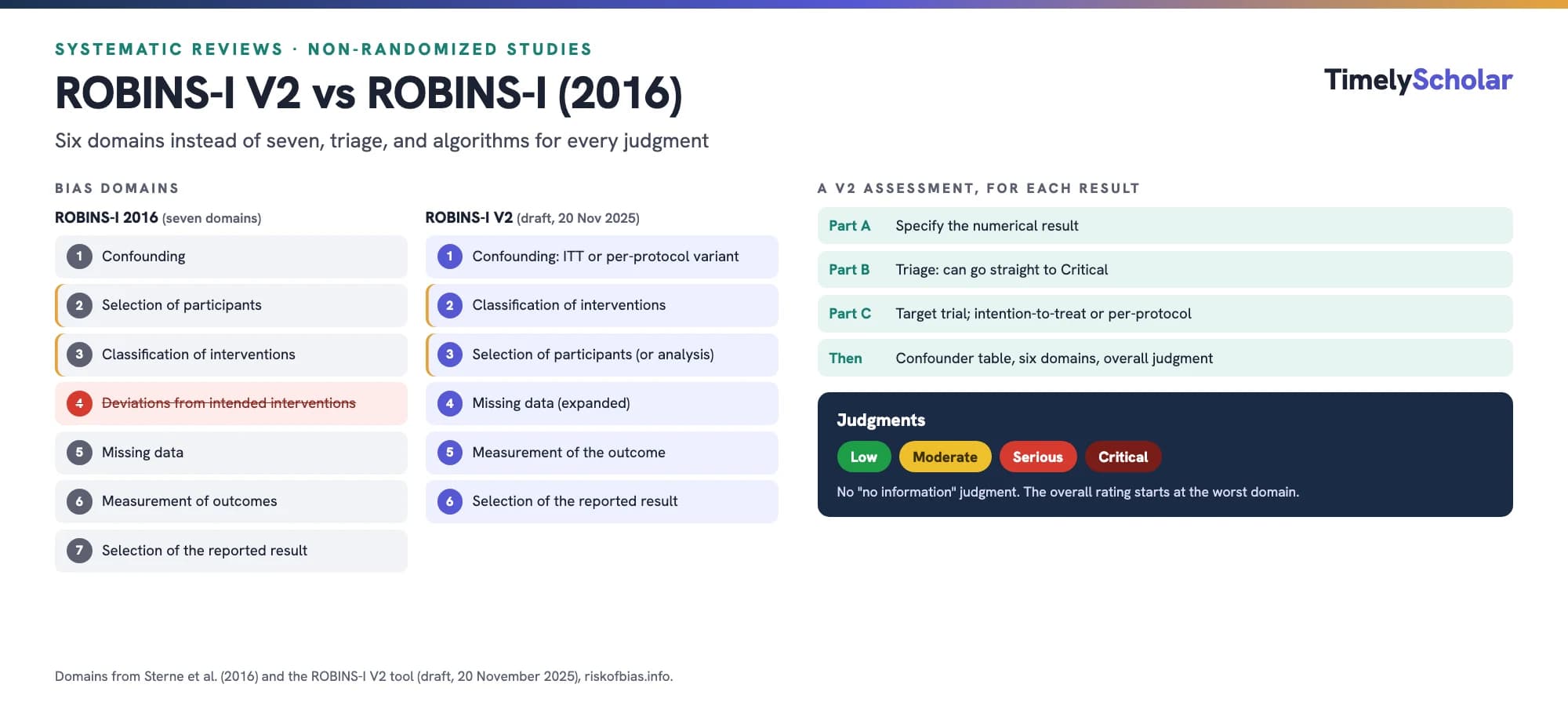
ROBINS-I V2 is the revised version of ROBINS-I, the tool for assessing risk of bias in a specific result from a non-randomized study of interventions, such as a cohort study. The current version, posted on 20 November 2025, is still labeled a draft that may change [1]. Compared with the 2016 tool [2], V2 has six domains instead of seven: it drops the domain on deviations from intended interventions and handles the per-protocol effect inside the confounding domain, which now has an intention-to-treat and a per-protocol variant. It adds algorithms that turn answers into proposed judgments, strong and weak yes and no answers, and a triage section that can rate a result as critical straight away. Judgments are low, moderate, serious, or critical risk of bias. Use the version your protocol names, and cite it.
Working on a systematic review? A PhD-led reviewer can help at any stage. Get a free quote →
What is ROBINS-I V2?
ROBINS-I stands for Risk Of Bias In Non-randomized Studies – of Interventions. It assesses the risk of bias in a specific result from an individual non-randomized study that examines the effect of an intervention on an outcome [1]. The current V2 document covers follow-up (cohort) studies [1].
The original tool was published in 2016 after about three years of development, largely by expert consensus, and treats each study as an attempt to emulate a hypothetical pragmatic randomized trial, the target trial [2]. The Cochrane Handbook recommends ROBINS-I for non-randomized studies of interventions in Cochrane reviews, and noted that a new version with variants for different study designs was being prepared [3].
That revision is ROBINS-I V2. A first V2 draft was posted in November 2024 and is now archived; the current, revised version was posted on 20 November 2025. The developers describe it as a draft that is subject to change and say further refinements are likely. The development group was led by Jonathan Sterne and Julian Higgins and involved members of the Cochrane Bias Methods Group and the Cochrane Non-Randomised Studies Methods Group [1].
Free ROBINS-I V2 tool: Record your V2 judgments for each result, get the overall rating suggested by the V2 algorithm, and download traffic light and summary plots with our free ROBINS-I V2 tool. If your protocol names the original tool, use our ROBINS-I (2016) tool.
What changed from ROBINS-I (2016) to ROBINS-I V2?
The developers list the key changes on the V2 page [1]. The table sets them against the 2016 tool [2,3].
ROBINS-I (2016) vs ROBINS-I V2 (draft, 20 November 2025)
| Feature | ROBINS-I (2016) | ROBINS-I V2 |
|---|---|---|
| Number of domains | Seven | Six |
| Deviations from intended interventions | Its own domain | Dropped as a domain; deviations are handled in the per-protocol variant of the confounding domain |
| Confounding | One domain; confounders and co-interventions listed in the protocol | Two variants: intention-to-treat (baseline confounding) and per-protocol (baseline and time-varying confounding); an improved confounder table; pre-specifying co-interventions dropped |
| Signaling question answers | Yes, probably yes, probably no, no, no information | The same five, plus strong and weak versions of yes or no for some questions |
| From answers to judgments | Signaling questions guide each domain judgment | Algorithms (flowcharts) map answers onto proposed judgments, which can be overridden with a justification |
| Triage | None | Part B can rate a result as critical risk of bias before the domains are assessed |
| Judgments | Low, moderate, serious, critical, or no information | Low, moderate, serious, or critical; the best confounding judgment is low except for concerns about uncontrolled confounding |
| Immortal time questions | — | New questions added to the classification and selection domains |
| Missing data | Domain 5 | Domain 4, reconceived and much expanded |
| Selection of the reported result | Domain 7 | Domain 6, with a new question on a pre-determined analysis plan |
The domain numbers changed too: classification of interventions moved from domain 3 to domain 2, and selection of participants moved from domain 2 to domain 3 [1]. The six-domain structure is new in the November 2025 revision. The archived November 2024 draft still had a domain on deviations from intended interventions, so check which draft any published V2 assessment used [1].
How is ROBINS-I V2 structured?
A V2 assessment has a planning stage for the whole review, then several parts for each result you assess [1]:
Planning (once per review): list the important confounding factors relevant to all or most studies on the topic, ideally in the review protocol [1]. The Cochrane Handbook gives the same advice for the 2016 tool [3].
Part A, specify the result: the numerical result being assessed, for example, a risk ratio with its confidence interval, or a reference to the table or figure it comes from. Each assessment covers one result, so one study may need several [1].
Part B, triage: B1 asks whether the authors made any attempt to control for confounding. If they didn't, B2 asks whether the potential for confounding is so large that the result should not be considered further. B3 asks whether the method of measuring the outcome was inappropriate. A yes or probably yes to B2 or B3 means the result is at critical risk of bias and no further assessment is needed [1].
Part C, specify the target trial: the eligible participants, the intervention strategy, and the comparator strategy (C1 to C3). Question C4 asks whether the analysis accounted for switches between strategies or other protocol deviations during follow-up: no means the result estimates the intention-to-treat effect, and yes means the per-protocol effect [1].
Part D, information sources: base the assessment on the maximum possible amount of available information, not only the published article [1].
Confounding factors table: for each pre-specified and study-specific confounder, record whether it was controlled for and measured validly and reliably, with an optional predicted direction of bias [1].
The six bias domains, then an overall judgment.
The target trial is the hypothetical randomized trial whose results would be the same as those of the non-randomized study, apart from sampling variation, if there were no bias. Because it is hypothetical, it does not have to be ethical or feasible. Differences between a study's target trial and your review question are a matter of heterogeneity or generalizability, not risk of bias [1]. The TARGET reporting statement describes how studies emulating a target trial should report it [4,5].
V2 asks all assessors to agree on the preliminary considerations together before each one works independently through the confounding factors and the bias domains [1].
What are the six ROBINS-I V2 domains?
Domain 1: Risk of bias due to confounding
ROBINS-I addresses two types of confounding: baseline and time-varying [1]. Which variant you use depends on question C4:
Variant A (intention-to-treat effect): only baseline confounding needs to be addressed. Questions ask whether the analysis controlled for the important confounders, whether they were measured validly and reliably, whether the analysis adjusted for variables measured after the intervention started that could have been affected by it, and whether negative controls, quantitative bias analysis, or other considerations suggest serious uncontrolled confounding [1].
Variant B (per-protocol effect): both baseline and time-varying confounding need to be addressed, and the analysis should use specialized methods, called g-methods, such as inverse probability weighting, because standard regression with time-varying confounders is likely to be biased [1].
Because uncontrolled confounding can never be ruled out in an observational study, the best judgment for this domain is low risk of bias except for concerns about uncontrolled confounding [1].
Domain 2: Risk of bias in classification of interventions
The first three questions address immortal time, a form of misclassification. Question 2.1 asks whether the intervention strategies were distinguishable at the time follow-up would have started in the target trial; methods such as clone-censor-weighting and the g-formula can overcome this problem. Later questions ask whether classification could have been influenced by knowledge of the outcome (differential misclassification) and whether there were further classification errors (non-differential misclassification) [1].
Domain 3: Risk of bias in selection of participants into the study (or into the analysis)
Selection bias here arises from conditioning on a common effect of the intervention and the outcome. The domain has three parts: questions on prevalent user bias and immortal time, starting with whether follow-up began at the start of the intervention strategies being compared (question 3.1); questions on other types of selection bias; and questions on the analysis and severity [1].
Domain 4: Risk of bias due to missing data
This domain was reconceived and much expanded in V2. It covers missing data on the intervention, the outcome, and the confounders, and its questions follow different pathways for complete case analyses, imputation, and other methods. No single threshold for an acceptable proportion of missing data can be defined. Multiple imputation is valid when data are missing completely at random or at random, but not when they are missing not at random, and simple methods such as last observation carried forward or mean imputation are answered with a strong or weak no [1].
Domain 5: Risk of bias in measurement of the outcome
Questions ask whether outcome measurement could have differed between groups and whether knowledge of the intervention received could have influenced the assessment. When participants report their own outcomes, they are the outcome assessors, so the question on awareness of the intervention will usually be answered yes [1].
Domain 6: Risk of bias in selection of the reported result
V2 adds a first question: was the result reported in accordance with an available, pre-determined analysis plan? Such plans are rarely public for non-randomized studies, so a low risk-of-bias judgment is unlikely here. Further questions ask whether the result was selected, based on the results, from multiple outcome measurements, multiple analyses, or multiple subgroups [1].
How do ROBINS-I V2 judgments and the overall rating work?
Each domain is judged at one of four levels. Risk of bias here means material bias: bias large enough to cause an important change in the estimated effect [1].
ROBINS-I V2 judgment levels (from the ROBINS-I V2 tool document [1])
| Judgment | Meaning for a domain | Overall rule |
|---|---|---|
| Low | Little or no concern about bias | Low except for concerns about uncontrolled confounding in domain 1, and low in all other domains |
| Moderate | Some concern, although it is not clear there is an important risk of bias | At least one domain moderate, none serious or critical |
| Serious | The study has some important problems in this domain | At least one domain is serious, and none is critical, or several domains are moderate, adding up to serious |
| Critical | The study is very problematic; the result should generally be excluded from evidence syntheses | At least one domain critical, or several domains serious, adding up to critical |
By default, the overall risk of bias equals the judgment for the domain with the greatest risk of bias [1]. You can raise it when problems in several domains are likely to compound. The judgments proposed by the algorithms can also be overridden if you give a justification: the developers aim for transparency and reasonableness rather than mechanistic adherence to every word of the tool. You may also predict the direction of bias for each domain, which is optional [1].
Unlike the 2016 tool [2], V2 has no "no information" judgment. "No information" is now only an answer to signaling questions, and the algorithms decide what it implies for the domain [1].
How to use ROBINS-I V2 step by step
Name the version in your protocol (V2, 20 November 2025, or the 2016 tool) and list the important confounding factors for your topic [1,3].
Build the right team. Applying ROBINS-I needs both subject-matter and epidemiological methods expertise [2,3].
Calibrate before you start. Rate a few studies together and discuss differences; calibration exercises and training are recommended before using the tool [6]. Customized guidance and training have been shown to improve agreement and reduce the time each assessment takes [7].
For each result: agree parts A to D as a team, run the triage, specify the target trial and the effect of interest, and fill in the confounding factors table [1].
Work through the six domains independently, in duplicate, using the official document's signaling questions and algorithms, and record a justification for every judgment.
Resolve disagreements by discussion or with a third reviewer, then agree on the overall judgment.
Report the assessment per result, not only per study, with the reasons for each judgment in a supplementary table.
How reliable is ROBINS-I, and how is it misapplied?
The published evidence so far concerns the 2016 tool; no evaluation of V2 had been published at the time of writing. It shows that ROBINS-I is demanding:
When five raters applied ROBINS-I to 31 cohort studies, agreement on the overall judgment was slight (inter-rater reliability 0.06), and each assessment took 27.8 minutes on average. The authors recommend calibration exercises and intensive training [6].
In a six-center study, agreement on the overall judgment was poor, and applying the tool and reaching consensus took about 48 minutes per study [8]. Customized guidance and training then improved agreement significantly and reduced the time needed [7].
Among 124 systematic reviews that used ROBINS-I, 20% modified the rating scale, 20% understated the overall risk of bias, and 19% included studies at critical risk of bias in their synthesis. Reviews of lower methodological quality were more likely to report low or moderate risk of bias [9].
Of 492 reviews that used ROBINS-I, found in a January 2023 search of the previous six months, only one met all expectations of the ROBINS-I guidance. Only 1% reported specifying a target trial, 20% listed important confounding factors, and 12% reported results at the outcome level [10].
Several of these problems involve steps the tool asks for: the target trial, the list of confounders, and result-level assessment. V2 makes those steps more explicit, but they still take time and expertise.
Should you use ROBINS-I V2 or the 2016 version?
Follow your protocol. If your registered protocol names ROBINS-I (2016), keep using it for every study, and say so in your methods.
Use one version throughout a review. Mixing versions makes the judgments impossible to compare.
For a new review, V2 is the current version on riskofbias.info, but it is still a draft and refinements are likely [1]. If you choose it, name the 20 November 2025 version, and check before you submit whether a newer one has been posted.
Check what your journal or supervisor expects. The Cochrane Handbook chapter on non-randomized studies still describes the 2016 tool [3].
ROBINS-I vs ROBINS-E, RoB 2, and QUIPS
Choosing a risk-of-bias tool by the review question
| Tool | Use it for | Judgments |
|---|---|---|
| ROBINS-I (2016 or V2) | The effect of an intervention, estimated in a non-randomized study | Low, moderate, serious, critical |
| ROBINS-E (2024) | The causal effect of an exposure, estimated in a cohort study | Low, some concerns, high, very high |
| RoB 2 | The effect of an intervention, estimated in a randomized trial | Low, some concerns, high [11] |
| QUIPS | Whether a prognostic factor is associated with a later outcome | Low, moderate, high |
ROBINS-E is built on ROBINS-I and RoB 2 to assess the effects of exposures rather than deliberate interventions. It has seven domains, including measurement of the exposure and post-exposure interventions, its own judgment levels, and a screening step that can rate a result as very high risk of bias straight away [12]. For prognostic factor reviews, see our QUIPS guide. Our free ROBINS-E and RoB 2 tools record judgments for the others.
How does ROBINS-I feed into GRADE?
Under the traditional GRADE approach, evidence from observational studies starts at low certainty. GRADE guidance 18 says that when ROBINS-I is used, a body of non-randomized evidence instead starts at high certainty, because confounding and selection bias are assessed within the tool, and is then rated down for risk of bias as needed. Reviewers applying ROBINS-I to conventional non-randomized studies will often reach high risk of bias, and the final certainty should be the same whichever starting point is used [13]. This applies only when ROBINS-I is the tool used [13].
Our GRADE evidence rating tool helps you record those judgments, and our guide to how to do a systematic review covers where risk of bias fits in the whole process.
How do you present ROBINS-I V2 results?
Report a table with one row per result and a column per domain, with the reasons in a supplementary file, plus a traffic light plot and a summary bar chart by domain. The official team no longer supports robvis or Excel implementations, and an online V2 implementation with automatic question routing and algorithm-derived judgments is being developed [1]. The robvis package draws figures formatted for the tool you used [14]; at the time of writing, its ROBINS-I template follows the 2016 domains, and it lists no V2 template [15], so V2 users either use its generic template or a tool built for V2, such as our ROBINS-I V2 tool.
Then use the judgments. Results at critical risk of bias should generally be excluded from evidence syntheses [1]. Consider a sensitivity analysis that excludes results at serious risk of bias, check the influence of single studies with our leave-one-out sensitivity analysis tool, and carry the judgments into GRADE.
ROBINS-I V2 template and how to cite it
riskofbias.info provides the full V2 document as a PDF and an editable template for answering the signaling questions. The tool is licensed under a Creative Commons Attribution-NonCommercial-NoDerivatives 4.0 license [1]. Our ROBINS-I V2 tool imports and exports your judgments as a CSV file that opens in Excel.
V2 is published as a tool document on riskofbias.info rather than as a journal article, and the page gives no citation format. Cite the document with its full title and date (20 November 2025), say that it is a draft, and cite Sterne et al. (2016) for the original tool [1,2]. Being a draft, the November 2025 document still contains a few leftover numbering slips; for example, the Domain 3 guidance refers to missing data as Domain 5, which is Domain 4 in V2.
Common ROBINS-I mistakes (and how to avoid them)
Assessing the study instead of the result. ROBINS-I judges one result at a time; report per outcome [10].
Skipping the target trial and the confounder list [10].
Changing the rating scale instead of using the four ROBINS-I levels [9].
Understating the overall judgment instead of letting the worst domain drive it [9].
Including results at critical risk of bias in the meta-analysis [9].
Mixing the 2016 tool and V2, or the November 2024 and November 2025 drafts, in one review.
Using the wrong confounding variant: if the analysis accounted for switches or other protocol deviations, it estimates the per-protocol effect (Variant B).
Using ROBINS-I for exposures rather than interventions, where ROBINS-E fits [12].
Giving no reasons for judgments, so readers can't follow them [10].
Getting help with ROBINS-I in your review
If you would like a second, independent ROBINS-I assessor, help specifying target trials and confounders for your protocol, or support with grading the evidence and writing up the results, see our systematic review service. Our PhD-led reviewers work alongside you, and you keep ownership of your question and conclusions.
Frequently asked questions
What is ROBINS-I V2?
ROBINS-I V2 is the revised version of ROBINS-I, the tool for assessing risk of bias in a specific result from a non-randomized study of interventions. The current version, for follow-up (cohort) studies, was posted on riskofbias.info on 20 November 2025 and is still labeled as a draft.
What changed in ROBINS-I V2?
V2 has six domains instead of seven, dropping deviations from intended interventions; splits the confounding domain into intention-to-treat and per-protocol variants; adds algorithms that propose judgments, strong and weak yes-or-no answers, and a triage section that can rate a result as critical; and drops the 'no information' judgment.
What are the six domains of ROBINS-I V2?
Confounding; classification of interventions; selection of participants into the study (or into the analysis); missing data; measurement of the outcome; and selection of the reported result.
Is ROBINS-I V2 final?
No. The riskofbias.info page describes the 20 November 2025 version as a draft that is subject to change and says further refinements are likely.
Should I use ROBINS-I V2 or the 2016 version?
Use the version your protocol specifies and apply it to every study in the review. For a new review, V2 is the current version but is still a draft, so name the version and date you used.
What are the ROBINS-I V2 judgments?
Low, moderate, serious, or critical risk of bias. For confounding, the best judgment is low, except when there are concerns about uncontrolled confounding. The overall judgment defaults to the worst domain and can be raised when several domains have problems.
What is the triage section in ROBINS-I V2?
Part B. If the authors made no attempt to control confounding and the potential for confounding is too large, or if the outcome was measured inappropriately, the result is at critical risk of bias, and no further assessment is needed.
How do I cite ROBINS-I V2?
Cite the tool document from riskofbias.info with its full title and the date 20 November 2025, noting that it is a draft, and cite Sterne et al. (2016) for the original ROBINS-I.
What is the difference between ROBINS-I and ROBINS-E?
ROBINS-I assesses studies of interventions. ROBINS-E assesses cohort studies of the causal effect of exposures rather than deliberate interventions, and uses different judgment levels: low, some concerns, high, and very high.
References
- ROBINS-I V2 Development Group. The risk of bias in non-randomized studies – of interventions, version 2 (ROBINS-I V2) assessment tool (for follow-up studies) [Internet]. riskofbias.info; 2025 Nov 20 [cited 2026 Nov 14]. Available from: https://www.riskofbias.info/welcome/robins-i-v2
- Sterne JAC, Hernán MA, Reeves BC, Savović J, Berkman ND, Viswanathan M, et al. ROBINS-I: a tool for assessing risk of bias in non-randomised studies of interventions. BMJ. 2016;355:i4919. doi:10.1136/bmj.i4919
- Sterne JAC, Hernán MA, McAleenan A, Reeves BC, Higgins JPT. Chapter 25: assessing risk of bias in a non-randomized study (last updated October 2019). In: Higgins JPT, Thomas J, Chandler J, Cumpston M, Li T, Page MJ, et al, editors. Cochrane handbook for systematic reviews of interventions. Version 6.5. Cochrane; 2024 [cited 2026 Nov 14]. Available from: https://training.cochrane.org/handbook/current/chapter-25
- Cashin AG, Hansford HJ, Hernán MA, Swanson SA, Lee H, Jones MD, et al. Transparent reporting of observational studies emulating a target trial: the TARGET statement. BMJ. 2025;390:e087179. doi:10.1136/bmj-2025-087179
- Hernán MA, Dahabreh IJ, Dickerman BA, Swanson SA. The target trial framework for causal inference from observational data: why and when is it helpful? Ann Intern Med. 2025;178(3):402-7. doi:10.7326/ANNALS-24-01871
- Minozzi S, Cinquini M, Gianola S, Castellini G, Gerardi C, Banzi R. Risk of bias in nonrandomized studies of interventions showed low inter-rater reliability and challenges in its application. J Clin Epidemiol. 2019;112:28-35. doi:10.1016/j.jclinepi.2019.04.001
- Jeyaraman MM, Robson RC, Copstein L, Al-Yousif N, Pollock M, Xia J, et al. Customized guidance/training improved the psychometric properties of methodologically rigorous risk of bias instruments for non-randomized studies. J Clin Epidemiol. 2021;136:157-67. doi:10.1016/j.jclinepi.2021.04.017
- Jeyaraman MM, Rabbani R, Copstein L, Robson RC, Al-Yousif N, Pollock M, et al. Methodologically rigorous risk of bias tools for nonrandomized studies had low reliability and high evaluator burden. J Clin Epidemiol. 2020;128:140-7. doi:10.1016/j.jclinepi.2020.09.033
- Igelström E, Campbell M, Craig P, Katikireddi SV. Cochrane's risk of bias tool for non-randomized studies (ROBINS-I) is frequently misapplied: a methodological systematic review. J Clin Epidemiol. 2021;140:22-32. doi:10.1016/j.jclinepi.2021.08.022
- Iheozor-Ejiofor Z, Savović J, Bowater RJ, Higgins JPT. The application of ROBINS-I guidance in systematic reviews of non-randomised studies: a descriptive study. Res Synth Methods. 2026;17(2):265-76. doi:10.1017/rsm.2025.10048
- Sterne JAC, Savović J, Page MJ, Elbers RG, Blencowe NS, Boutron I, et al. RoB 2: a revised tool for assessing risk of bias in randomised trials. BMJ. 2019;366:l4898. doi:10.1136/bmj.l4898
- Higgins JPT, Morgan RL, Rooney AA, Taylor KW, Thayer KA, Silva RA, et al. A tool to assess risk of bias in non-randomized follow-up studies of exposure effects (ROBINS-E). Environ Int. 2024;186:108602. doi:10.1016/j.envint.2024.108602
- Schünemann HJ, Cuello C, Akl EA, Mustafa RA, Meerpohl JJ, Thayer K, et al. GRADE guidelines: 18. How ROBINS-I and other tools to assess risk of bias in nonrandomized studies should be used to rate the certainty of a body of evidence. J Clin Epidemiol. 2019;111:105-14. doi:10.1016/j.jclinepi.2018.01.012
- McGuinness LA, Higgins JPT. Risk-of-bias VISualization (robvis): an R package and Shiny web app for visualizing risk-of-bias assessments. Res Synth Methods. 2021;12(1):55-61. doi:10.1002/jrsm.1411
- McGuinness LA. robvis: a package to quickly visualise risk-of-bias assessment results [Internet]. GitHub; 2026 [cited 2026 Nov 14]. Available from: https://github.com/mcguinlu/robvis

Emily brings 12 years of experience in higher education. She provides senior-level oversight for complex research projects, helping teams clarify scope, align research questions with methods, and strengthen the logic and reporting of their work. Areas of expertise Oversight of institutional research and research…