
To do a scoping review, follow the Arksey and O'Malley (2005) framework as refined by Levac et al. (2010) and JBI (Peters et al., 2020): (1) define a broad question with PCC (Population, Concept, Context), (2) write a protocol, (3) search comprehensively, including grey literature, (4) select sources with two reviewers and explicit criteria, (5) chart the data with a piloted form, (6) collate, summarise and report the results with the PRISMA-ScR checklist, and ideally (7) consult stakeholders.
Working on a scoping review? Our specialists follow JBI methods and PRISMA-ScR. Get a free quote →
What is a scoping review?
A scoping review is a type of evidence synthesis that maps the literature on a topic: how much research exists, what kinds of studies and sources there are, which populations, settings and methods they cover, and where the gaps lie. Rather than asking "does this intervention work?", it asks "what do we know about this, and how has it been studied?"
JBI's updated guidance (Peters et al., 2020) notes that scoping reviews can draw on evidence from any research methodology and may also include non-research sources, such as policy documents. That breadth makes them well suited to emerging or complex fields, and a useful first step before a systematic review.
Munn et al. (2018) identify four main reasons to choose a scoping review: to identify knowledge gaps, to scope a body of literature, to clarify concepts, and to investigate how research is conducted. If your question is about the effectiveness of an intervention, you need a systematic review instead; our comparison of systematic reviews vs scoping reviews explains the difference in detail.
Scoping review frameworks: Arksey and O'Malley, Levac and JBI
Three sources define modern scoping review methods, and most protocols cite all of them:
| Framework | What it contributes |
|---|---|
| Arksey and O'Malley (2005) | The first methodological framework, with five stages and an optional sixth: consultation. |
| Levac, Colquhoun and O'Brien (2010) | Recommendations that clarify each stage, including linking purpose and question, iterative team-based selection and charting, and making stakeholder consultation a required stage. |
| JBI (Peters et al., 2020) | Detailed guidance for conduct, the PCC mnemonic, and alignment with the PRISMA-ScR reporting checklist. |
The stages below follow the Arksey and O'Malley (2005) structure, with the refinements from Levac et al. (2010) and JBI (Peters et al., 2020) built in.
Stage 1: Identify the research question (PCC)
Scoping review questions are broader than systematic review questions, but they still need clear boundaries. JBI recommends the PCC mnemonic (Peters et al., 2020):
- Population: the people of interest, with relevant characteristics such as age or condition.
- Concept: the core idea you are mapping, such as an intervention, phenomenon or outcome.
- Context: the setting, such as geographic location, care setting or cultural factors.
Population: older adults living with dementia.
Concept: use of assistive technology for daily living.
Context: community and home settings.
Question: What is known about the use of assistive technology to support daily living for older adults with dementia in community settings?
Levac et al. (2010) recommend stating the purpose of the review alongside the question and linking them explicitly, so that it is clear what the mapping is for, whether that is informing policy, identifying research gaps or clarifying a concept.
Stage 2: Write and register a protocol
A protocol sets out your objectives, PCC question, eligibility criteria, search strategy, source selection process, charting approach and how you will present the results. Writing it first keeps the review transparent and reduces ad hoc decisions once you see the literature.
Scoping review protocols are commonly registered on the Open Science Framework (OSF) or published in journals such as JBI Evidence Synthesis. PROSPERO focuses on systematic reviews, so check its eligibility criteria before trying to register a scoping review there.
- State which framework you follow (for example JBI methodology informed by Arksey and O'Malley).
- Define inclusion criteria for each PCC element, plus types of sources, languages and dates.
- Describe how many reviewers will screen and chart data, and how you will resolve disagreements.
- Include a draft data charting form.
Stage 3: Identify relevant studies (the search)
Because scoping reviews aim for breadth, the search is usually wider than for a systematic review. The JBI Manual (Aromataris et al., 2024) describes a three-step search: an initial limited search of at least two appropriate databases to identify keywords and index terms; a full search using all identified terms across all included databases; and a search of the reference lists of included sources.
- Search subject databases relevant to your field, such as MEDLINE, CINAHL, Embase, PsycINFO, ERIC or Scopus.
- Include grey literature: government and organisation reports, theses, conference proceedings and trial registers.
- Combine controlled vocabulary with free-text terms for each concept, joined with OR within concepts and AND between them.
- Record every search with the date and number of results, and report full strategies (PRISMA-S offers a 16-item checklist for search reporting; Rethlefsen et al., 2021).
Levac et al. (2010) advise balancing breadth with feasibility. If a pilot search returns an unmanageable number of records, narrow the context or concept, and document the decision rather than silently dropping sources.
Stage 4: Select sources with explicit criteria
Remove duplicates, then screen titles and abstracts, followed by full texts, against your eligibility criteria. Levac et al. (2010) recommend an iterative team approach: at least two reviewers independently screen, meet early to discuss disagreements and uncertainty, and refine the criteria if needed, recording any changes.
- Pilot the criteria on a sample of records before full screening.
- Record the reason for every full-text exclusion.
- Keep counts at each stage for the PRISMA-ScR flow diagram.
Stage 5: Chart the data
In scoping reviews, data extraction is called charting. You record key information from each source in a standard form, typically: author, year and country; aims; population and sample; context; methods or source type; concept details (for example intervention type or definitions used); and key findings relevant to the question.
Draft the charting form in the protocol, pilot it on a few sources with two reviewers, and refine it. Charting is iterative: new categories may emerge as you read, and that is expected, but record what changed and why. For a full charting form template, piloting steps and examples of how to present the results, see our guide to data charting in a scoping review.
Stage 6: Collate, summarise and report the results
Scoping review results are descriptive. Levac et al. (2010) recommend combining a numerical summary (how many sources, of which types, from which countries, in which years) with a qualitative thematic analysis of the charted content, and then discussing the implications for policy, practice or research. More recent JBI guidance recommends frequency counts and, where needed, a descriptive basic qualitative content analysis rather than interpretive thematic synthesis (Pollock et al., 2023).
- Tables and charts of study characteristics (design, country, population, year).
- Evidence maps or heat maps showing where evidence is concentrated and where it is missing.
- A narrative summary organised by the concepts or categories in your question.
- Clear statements of gaps and recommendations for future research.
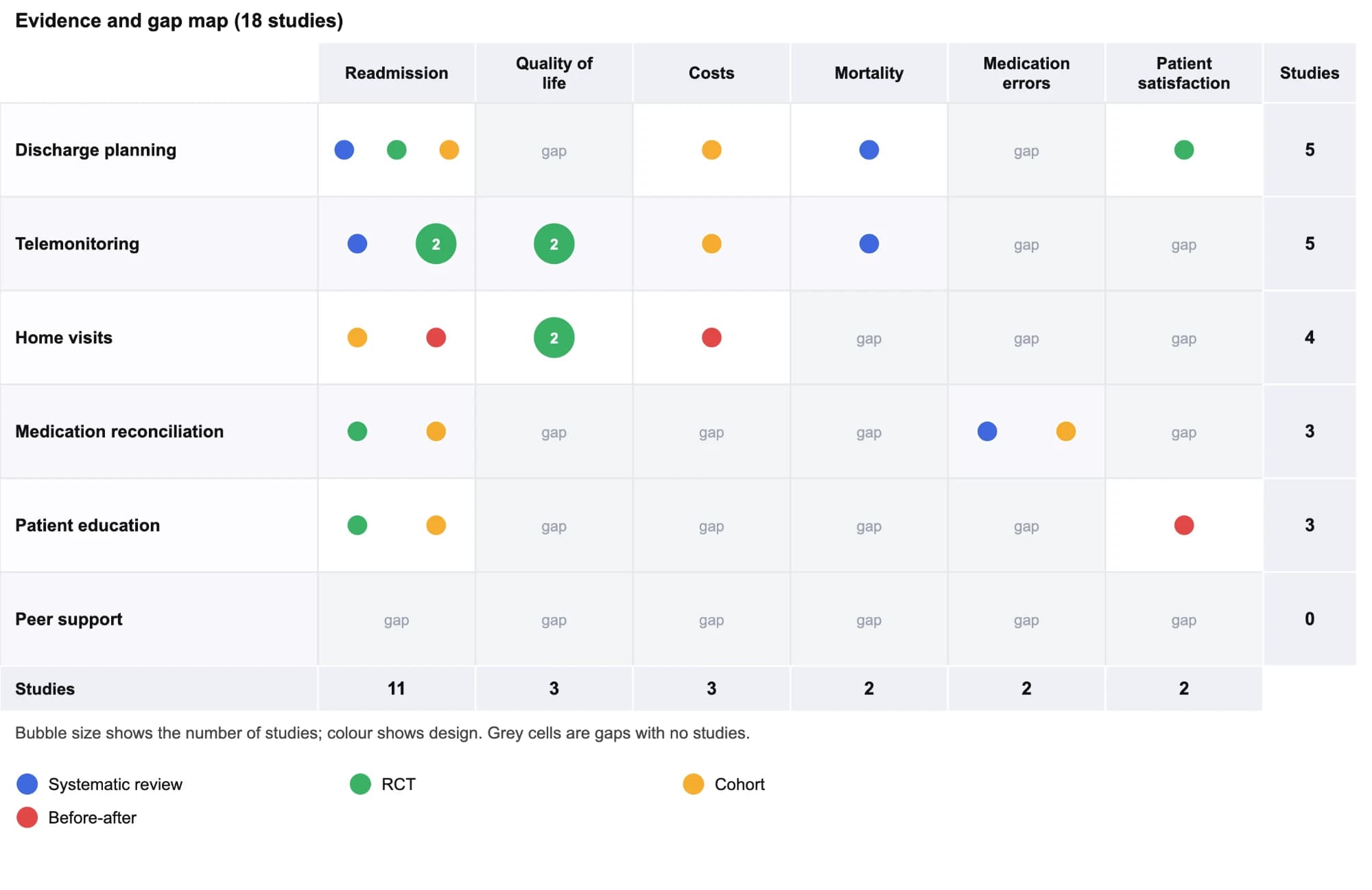
Avoid drawing conclusions about effectiveness. A scoping review can say that most studies of an intervention measured satisfaction and few measured clinical outcomes; it should not say the intervention works.
Stage 7 (recommended): Consult stakeholders
Arksey and O'Malley (2005) described consultation with stakeholders as an optional sixth stage. Levac et al. (2010) went further, recommending it as a required knowledge translation component. Consultation might involve sharing preliminary findings with clinicians, patients, policymakers or community members to check that the mapping makes sense, add sources you missed and shape recommendations.
If you include consultation, describe who was involved, how, and how their input changed the review.
Reporting with PRISMA-ScR
Report your scoping review using the PRISMA-ScR checklist (Tricco et al., 2018), developed by an expert panel following EQUATOR Network guidance. It contains 20 essential reporting items and 2 optional items, covering the title, rationale, objectives, protocol and registration, eligibility criteria, sources, search, selection, charting, results and limitations.
Worked example: from PCC question to evidence map
Here is how the stages fit together for the example question above, on assistive technology for older adults with dementia living in the community.
| Stage | What the team does |
|---|---|
| Question | Frames the PCC question and states the purpose: to inform a local service plan and identify research gaps. |
| Protocol | Registers the protocol on OSF, with eligibility criteria for each PCC element and a draft charting form. |
| Search | Runs a pilot search in MEDLINE and CINAHL, collects index terms such as dementia and self-help devices, then searches all planned databases plus government and charity reports. |
| Selection | Two reviewers screen 50 records together to calibrate, then screen independently, discussing disagreements weekly. |
| Charting | Records country, setting, type of technology, who used it (person or carer), outcomes measured and study design. |
| Results | Counts sources by technology type and design, maps technology against outcomes, and summarises themes such as acceptability and cost. |
| Consultation | Shares the draft map with carers and community nurses, who point to missing technology categories. |
Notice that the output describes what has been studied and how, for example that most studies are small and report acceptability rather than safety, instead of concluding which technology works best.
Scoping review protocol template: headings to include
Most published scoping review protocols follow a similar structure, aligned with JBI guidance (Peters et al., 2020) and PRISMA-ScR (Tricco et al., 2018). Use these headings as a starting point:
- Title identifying the work as a scoping review protocol.
- Introduction: background, why a scoping review is the right approach, and a check that no similar review already exists.
- Review question(s) and objectives, framed with PCC.
- Eligibility criteria: participants, concept, context and types of sources.
- Methods: framework followed, search strategy (with a full draft search for one database), information sources and planned grey literature.
- Source selection: software, number of reviewers, pilot testing and handling of disagreements.
- Data extraction (charting): the draft charting form and how it will be piloted and updated.
- Data analysis and presentation: planned tables, charts, maps and narrative summary.
- Consultation (if planned), funding and conflicts of interest.
If you are registering on OSF, attach the full protocol document so readers can compare it with the final report.
Common scoping review mistakes
- A question that is really about effectiveness. If you want to know whether something works, you need a systematic review.
- No protocol, or a protocol written after screening began.
- Too narrow a search, missing grey literature that is often central to scoping reviews.
- Single-reviewer screening without the iterative team approach Levac et al. (2010) recommend.
- Appraising quality and then excluding studies on that basis, which conflicts with the aim of mapping all the evidence.
- Results that only summarise studies one by one instead of mapping patterns and gaps.
- Reporting against PRISMA 2020 instead of PRISMA-ScR.
Getting help with your scoping review
Scoping reviews are often larger than expected: broad questions and grey literature can mean thousands of records to screen. If you need help with the search, second-reviewer screening, charting or the evidence map, our scoping review service follows JBI methodology and reports to PRISMA-ScR, and you keep ownership of the question and conclusions.
Frequently asked questions
What are the steps of a scoping review?
Identify the research question (PCC), write a protocol, search comprehensively, select sources with two reviewers, chart the data, and collate, summarise and report the results with PRISMA-ScR. Stakeholder consultation is recommended as a further stage.
What is the PCC framework?
PCC stands for Population, Concept and Context. JBI recommends it for framing scoping review questions (Peters et al., 2020), in place of the PICO framework used for effectiveness questions.
Do scoping reviews need two reviewers?
Yes, best practice is for at least two reviewers to screen and chart data, working iteratively and resolving disagreements, as recommended by Levac et al. (2010) and JBI (Peters et al., 2020).
Can I register a scoping review in PROSPERO?
PROSPERO focuses on systematic reviews, so check its eligibility criteria. Scoping review protocols are commonly registered on the Open Science Framework or published in journals such as JBI Evidence Synthesis.
Do scoping reviews assess study quality?
Quality appraisal is not usually required, because the aim is to map the evidence rather than judge effectiveness.
How many items does PRISMA-ScR have?
PRISMA-ScR has 20 essential reporting items and 2 optional items.
Sources
- Pollock D, Peters MDJ, Khalil H, et al. Recommendations for the extraction, analysis, and presentation of results in scoping reviews. JBI Evid Synth 2023;21(3):520-532
- Arksey H, O'Malley L. Scoping studies: towards a methodological framework. Int J Soc Res Methodol 2005;8:19-32
- Levac D, Colquhoun H, O'Brien KK. Scoping studies: advancing the methodology. Implement Sci 2010;5:69
- Peters MDJ, Marnie C, Tricco AC, et al. Updated methodological guidance for the conduct of scoping reviews. JBI Evid Synth 2020;18:2119-2126
- Aromataris E, Lockwood C, Porritt K, Pilla B, Jordan Z, editors. JBI Manual for Evidence Synthesis. JBI; 2024. Chapter 10: Scoping reviews, 10.2.5 Search strategy
- Tricco AC, Lillie E, Zarin W, et al. PRISMA Extension for Scoping Reviews (PRISMA-ScR): checklist and explanation. Ann Intern Med 2018;169:467-473
- Munn Z, Peters MDJ, Stern C, et al. Systematic review or scoping review? Guidance for authors when choosing between a systematic or scoping review approach. BMC Med Res Methodol 2018;18:143
- Rethlefsen ML, Kirtley S, Waffenschmidt S, et al. PRISMA-S: an extension to the PRISMA Statement for reporting literature searches in systematic reviews. Syst Rev 2021;10:39
- White H, Albers B, Gaarder M, et al. Guidance for producing a Campbell evidence and gap map. Campbell Syst Rev 2020;16:e1125

James has 7 years of experience in epidemiology, clinical research, public health, and evidence-based healthcare. He supports researchers and healthcare professionals through the whole evidence synthesis process, from refining a question and planning a protocol to reporting the results. Areas of expertise Systematic…