
To write a literature review: (1) define a clear topic and research question; (2) search academic databases with planned keywords and record your search; (3) screen and select relevant, credible sources; (4) read critically and take structured notes in a synthesis matrix; (5) identify themes, debates, methods and gaps across studies; (6) choose a structure (thematic, chronological, methodological or theoretical); (7) write an introduction, a body organised by themes that synthesises rather than summarises, and a conclusion that states the gap your research addresses; then (8) revise and check every citation.
Writing a literature review? A specialist can help you search, synthesise and structure it. Get a free quote →
What is a literature review?
A literature review is a critical synthesis of published research on a topic. It explains what is already known, how that knowledge was produced, where researchers agree and disagree, and what remains unanswered. It is not an annotated list of papers: its value comes from connecting studies to each other and to your own question.
You will write one in several forms: as a chapter in a dissertation or thesis, as the background section of a journal article or grant proposal, or as a stand-alone review article. In all of them, the review has the same job: to justify why your research question matters and how it builds on what came before.
Literature reviews range from informal narrative reviews to fully systematic reviews; Grant and Booth (2009) identified 14 distinct review types. Snyder's (2019) widely cited overview describes three broad approaches: systematic, for precise questions about effects; semi-systematic, for mapping how a topic has developed across research traditions; and integrative, for critiquing and synthesising literature to generate new frameworks or perspectives. Knowing which you are writing shapes how much of your method you need to report. Our comparison of literature reviews vs systematic and scoping reviews explains the differences.
Step 1: Define your topic and question
Start by writing the question your review will answer, even if it is provisional. "Social media and mental health" is a topic; "What is known about the relationship between passive social media use and depressive symptoms in adolescents?" is a question that tells you what to search for and when to stop.
- Narrow by population (adolescents, nurses, SMEs), context (country, setting, sector) or time period.
- Decide what kinds of evidence count: empirical studies only, or also theory, policy and grey literature?
- Check your programme's requirements for length, number of sources, and whether a search strategy must be reported.
Step 2: Search the literature systematically
Even for a narrative review, a planned search makes your review stronger and easier to defend. Break your question into two or three key concepts, list synonyms for each, and combine them with Boolean operators: OR within a concept, AND between concepts.
Concept 1: adolescen OR teen OR "young people"
Concept 2: "social media" OR Instagram OR TikTok OR "social networking"
Concept 3: depress* OR "mental health" OR wellbeing
Search: Concept 1 AND Concept 2 AND Concept 3
- Databases by field: PubMed/MEDLINE and CINAHL (health and nursing), PsycINFO (psychology), ERIC (education), Business Source Complete (business), IEEE Xplore (engineering), Scopus and Web of Science (multidisciplinary).
- Google Scholar is useful for citation chasing and grey literature, but its results cannot be fully reproduced, so do not rely on it alone.
- Citation chasing: check the reference lists of key papers (backward) and see who has cited them since (forward).
- Keep a search log with the database, date, search string and number of results.
Step 3: Select and evaluate sources
Screen titles and abstracts first, then read the full text of promising papers. Decide your inclusion criteria in advance: publication dates, languages, study types, populations. As you read, evaluate each source critically:
- Credibility: peer-reviewed journal, reputable publisher, clear authorship and methods.
- Relevance: does it address your question, population and context?
- Methodological quality: sample size and selection, study design, measurement, analysis, and how well conclusions follow from the data.
- Currency: recent work for fast-moving fields, plus the seminal studies that everyone cites.
For health and social science reviews, formal appraisal tools help you judge quality consistently; the JBI critical appraisal checklists cover most study designs. Our guide to the levels of evidence pyramid explains how design affects the weight you give each study.
Step 4: Take notes in a synthesis matrix
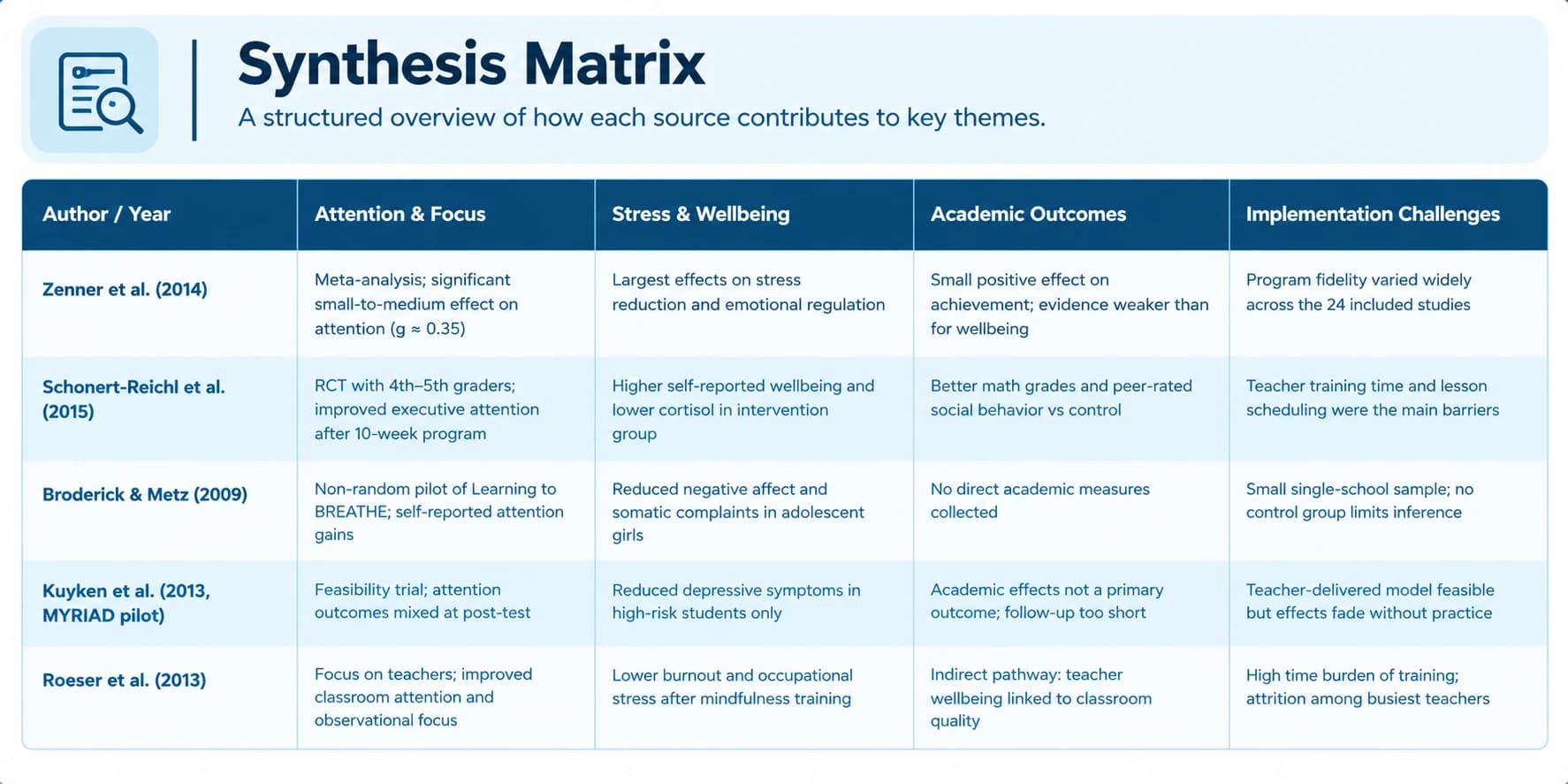
The single most useful habit for writing a good literature review is to take notes by theme, not by paper. A synthesis matrix is a table with one row per source and one column per theme or question. As you read, you fill in what each source says about each theme.
The image at the top of this article is an example: five studies of school mindfulness programmes compared across attention, stress and wellbeing, academic outcomes, and implementation challenges. Reading down a column shows you at once where studies agree, where they conflict and which themes have little evidence. Those patterns become the paragraphs of your review.
| Column | What to record |
|---|---|
| Citation | Author, year, and link or DOI |
| Aim and design | What the study set out to do and how (RCT, survey, interviews, etc.) |
| Sample and context | Who, how many, where |
| Theme 1, 2, 3… | What the study found on each theme, with page numbers for quotes |
| Strengths and limitations | Your critical appraisal |
| Relevance to my question | How it supports, challenges or extends your argument |
Step 5: Identify themes, debates and gaps
Once your matrix is populated, step back and look for patterns:
- Consensus: findings that most studies support.
- Debates and contradictions: where studies disagree, and possible reasons (different populations, measures, designs or time periods).
- Methodological patterns: for example, most studies are cross-sectional, rely on self-report, or come from one country.
- Theoretical frameworks: which theories researchers use and whether they are tested or just cited.
- Gaps: populations, settings, outcomes or methods that have not been studied. This is where your own research fits.
A strong gap statement is specific: not "little research exists" but "most studies measure total screen time; few distinguish passive from active use, and none have followed adolescents in low- and middle-income countries over time."
Step 6: Choose a structure
| Structure | Organised by | Works well when |
|---|---|---|
| Thematic | Key themes or sub-questions | Most reviews; the default choice |
| Chronological | How thinking developed over time | Tracing the history of a concept, policy or debate |
| Methodological | Research approaches or designs | Comparing what different methods have found |
| Theoretical | Competing theories or frameworks | Building the theoretical basis for a study |
You can combine them, for example a thematic structure with a chronological thread within each theme. Whatever you choose, use informative headings so readers can follow your argument.
Step 7: Write the introduction, body and conclusion
Introduction
Introduce the topic and why it matters, state the aim or question of the review, define key terms, explain the scope (what is included and excluded) and, for a dissertation, briefly describe how you searched. End with a roadmap of the sections that follow.
Body
Each section or paragraph should make a point about the literature, supported by several sources, rather than describing one study at a time (Purdue Online Writing Lab, n.d.). Compare the two approaches:
Summary (weak): Smith (2020) found that mindfulness improved attention. Jones (2021) studied stress. Lee (2022) found no effect on grades.
Synthesis (strong): School mindfulness programmes appear to improve attention and self-reported stress (Smith, 2020; Jones, 2021), but evidence for academic outcomes is weaker: the only study measuring grades found no effect (Lee, 2022), possibly because follow-up was limited to one term.
Useful synthesis language includes: similarly, in contrast, consistent with, however, extending this work, a limitation shared by these studies is, and one explanation for these conflicting findings is.
Conclusion
Summarise the main findings of the review, state the key gap or problem clearly, and explain how your research question responds to it. In a stand-alone review, add implications for practice, policy and future research.
Step 8: Revise, reference and check
- Check that each paragraph starts with a clear topic sentence about the literature, not about a single author.
- Make sure your own voice is present: evaluate, compare and interpret, rather than just report.
- Balance the evidence: include studies that challenge your position and explain why you weigh them as you do.
- Use a consistent referencing style (APA 7, Harvard, Vancouver) and check every in-text citation has a reference entry.
- Remove long quotations; paraphrase and cite instead.
Literature review outline template
- Introduction: topic, importance, aim or question, scope, search approach, roadmap.
- Theme 1: the most established finding, with supporting and conflicting studies.
- Theme 2: a contested or developing area, with possible explanations for disagreement.
- Theme 3: methods and theory: how the topic has been studied, and the limits of that evidence.
- Gaps and critique: what is missing and why it matters.
- Conclusion: summary of the state of knowledge and how your study addresses the gap.
How reviewers judge a literature review
Journal editors increasingly assess narrative reviews against explicit criteria. The SANRA scale (Scale for the Assessment of Narrative Review Articles; Baethge et al., 2019), developed by three journal editors, rates six items: the explanation of the review's importance, its aims, the description of the literature search, referencing, scientific reasoning (for example, stating evidence levels), and the presentation of relevant outcome data. Even for a dissertation chapter, these six points make a useful self-check.
How long should a literature review be, and how many sources?
There is no universal rule; follow your programme or journal guidance. As a rough orientation, the background of a journal article may run to several paragraphs, a master's dissertation literature review often forms a substantial chapter, and a doctoral thesis may devote one or more chapters to it. The number of sources depends on the topic and level: aim to cover the key studies thoroughly rather than to reach a count.
Common literature review mistakes
- Summarising studies one by one instead of synthesising them by theme.
- Relying on a few sources, or mostly on textbooks and websites instead of peer-reviewed research.
- Leaving out seminal or recent studies that examiners expect to see.
- Describing findings without evaluating the quality of the evidence.
- No clear link between the review and your own research question.
- A vague gap statement that does not justify your study.
Getting expert help with your literature review
If you are short of time or unsure how to move from a pile of papers to a coherent argument, our literature review service can help with searching, building your synthesis matrix, identifying themes and gaps, and structuring the chapter, with every source verified. For a fully systematic approach, see our guide on how to do a systematic review.
Frequently asked questions
What are the steps to write a literature review?
Define your question, search databases with planned keywords, select and evaluate sources, take notes in a synthesis matrix, identify themes and gaps, choose a structure, write the introduction, body and conclusion, and revise your citations.
What is a synthesis matrix?
A synthesis matrix is a table with one row per source and one column per theme. It helps you see where studies agree and disagree, which makes it easier to write by theme rather than paper by paper.
What is the difference between a literature review and a systematic review?
A literature review summarises and critiques selected literature, often with flexible methods. A systematic review follows a pre-registered protocol with a comprehensive search, explicit eligibility criteria, dual screening and formal quality appraisal.
How do I structure a literature review?
Most literature reviews use a thematic structure, organised by key themes or sub-questions. Alternatives are chronological, methodological and theoretical structures.
How many sources should a literature review have?
It depends on the topic, level and guidelines. Focus on covering the key and most relevant studies thoroughly rather than on reaching a set number.
How do I find a research gap?
Look across your synthesis matrix for populations, settings, outcomes or methods that few or no studies have addressed, or for conflicting findings that have not been explained.
Sources
- Snyder H. Literature review as a research methodology: an overview and guidelines. J Bus Res 2019;104:333-339
- Baethge C, Goldbeck-Wood S, Mertens S. SANRA: a scale for the quality assessment of narrative review articles. Res Integr Peer Rev 2019;4:5
- Grant MJ, Booth A. A typology of reviews: an analysis of 14 review types and associated methodologies. Health Info Libr J 2009;26:91-108
- Purdue Online Writing Lab. Writing a literature review. Purdue University; n.d.