
A quasi-experimental design tests the effect of an intervention or condition, like an experiment, but without random assignment to groups. Researchers use it when randomising people is impossible, unethical or impractical, for example when whole classes, clinics or campuses receive a programme. The main types are nonequivalent groups designs, one-group pretest-posttest designs, interrupted time series and regression discontinuity. Because the groups may differ before the study starts, quasi-experiments give weaker evidence of cause and effect than true experiments, so a good design adds pretests, comparison groups and repeated measurements to rule out other explanations.
Working on a psychology methods assignment or lab report? Get one-to-one support from a specialist. Get a free quote →
What is a quasi-experimental design?
A quasi-experiment has the same goal as a true experiment: to find out whether an intervention, treatment or condition changes an outcome. Researchers still introduce or study a change (the independent variable) and still measure its effect (the dependent variable). The missing ingredient is random assignment. People end up in the treatment or comparison condition because of something other than chance: the class they are in, the clinic they attend, when they enrolled, or a score on a screening test.
That missing ingredient matters. Random assignment is what makes groups equivalent, on average, before the study starts, so any later difference can be attributed to the intervention. Without it, the groups may already differ in motivation, ability, severity or circumstances, and those pre-existing differences, rather than the intervention, could explain the results. Harris et al. (2006) describe quasi-experiments as studies that aim to evaluate interventions without randomisation, and stress that their conclusions depend on how well the design rules out these alternative explanations.
Psychology students meet quasi-experiments constantly, because so much psychological research happens in real settings: schools, universities, hospitals, workplaces and communities. A researcher evaluating a new anti-bullying programme usually cannot randomly assign individual pupils to it; the whole school adopts it or does not. A researcher studying a campus mental-health policy cannot randomise which students live under the policy. In these situations, a quasi-experiment is often the strongest design that is ethical and feasible.
Quasi-experimental vs true experimental vs correlational designs
Research designs in psychology sit on a spectrum of control. The table below compares the three you will meet most often in a research methods course.
| Feature | True experiment | Quasi-experiment | Correlational study |
|---|---|---|---|
| Researcher manipulates or introduces the independent variable | Yes | Usually yes (or studies a naturally occurring change) | No |
| Random assignment to conditions | Yes | No | No |
| Comparison or control group | Yes | Often, but not equivalent | Not applicable |
| Main threat to valid conclusions | Few, if well run | Pre-existing group differences and outside events | Third variables and reverse causation |
| Strength of causal conclusions | Strongest | Moderate; depends on the design | Weakest; shows association |
| Typical example | Students randomly assigned to a mindfulness app or a waitlist | Two existing classes, one receiving the mindfulness programme | Measuring how often students meditate and their anxiety levels |
Notice that the quasi-experiment sits in the middle. It is more controlled than a correlational study because the researcher introduces or tracks a specific change and compares conditions, but it cannot match the internal validity of a randomised experiment. In evidence hierarchies such as the levels of evidence pyramid, non-randomised studies of interventions sit below randomised controlled trials for exactly this reason, and their risk of bias is judged with tools such as ROBINS-I (Sterne et al., 2016).
Some textbooks also use the term quasi-independent variable for characteristics that cannot be assigned at all, such as age, gender, diagnosis or smoking status. A study comparing anxiety in first-year and final-year students uses a quasi-independent variable: the researcher compares groups but cannot assign anyone to a year of study.
Types of quasi-experimental design, with examples
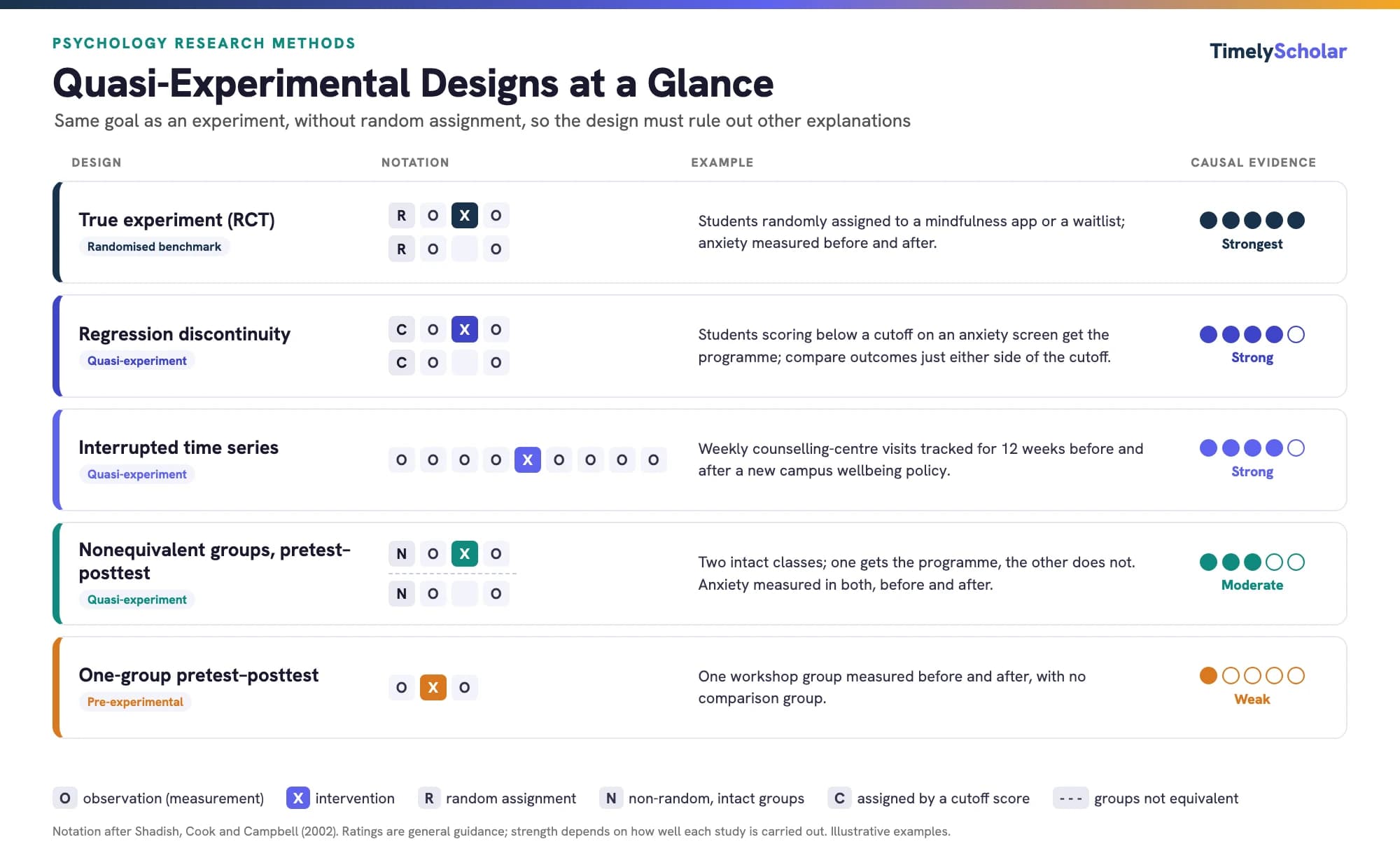
Research methods texts describe designs with a simple notation that comes from Campbell and Stanley (1963) and was developed further by Shadish et al. (2002): O is an observation (a measurement), X is the intervention, R means random assignment, and N means non-random, nonequivalent groups. Reading a design left to right shows the order of events.
1. Nonequivalent groups design
Two or more existing groups are compared: one receives the intervention, and the other does not. Because the groups were not formed at random, they are "nonequivalent". The posttest-only version measures the outcome only after the intervention, which leaves you unable to tell whether the groups differed beforehand. The pretest-posttest version measures both groups before and after, so you can check how similar they were at the start and examine change over time.
Design: N O X O / N O O (pretest and posttest in two intact classes).
Study: One psychology class takes a six-week mindfulness programme; a second class at the same university does not.
Measure: Both classes complete the GAD-7 anxiety scale in week 1 and week 8.
Logic: If anxiety falls more in the programme class than in the comparison class, and the classes started at similar levels, the programme is a plausible cause.
2. One-group pretest-posttest design
A single group is measured, given the intervention and measured again (O X O). It is easy to run and common in student projects, but many textbooks call it pre-experimental because there is no comparison group. Any change could reflect the passage of time, an event in participants' lives, practice on the measure, or regression to the mean, so it provides weak evidence on its own.
3. Interrupted time series
The outcome is measured many times before and many times after an intervention (O O O O X O O O O). The long run of pre-intervention measurements shows the underlying trend, so you can see whether the intervention changed the level or the slope of the series beyond what that trend predicts. Lopez Bernal et al. (2017) describe interrupted time series as one of the strongest quasi-experimental approaches for evaluating interventions introduced at a clear point in time, such as a new policy.
Study: A university introduces a wellbeing policy that adds drop-in counselling hours.
Data: Weekly counselling-centre visits for 12 weeks before and 12 weeks after the change.
Question: Did visits jump when the policy began, or start rising faster, compared with the earlier trend?
4. Regression discontinuity design
Participants are assigned to the intervention by a cutoff on a continuous score: everyone below (or above) the cutoff receives it. People just on either side of the cutoff are very similar, so a sudden jump in the outcome exactly at the cutoff is strong evidence that the intervention caused it. Imbens and Lemieux's (2008) practical guide explains how the analysis focuses on observations close to the cutoff. When the cutoff is applied strictly, regression discontinuity is often considered the most convincing quasi-experimental design.
Study: Students scoring 10 or more on an anxiety screening questionnaire are offered a group programme; those scoring below 10 are not.
Comparison: End-of-term anxiety for students who scored just above and just below 10.
5. Natural experiments
Sometimes an event outside the researcher's control, such as a new law, a school closure or a natural disaster, affects one group and not a similar one. Researchers then compare the groups as if the event were an intervention. Natural experiments can study effects that could never be manipulated ethically, but the researcher has no control over who was exposed, so the same threats apply as in other quasi-experiments.
Threats to internal validity and how to reduce them
Internal validity is the degree to which you can conclude that the intervention, and not something else, caused the change. Quasi-experiments are vulnerable to several classic threats. Knowing them by name helps you design a stronger study and write a sharper limitations section.
| Threat | What it means | How to reduce it |
|---|---|---|
| Selection | Groups differed before the intervention (e.g., the programme class was already less anxious) | Pretest both groups; match groups on key variables; adjust statistically for pretest scores |
| History | Another event between measurements affects the outcome (e.g., exams start in week 8) | Use a comparison group exposed to the same events; time measurements carefully |
| Maturation | Participants change naturally over time (e.g., settling into university reduces anxiety) | Add a comparison group; use several pretests to show the existing trend |
| Testing | Taking the pretest changes scores on the posttest | Use alternative forms of the measure; include a comparison group that also takes the pretest |
| Instrumentation | The measure or the way it is administered changes | Keep the measure, setting and procedure the same at every time point |
| Regression to the mean | Groups chosen for extreme scores drift towards the average when retested | Avoid selecting on extreme pretest scores, or use regression discontinuity, which models this directly |
| Attrition | Participants drop out unevenly across groups | Track and report dropouts by group; compare those who complete with those who do not complete. |
A useful habit is to list, for your own study, which of these threats are plausible and which design features rule them out. Handley et al. (2018) recommend exactly this: choose and strengthen the design by thinking through the specific rival explanations in your setting.
How to make a quasi-experiment stronger
- Add a pretest. Measuring everyone before the intervention lets you show whether groups started out similar and lets you analyse change rather than a single score.
- Add a comparison group. Even a nonequivalent comparison group rules out history, maturation and testing far better than none.
- Measure repeatedly. Several pretests reveal existing trends; several posttests show whether effects last.
- Match or adjust. Match groups on important variables such as baseline anxiety or year of study, or adjust for them statistically.
- Use switching replications. Give the intervention to the comparison group later. If the effect appears in each group when it receives the intervention, history is a much less likely explanation.
- Add a nonequivalent dependent variable. Measure an outcome the intervention should not affect. If only the targeted outcome changes, a general shift over time is less likely.
- Plan the analysis in advance. Decide your main outcome and analysis before you see the data, and justify your sample size with a power analysis.
How to analyse quasi-experimental data
The right test follows from the design; our SPSS guides to the independent-samples t-test, one-way ANOVA and 2 × 2 factorial ANOVA show each analysis step by step. The table below covers the designs most often used in psychology courses; our guide on which statistical test to use explains the reasoning behind each choice in more detail.
| Design | Common analysis | What it tests |
|---|---|---|
| Nonequivalent groups, posttest only | Independent-samples t-test (two groups) or one-way ANOVA (three or more) | Whether posttest scores differ between groups, with no way to adjust for starting differences |
| Nonequivalent groups, pretest-posttest | ANCOVA with the pretest as a covariate, or a mixed ANOVA (group × time) | Whether groups differ at posttest after accounting for pretest scores; in the mixed ANOVA, the group × time interaction |
| One-group pretest-posttest | Paired-samples t-test (or Wilcoxon signed-rank test) | Whether scores changed from pretest to posttest |
| Interrupted time series | Segmented (interrupted) regression | Changes in level and slope after the intervention, beyond the existing trend |
| Regression discontinuity | Regression of the outcome on the assignment score near the cutoff | Whether there is a jump in the outcome at the cutoff |
For a pretest-posttest design with a comparison group, the key result is not whether each group improved but whether the programme group improved more than the comparison group. In a mixed ANOVA, this is the group × time interaction; in an ANCOVA it is the group effect after adjusting for the pretest. Report effect sizes and confidence intervals alongside p-values.
Writing up a quasi-experiment in APA style
The APA Journal Article Reporting Standards for quantitative research (JARS; Appelbaum et al., 2018) include a specific module for studies that use nonrandom assignment. In your method section, say clearly that participants were not randomly assigned, explain how they came to be in each condition, and describe what you did to reduce bias, such as matching or statistical adjustment. For behavioural and public health interventions, the TREND statement (Des Jarlais et al., 2004) offers a similar checklist.
"Participants were not randomly assigned to conditions. Two intact sections of an introductory psychology course were used: one section (n = 42) completed the six-week mindfulness programme, and the other (n = 39) served as a comparison group. Both sections completed the GAD-7 in Week 1 and Week 8. Pretest anxiety did not differ significantly between sections, and pretest scores were included as a covariate in the analysis."
In the discussion, match your language to your design. Write that the programme was associated with a larger reduction in anxiety, or that the results are consistent with a programme effect, rather than claiming the programme caused the change. Then name the specific threats your design could not rule out, such as selection differences you did not measure.
Advantages and limitations of quasi-experimental designs
| Advantages | Limitations |
|---|---|
| Possible when random assignment is unethical or impractical | Groups may differ before the study, weakening causal conclusions |
| Studies interventions in real settings, so results often generalise well | Outside events and natural change are harder to rule out |
| Often cheaper and quicker than a randomised trial | Needs careful design and analysis to be convincing |
| Can evaluate policies and programmes that are already in place | Readers and reviewers may treat the evidence with more caution |
Getting help with your research methods course
Quasi-experimental designs come up in both halves of a typical psychology research methods sequence: in the first course when you learn to classify designs, and in the second when you design, analyse and write up your own study. If you would like one-to-one help choosing a design, running the analysis in SPSS, R or JASP, or getting feedback on your APA lab report, see our psychology research methods and data analysis support. You stay the author of your work; we explain the methods and give feedback.
Frequently asked questions
What is a quasi-experimental design in simple terms?
It is a study that tests whether an intervention or condition affects an outcome, like an experiment, but without randomly assigning people to groups. Participants are in each condition because of existing groups, timing or a cutoff score.
What is the main difference between a quasi-experiment and a true experiment?
Random assignment. A true experiment randomly assigns participants to conditions, which makes the groups equivalent on average. A quasi-experiment does not, so pre-existing differences between groups could explain the results.
What are examples of quasi-experimental designs?
Comparing two existing classes when only one receives a programme (nonequivalent groups), measuring one group before and after a workshop (one-group pretest-posttest), tracking weekly counselling visits before and after a policy change (interrupted time series), and offering a programme to everyone below a screening cutoff (regression discontinuity).
Is a quasi-experiment quantitative or qualitative?
Quasi-experiments are quantitative designs: they measure outcomes numerically and compare conditions statistically. They can be combined with qualitative interviews in a mixed methods study.
Can a quasi-experiment show cause and effect?
It can provide evidence about cause and effect, but weaker evidence than a randomised experiment. Strong designs such as regression discontinuity and interrupted time series, or nonequivalent groups with pretests and statistical adjustment, make causal conclusions more credible.
What statistical test do I use for a quasi-experiment?
It depends on the design: an independent t-test or ANOVA for posttest-only group comparisons, ANCOVA or a mixed ANOVA for pretest-posttest designs with a comparison group, a paired t-test for one-group pretest-posttest designs, and segmented regression for interrupted time series.
Is a pretest-posttest design a quasi-experiment?
A pretest-posttest design with a non-randomised comparison group is a quasi-experiment. A one-group pretest-posttest design with no comparison group is usually classed as pre-experimental because it cannot rule out many alternative explanations.
Sources
- Harris AD, McGregor JC, Perencevich EN, et al. The use and interpretation of quasi-experimental studies in medical informatics. J Am Med Inform Assoc 2006;13:16-23
- Campbell DT, Stanley JC. Experimental and Quasi-Experimental Designs for Research. Chicago, IL: Rand McNally; 1963
- Shadish WR, Cook TD, Campbell DT. Experimental and Quasi-Experimental Designs for Generalized Causal Inference. Boston, MA: Houghton Mifflin; 2002
- Handley MA, Lyles CR, McCulloch C, Cattamanchi A. Selecting and improving quasi-experimental designs in effectiveness and implementation research. Annu Rev Public Health 2018;39:5-25
- Lopez Bernal J, Cummins S, Gasparrini A. Interrupted time series regression for the evaluation of public health interventions: a tutorial. Int J Epidemiol 2017;46:348-355
- Imbens GW, Lemieux T. Regression discontinuity designs: a guide to practice. J Econom 2008;142:615-635
- Appelbaum M, Cooper H, Kline RB, et al. Journal article reporting standards for quantitative research in psychology: the APA Publications and Communications Board task force report. Am Psychol 2018;73:3-25
- Des Jarlais DC, Lyles C, Crepaz N; TREND Group. Improving the reporting quality of nonrandomized evaluations of behavioral and public health interventions: the TREND statement. Am J Public Health 2004;94:361-366
- Sterne JA, Hernán MA, Reeves BC, et al. ROBINS-I: a tool for assessing risk of bias in non-randomised studies of interventions. BMJ 2016;355:i4919

Emily brings 12 years of experience in higher education. She provides senior-level oversight for complex research projects, helping teams clarify scope, align research questions with methods, and strengthen the logic and reporting of their work. Areas of expertise Oversight of institutional research and research…