
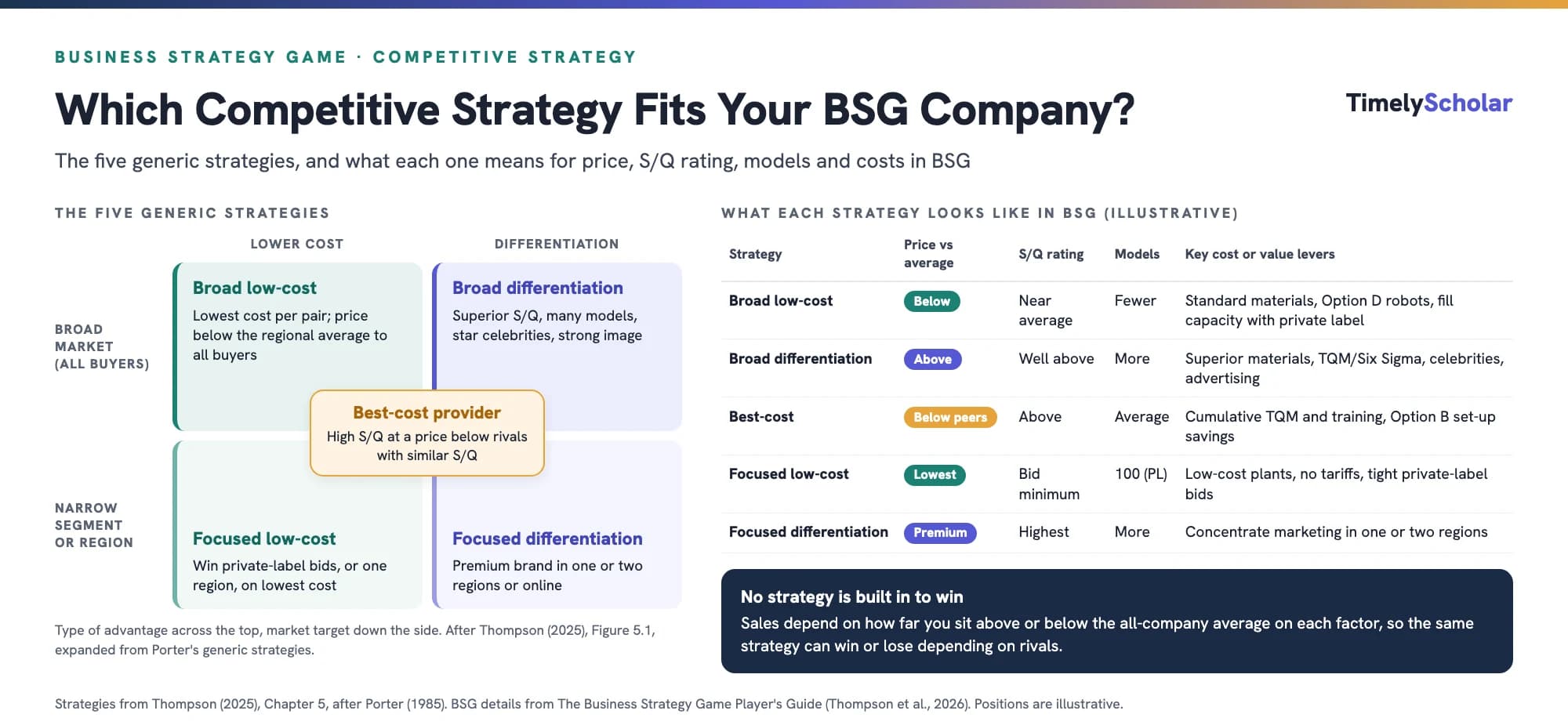
Chapter 5 of Thompson's (2025) strategy text describes five generic competitive strategies: broad low-cost, broad differentiation, focused low-cost, focused differentiation, and best-cost provider. They differ on two choices: whether you target a broad or narrow market, and whether your advantage comes from lower costs or from differentiation. In the Business Strategy Game (BSG), a low-cost company prices below the regional average and wins by having the lowest cost per pair. A differentiator charges more for a higher S/Q rating, more models, and stronger celebrities and image. A best-cost company offers a high S/Q rating at a lower price than rivals with similar quality. A focuser concentrates on private-label contracts, online sales, or one or two regions. BSG has no built-in winning strategy (Thompson et al., 2026): the best one is the one your team can execute at lower cost or with more buyer appeal than your rivals.
Playing the Business Strategy Game? Get coaching on strategy and the reports. Get a free quote →
The five generic competitive strategies (Chapter 5)
A company's competitive strategy is its game plan for winning customers and outcompeting rivals. Thompson (2025) argues that once the details are stripped away, every competitive strategy rests on two choices. The first is the market target: a broad cross-section of buyers or a narrow segment (niche). The second is the type of competitive advantage: lower costs than rivals or a differentiated product that buyers value. Combining the two gives five options, an expanded version of Porter's (1985) three generic strategies.
| Strategy | Market target | Source of advantage | Real-world examples from Chapter 5 |
|---|---|---|---|
| Broad low-cost provider | Broad cross-section of buyers | Lower overall costs than rivals | Walmart, Nucor, Southwest Airlines |
| Broad differentiation | Broad cross-section of buyers | Unique attributes many buyers will pay for | Apple Watch, Mercedes, Michelin |
| Focused low-cost | Narrow niche | Lower costs in serving the niche | Private-label makers, budget motels |
| Focused differentiation | Narrow niche | Attributes tailored to niche buyers | Whole Foods, Ferrari, Canada Goose |
| Best-cost provider | Value-conscious middle market | Upscale attributes at lower cost than rivals | Toyota's Lexus line |
Thompson (2025) calls this choice perhaps the most important strategic commitment a company makes, because it sets the tone for every other decision. Research on real firms supports taking it seriously. In a study of 113 firms, all three of Porter's strategies improved performance, with differentiation linked to the highest performance (Islami et al., 2020). An analysis of nearly 13,000 firm-years found that cost leadership and differentiation both lifted current profits, but differentiation sustained them longer, at the price of more volatile earnings (Banker et al., 2014).
How the five strategies work in the Business Strategy Game
Thompson et al. (2026) list strategy options that mirror Chapter 5 almost exactly. Your company can pursue low-cost leadership, differentiate on features, styling, quality, product line breadth or celebrity appeal, or offer "more value for the money" by selling high-S/Q footwear below the price of rival brands with the same rating. It can also focus on one market segment (wholesale, internet, or private-label) or on one or two geographic regions, and it can run the same strategy everywhere or tailor it region by region.
Two rules in the game shape how any of these strategies plays out:
- Gaps against the average are what matter. Branded sales in each region depend on 13 competitive factors, led by price, S/Q rating, and the number of models. The further your company sits above or below the all-company average on a factor, the more that factor drives your sales. A factor on which everyone is equal has no effect at all (Thompson et al., 2026).
- There is no built-in winning strategy. The simulation has no bias toward any strategy, and outcomes are 100% competition-based, so a strategy that won in another class may fail in yours (Thompson et al., 2026).
In practice, your generic strategy is the pattern you create on the Competitive Intelligence Report: where you choose to be well above average, where you accept being below it, and where your cost per pair lets you do that profitably. If you have not yet analyzed what buyers reward and where rivals stand, start with our guide to BSG industry analysis and key success factors.
Broad low-cost provider strategy in BSG
A low-cost provider aims for meaningfully lower costs than rivals, not the lowest possible cost, while still offering the attributes buyers consider essential (Thompson, 2025). In BSG, that means a cost per pair clearly below the industry average and an S/Q rating and model count that are good enough not to drive buyers away.
Cost drivers: where BSG costs per pair come from
Thompson (2025) identifies cost drivers, adapted from Porter (1985), as the levers for driving costs down. Nearly every one has a counterpart in the simulation:
| Cost driver | BSG lever | In the game |
|---|---|---|
| Economies of scale | Larger facilities; fewer models per facility | Set-up costs depend on the number of models, not plant size: 500 models cost $3.75 per pair at 4 million pairs but $1.50 at 10 million |
| Capacity utilization | Running near full capacity; private-label volume | Private-label pairs spread fixed costs over more output, provided the bid price covers direct costs |
| Learning and experience | Cumulative TQM/Six Sigma and best-practices training | Cumulative spending lowers reject rates and lifts the S/Q rating over time |
| Lower-cost inputs | Share of standard versus superior materials | Base prices are $6 per pair for standard and $12 for superior materials, adjusted for industry-wide usage |
| Labor efficiency and pay | Incentive pay, training, and Option D robots | Robots raise worker productivity by 50%; Asia-Pacific and Latin America base wages are about 35% of those elsewhere |
| Product design and technology | Production improvement options A, B, and D | Option A halves reject rates; Option B halves set-up costs |
| Supply chain and distribution | Producing where you sell | Shipping costs $1 per pair at home and $2 abroad, plus tariffs of $4 to $10 per pair on some routes |
Thompson (2025) also describes a second route to low costs: revamping the value chain to bypass costly activities, such as selling direct online instead of through retailers. In BSG, a growing online share (15% of branded sales in Year 10, rising about 1% a year) gives a low-cost company a channel without retailer markups. For a fuller cost breakdown, see our BSG value chain and benchmarking guide.
Two ways to turn a cost advantage into profit
Thompson (2025) describes two options: underprice rivals to win more buyers, or match rivals' prices and keep the cost advantage as a bigger margin. Price cuts often trigger retaliation, so the second option becomes more attractive the more likely rivals are to respond. In BSG, a team that cuts prices hard in a region where several rivals also compete on price can start a price war that leaves every company less profitable.
Chapter 5 also shows why a price cut must be backed by a large gain in volume. Here is the same arithmetic with BSG-style numbers (hypothetical):
| Wholesale price | Margin per pair | Profit on 1 million pairs | Pairs needed for $10 million profit | Sales increase needed |
|---|---|---|---|---|
| $60.00 | $10.00 | $10.0 million | 1,000,000 | None |
| $57.00 (5% cut) | $7.00 | $7.0 million | 1,428,572 | +43% |
| $54.00 (10% cut) | $4.00 | $4.0 million | 2,500,000 | +150% |
Unless cost per pair falls as volume rises, a 10% price cut has to more than double sales just to stand still. Thompson (2025) calls overly aggressive price cutting perhaps the biggest mistake a low-cost provider can make.
When low-cost works best, and its pitfalls
Thompson (2025) says low-cost strategies are strongest when price competition is vigorous, products are similar, differentiation is hard to achieve, buyers use the product in the same way, and switching costs are low. In BSG, watch for regions where rivals' S/Q ratings and model counts are bunched close together, since price differences then decide more of the sales.
- Easily copied cost savings. Low-wage plants and robots are available to every company, so they rarely give a lasting edge on their own.
- A product that is too basic. An S/Q rating far below average can cost more in lost sales than it saves in materials.
- Fixating on costs while buyers in your industry shift toward higher S/Q ratings and more models.
Broad differentiation strategy in BSG
A differentiator offers attributes that a wide range of buyers find appealing and worth paying for (Thompson, 2025). Successful differentiation lets a company charge a premium price, sell more units, or build brand loyalty. It pays only when the premium or extra volume more than covers the added cost of differentiating.
Value drivers: how BSG companies differentiate
| Value driver | BSG lever |
|---|---|
| Product features and performance | Spending per model on enhanced styling and features |
| Quality inputs and quality control | Superior materials, TQM/Six Sigma, and Option C (+1 S/Q star) |
| Wide product selection | Number of models/styles offered |
| Employee skills and training | Best-practices training, which also lowers reject rates |
| Marketing and brand-building | Brand advertising, search engine ads, and celebrity endorsements |
| Distribution activities | Number of retail outlets, retailer support, and faster delivery |
| Customer service | Free shipping on online orders and mail-in rebates |
Making differentiation hard to copy
Thompson (2025) warns that any differentiating feature that works well attracts imitators. Lasting differentiation rests on attributes that are slow or costly to copy, and on intangibles such as brand reputation. BSG builds this in. The S/Q rating rewards cumulative TQM/Six Sigma and training spending, not just this year's, and the image rating combines S/Q ratings, market share, and four to five years of corporate citizenship (Thompson et al., 2026). A rival can match your models or advertising budget next year, but it cannot buy your cumulative quality record overnight. For how each factor feeds the rating, see our guide to the BSG S/Q rating and how to increase it.
Signaling value also matters, according to Thompson (2025). In BSG, the image rating, celebrity endorsers, and advertising all signal quality to buyers, and Thompson et al. (2026) note that a celebrity lineup is much more effective when it is backed by advertising.
Differentiation pitfalls in BSG
- Weak differentiation. Being just slightly above average on S/Q rating and models creates little buyer preference. Chapter 5 urges meaningful gaps.
- Over-differentiating. Moving from 200 to 500 models raises annual set-up costs at a facility from $4.5 million to $15 million (Thompson et al., 2026). Unless volume or Option B offsets it, cost per pair climbs.
- Charging too high a premium. Thompson et al. (2026) note that a high S/Q rating can be undermined by a price premium buyers consider not worth it.
- Copying rivals' differentiation. When several companies chase the same attributes, the industry fills with me-too brands and nobody earns a premium (Thompson, 2025).
Focused low-cost and focused differentiation strategies in BSG
Focused strategies concentrate on a narrow part of the market, defined by geography, special requirements, or special attributes (Thompson, 2025). A focused low-cost company serves its niche more cheaply than rivals; a focused differentiation company serves it with attributes tailored to niche buyers. BSG offers three kinds of niche.
Private-label footwear: a focused low-cost niche
Chapter 5 names private-label producers as a classic focused low-cost example, and BSG's private-label segment works the same way. Chain retailers award contracts to the lowest bidders, and ties go to the company with the higher image rating. The required specifications are an S/Q rating one star below the prior-year worldwide branded average (capped at 5.0 stars) and 100 models, and set-up costs are only 25% of those for branded footwear (Thompson et al., 2026). Private-label demand is projected to grow 12% a year in Years 11 to 15 and 10% a year after that.
To compete here, keep superior materials and styling spending to the minimum needed for the required S/Q rating. Produce in a low-cost facility in the same region to avoid tariffs, and bid only at prices that cover all costs plus a profit. The risk is that a rival underbids you and your planned volume never arrives. For bidding basics, see our BSG Year 11 strategy guide.
Regional and online focus
Thompson et al. (2026) explicitly allow focusing on one or two geographic regions, for example where efficient plants give you a cost advantage. A company with a low-cost Latin America plant might aim to lead Latin America on price. Another might pursue focused differentiation in North America, with the highest S/Q rating and the heaviest advertising and celebrity spending there. Focusing on online sales is a third option, built on online price, free shipping, and search engine advertising.
When focus works and what can go wrong
Thompson (2025) says focus is most attractive when the niche is big enough to be profitable and growing, industry leaders are not competing in it, it is costly for broad competitors to serve it well, and few rivals are targeting it. The main risks are that broad competitors move in, that the niche becomes overcrowded, and that its growth slows. In BSG, watch the private-label bid results and regional market shares each year for rivals moving into your niche.
Best-cost provider strategy in BSG
A best-cost provider gives buyers more value for the money: upscale attributes at a lower price than rivals with similar attributes (Thompson, 2025). It is a hybrid. The advantage is not a cheap product but a lower cost of producing a good product, which lets the company undercut comparable rivals and still earn good margins. Toyota's Lexus line, built with Toyota's low-cost manufacturing skills and priced below comparable German luxury models, is Chapter 5's example.
Thompson et al. (2026) describe the BSG version directly: offering high-S/Q footwear at lower prices than other brands with the same S/Q rating, because you can build styling, quality, and selection at a lower cost than rivals. The capabilities that make this possible are the hard-to-copy ones:
- Cumulative TQM/Six Sigma and training spending, which raises S/Q ratings and lowers reject rates more cheaply over time.
- Production improvement options chosen to lower cost per pair at a high S/Q rating, such as Option A (reject rates) and Option B (set-up costs).
- Scale and full capacity use, so the cost of a broad product line is spread over more pairs.
- Producing in the region where you sell, avoiding tariffs and higher shipping costs.
The big risk, according to Thompson (2025), is being squeezed in the middle: low-cost rivals draw away price-sensitive buyers, while premium differentiators draw away buyers who want the very best. To avoid that, a best-cost company needs a clear S/Q lead over the low-cost players and a clear price advantage over the premium players. Thompson (2025) also cautions that the strategy is ill-advised without the capability to deliver upscale attributes at lower cost.
Choosing a competitive strategy for your BSG company
Every company starts the game in the same position, so your choice depends on what rivals do, which regions are growing, and which capabilities your team is willing to build. The table below links Chapter 5's conditions to signals in your BSG reports.
| Strategy | Consider it when | BSG signals to check |
|---|---|---|
| Broad low-cost | Rivals' offerings are similar and price competition is strong | Narrow spread in S/Q ratings and models; your cost per pair is below average |
| Broad differentiation | Buyer needs are diverse and few rivals differentiate the same way | Few rivals investing heavily in S/Q, models, or celebrities |
| Best-cost | Many buyers want good quality at a fair price | You can reach an above-average S/Q rating at an average or lower cost per pair |
| Focused low-cost | A niche is large, growing, and underserved | Private-label demand exceeds bids; a region where you have the cheapest plant |
| Focused differentiation | Some buyers will pay a premium for the best | A region where rivals spend little on quality and marketing |
Chapter 5 ends by noting that any competitive strategy works only if it is backed by resources and capabilities that let the company execute it well, and that some of them must be hard for rivals to duplicate (Thompson, 2025). That is why the strategy choice and the internal analysis of your BSG company's resources, SWOT, and VRIO belong together. For how strategy connects to the board's targets and scoring, see how to craft a strategy that beats your rivals in BSG and vision, mission, and objectives in BSG.
Writing about your competitive strategy in BSG assignments
Most BSG courses ask teams to state and defend their strategy, often in a strategy statement, a 3-Year Strategic Plan, or a presentation. A strong strategy statement names the generic strategy, the market target, the main sources of advantage, and the targets that will show whether it is working.
Competitive strategy: a best-cost provider strategy across all four regions, with extra emphasis on Asia-Pacific and Latin America, where demand grows fastest.
Market target: value-conscious buyers who want above-average styling and quality without paying premium prices; private-label contracts used to fill spare capacity.
Source of advantage: steady cumulative TQM/Six Sigma and training spending, Option B at both plants, and production in each region we sell in, so we can reach an S/Q rating above the industry average at a cost per pair at or below average.
Pricing: wholesale prices below those of rivals with similar S/Q ratings, but not below the industry average.
Measures of success: S/Q rating at least 0.5 stars above average, cost per pair within 3% of the lowest-cost rival, and rising regional market shares.
When you explain results in a reflection or presentation, use Chapter 5's language. Describe whether your cost or differentiation advantage was real and lasting, whether rivals copied it, and whether your price premium or price cuts paid off. Support each point with figures from your reports.
Common competitive strategy mistakes in BSG
- Having no clear strategy. Sitting near the average on every factor tends to produce average sales and profits.
- Following tips from past players. Thompson et al. (2026) warn that outcomes depend on the rivals in your own class.
- Cutting price without the cost to back it up, which shrinks margins without enough extra sales.
- Differentiating without counting the cost, for example adding models and celebrities that raise cost per pair more than the price premium.
- A best-cost strategy without a cost advantage, which leaves you stuck in the middle.
- Changing strategy every year, which throws away cumulative investments in quality, training, and image.
Getting help with your BSG strategy
If you would like a strategy specialist to talk through your competitive strategy, strategy statement, or 3-Year Strategic Plan, see our Business Strategy Game coaching. We explain the reasoning so your team makes its own decisions, in line with your course's rules.
Frequently asked questions
What are the five generic competitive strategies?
Broad low-cost provider, broad differentiation, focused low-cost, focused differentiation, and best-cost provider. They come from two choices: a broad or narrow market target, and an advantage based on lower costs or on differentiation.
What is the best strategy in the Business Strategy Game?
There is no single best strategy. Thompson et al. (2026) state that the simulation favors no strategy and that sales depend on how your company compares with rivals on each competitive factor. The best strategy is the one your team can execute better than the rivals in your industry.
Is low-cost or differentiation better in BSG?
Either can win. Low-cost works best when rivals' offerings are similar and buyers are price-sensitive; differentiation works best when buyers have diverse needs and few rivals differentiate the same way. Research on real firms suggests differentiation tends to sustain profits longer but with more volatile earnings.
What is a best-cost provider strategy in BSG?
Offering footwear with a high S/Q rating at a lower price than rival brands with similar S/Q ratings. It requires the ability to build quality and selection at a lower cost than those rivals, for example through cumulative quality and training spending and efficient plants.
How do private-label sales fit a BSG strategy?
Private-label production is a focused low-cost niche. Contracts go to the lowest bidders that meet an S/Q requirement one star below the prior-year worldwide branded average (capped at 5.0) and 100 models. It also uses spare capacity, which lowers cost per pair if bids cover costs.
What is a focused differentiation strategy example?
In Chapter 5, Whole Foods, Ferrari, and Canada Goose serve narrow segments with tailored, premium products. In BSG, a company might focus on one or two regions with the highest S/Q rating and the heaviest marketing there.
Can you change your competitive strategy during the BSG?
Yes, but frequent changes are costly. Many advantages, such as cumulative quality spending and the image rating, build over several years, so most teams adjust tactics each round while keeping the same overall strategy.
What does stuck in the middle mean for a BSG company?
A company that is neither the low-cost leader nor clearly differentiated, or a best-cost company without a real cost advantage, can lose price-sensitive buyers to low-cost rivals and quality-focused buyers to premium rivals.
References
- Banker, R. D., Mashruwala, R., & Tripathy, A. (2014). Does a differentiation strategy lead to more sustainable financial performance than a cost leadership strategy? Management Decision, 52(5), 872–896. https://doi.org/10.1108/MD-05-2013-0282
- Islami, X., Mustafa, N., & Topuzovska Latkovikj, M. (2020). Linking Porter's generic strategies to firm performance. Future Business Journal, 6(1), Article 3. https://doi.org/10.1186/s43093-020-0009-1
- Porter, M. E. (1985). Competitive advantage: Creating and sustaining superior performance. Free Press.
- Thompson, A. A. (2025). Strategy: Core concepts and analytical approaches (8th ed.). McGraw Hill.
- Thompson, A. A., Stappenbeck, G. J., & Reidenbach, M. A. (2026). The Business Strategy Game player's guide (2026 ed.). GLO-BUS Software. https://www.bsg-online.com