
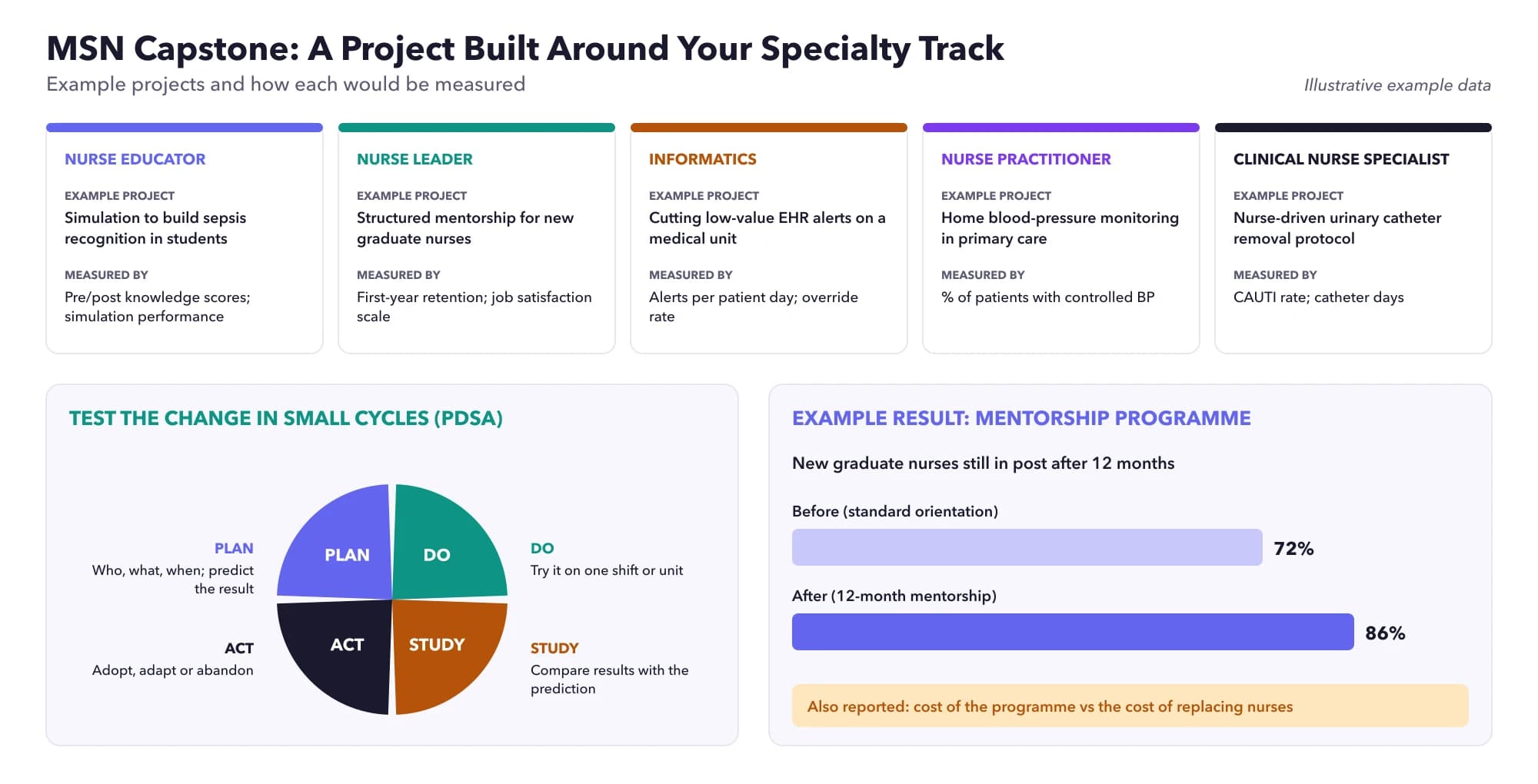
Good MSN capstone project ideas match your specialty track and address a real problem you can influence in that role. Nurse educators might evaluate simulation, preceptor programmes or NCLEX preparation; nurse leaders might tackle turnover, staffing, handoffs or shared governance; informatics nurses might improve EHR documentation, clinical decision support or telehealth; nurse practitioners might implement screening, chronic disease protocols or prescribing guidelines in primary care; and clinical nurse specialists might lead evidence-based protocols to reduce infections, falls or pressure injuries. Frame the idea as a PICOT question, confirm the evidence base, and plan how you will implement and evaluate it.
Working on your MSN capstone? A specialist can help you plan and evaluate it. Get a free quote →
What is an MSN capstone project?
The MSN capstone is the culminating project of a Master of Science in Nursing programme. It shows that you can apply advanced nursing knowledge to a real problem in your chosen role: educator, leader, informatics specialist, clinical nurse specialist or nurse practitioner. Depending on the programme, it may be an evidence-based practice proposal, a quality improvement project, a curriculum or programme development project, a policy analysis, or an integrative literature review.
Compared with a BSN capstone, an MSN capstone usually has a wider scope (a unit, a department or a patient population rather than a single task), a stronger emphasis on leadership and systems thinking, and more rigorous evaluation. It is typically less extensive than a DNP project, which AACN (2015) expects to include full implementation, sustainability planning and evaluation in practice.
Advanced-level nursing education in the United States is organised around the AACN Essentials (AACN, 2021), with 10 domains and 8 featured concepts, including scholarship for the nursing discipline, quality and safety, systems-based practice, informatics, and personal, professional and leadership development. A strong capstone lets you demonstrate several of these domains within your specialty.
How to choose an MSN capstone topic
- Anchor it to your track. An education capstone should improve learning; a leadership capstone should improve a system or team; an NP capstone should improve patient care within your scope.
- Find a real problem. Use your workplace or practicum: incident data, staff surveys, patient outcomes, accreditation reports or student evaluation data.
- Check the evidence. You need recent research or guidelines supporting an intervention.
- Check your influence. Can you realistically implement or propose the change in your role and site?
- Define measurable outcomes that fit the timeline, such as knowledge scores, compliance rates, turnover, or clinical indicators.
- Get early buy-in from your preceptor, manager and faculty adviser.
MSN capstone ideas for nurse educators
- High-fidelity simulation versus case studies for teaching sepsis recognition to nursing students.
- Virtual simulation to build clinical judgement in pre-licensure students.
- A structured preceptor development programme and new graduate retention.
- Evaluating an NCLEX preparation programme using the Next Generation NCLEX clinical judgement model.
- Debriefing methods after simulation and student self-efficacy.
- Flipped classroom teaching in pharmacology courses.
- Peer mentoring for first-year nursing students and attrition.
- Competency-based orientation for nurses moving into critical care.
- Annual skills validation using just-in-time training for low-frequency, high-risk procedures.
- Patient education materials redesigned for low health literacy.
- Incivility in nursing education: faculty and student training.
- Developing a curriculum module on social determinants of health.
Education capstones often use frameworks such as Kolb's experiential learning theory, Benner's novice to expert model, the Jeffries simulation theory, or Kirkpatrick's four levels of training evaluation.
MSN capstone ideas for nurse leaders and administrators
- Reducing first-year nurse turnover through a structured residency or mentorship programme.
- Implementing shared governance councils and measuring nurse engagement.
- Self-scheduling and its effect on nurse satisfaction and overtime.
- Standardised bedside shift report and patient experience scores.
- Leader rounding on staff and nurse retention.
- Charge nurse leadership development programmes.
- Workplace violence prevention policies and reporting culture.
- Reducing agency staff costs through an internal float pool.
- Improving patient throughput and reducing ED boarding.
- Just culture training and incident reporting rates.
- Burnout prevention: resilience training or schedule redesign.
- Nurse staffing models and missed care.
Useful frameworks include transformational leadership theory, Kotter's eight-step change model, Lewin's change theory and the IHI Model for Improvement (Institute for Healthcare Improvement, n.d.).
MSN capstone ideas for nursing informatics
- Reducing duplicate documentation in the EHR and nurse documentation time.
- Clinical decision support for sepsis or VTE risk assessment.
- Barcode medication administration compliance and workaround reduction.
- Smart pump integration with the EHR.
- Nurse-designed dashboards for quality indicators on a unit.
- Patient portal adoption among older adults.
- Telehealth implementation for post-discharge follow-up.
- Alert fatigue: auditing and reducing low-value alerts.
- Downtime procedures and continuity of documentation during EHR outages.
- Data governance and quality for nurse-sensitive indicators.
Informatics capstones often draw on the Technology Acceptance Model, sociotechnical systems theory, or the diffusion of innovations theory.
MSN capstone ideas for nurse practitioner students (FNP, AGNP, PMHNP)
Family and adult-gerontology primary care
- Implementing a diabetes self-management education protocol in primary care.
- Home blood pressure monitoring for uncontrolled hypertension.
- Colorectal cancer screening outreach using mailed FIT kits.
- Annual wellness visits with cognitive screening in older adults.
- Antibiotic stewardship for acute respiratory infections in urgent care.
- Deprescribing in older adults with polypharmacy.
- Adolescent depression screening at well visits.
- Obesity management with motivational interviewing.
- Falls risk screening in primary care for adults over 65.
- HPV vaccination rates in adolescents.
Psychiatric mental health
- Depression and anxiety screening with PHQ-9 and GAD-7 in primary care.
- Metabolic monitoring for patients prescribed antipsychotics.
- Suicide risk screening and safety planning in outpatient settings.
- Medication for opioid use disorder in primary care.
- Sleep hygiene education for adults with insomnia.
MSN capstone ideas for clinical nurse specialists and acute care
- A nurse-driven catheter removal protocol to reduce CAUTI, based on the CDC's prevention guideline (Gould et al., 2009).
- CLABSI prevention bundle compliance audits and feedback.
- Pressure injury prevention with risk-based surface selection in ICU.
- Delirium screening and non-pharmacological prevention in older inpatients.
- Sepsis screening and early warning scores on medical-surgical units.
- Falls prevention bundles with post-fall huddles.
- Early mobility programmes for ICU patients.
- Heart failure discharge education and readmissions.
- Pain reassessment compliance and patient-reported pain control.
- Hypoglycaemia management protocols in hospitalised patients.
MSN capstone ideas in public and community health
- Community health worker programmes for chronic disease management.
- Food insecurity screening and referral in paediatric clinics.
- Vaccination outreach in underserved neighbourhoods.
- School nurse-led asthma management plans.
- Harm reduction education and naloxone distribution.
- Prenatal care access for rural or low-income women.
Worked example: developing an MSN leadership capstone
| Component | Example |
|---|---|
| Problem | A medical-surgical unit loses a large share of newly graduated nurses within their first year. |
| PICOT | In newly graduated registered nurses on a medical-surgical unit (P), does a 12-month structured mentorship programme (I) compared with standard orientation (C) improve first-year retention and job satisfaction (O) over 12 months (T)? |
| Evidence | Studies and systematic reviews of nurse residency and mentorship programmes; appraise and level each one. |
| Framework | Benner's novice to expert model; Kotter's eight-step change model for implementation. |
| Plan | Recruit and train mentors; schedule monthly meetings; protect time for mentoring; build a feedback loop with the manager. |
| Evaluation | Retention at 6 and 12 months; a validated job satisfaction scale at baseline and 12 months; mentor and mentee feedback. |
| Budget | Mentor training hours, protected meeting time, and comparison with the cost of replacing nurses. |
Which type of MSN capstone? Proposal, QI project or integrative review
| Format | What you produce | Best when |
|---|---|---|
| Evidence-based practice proposal | A problem, PICOT question, evidence synthesis, and a detailed implementation and evaluation plan | You cannot implement within the programme, or site approval would take too long |
| Quality improvement project | A small-scale change tested with PDSA cycles and measured before and after | You have site support and access to data |
| Programme or curriculum development | A designed and piloted education or orientation programme with evaluation | You are on an education or leadership track |
| Integrative or systematic literature review | A rigorous synthesis of the evidence on a focused question, with practice recommendations | Your programme allows a review-based capstone |
| Policy analysis | An analysis of an organisational or public policy with evidence-based recommendations | You are on a leadership or public health track |
If you choose a review-based capstone, follow a recognised method; our guides on how to do a systematic review and how to write a literature review explain the steps.
Finding and appraising evidence for your capstone
Search CINAHL and PubMed/MEDLINE for primary research, the Cochrane Library for systematic reviews, and professional organisations for clinical practice guidelines. Education capstones may also need ERIC; leadership capstones may draw on business and management databases. Combine subject headings with keywords for each PICOT element, limit to recent peer-reviewed sources, and record the full strategy for your methods section.
Appraise each study with a recognised tool, such as the JBI critical appraisal checklists, and level it with the hierarchy your programme uses, often Melnyk and Fineout-Overholt's (2023) or the Johns Hopkins model (Dang et al., 2021).
Typical MSN capstone structure
- Introduction and problem statement, with organisational and national significance.
- PICOT question and project objectives.
- Literature search and review, including search strategy and levels of evidence.
- Theoretical framework and change or implementation model.
- Project design: setting, participants, intervention, and data collection.
- Implementation plan: stakeholders, timeline, resources, budget and barriers.
- Evaluation plan: outcome, process and balancing measures, with an analysis plan.
- Ethical considerations and approvals.
- Dissemination and implications for practice.
If you collect pre- and post-intervention data, choose analyses that fit your design; our guide to which statistical test to use covers the common options, and the free t-test and chi-square calculators handle most capstone comparisons.
Presenting and sharing your capstone
Most programmes require a final presentation, often as a poster or slide presentation to faculty and your practicum site. Lead with the problem and your PICOT question, show the evidence in a compact table, present results or the evaluation plan visually, and end with clear recommendations. Sharing an executive summary with your site's leadership increases the chance that the change is adopted. Strong capstones can also become conference posters or journal articles.
Common MSN capstone mistakes
- A topic that does not match your specialty track or future role.
- A scope that is too broad for the timeline, such as "improving patient safety in the hospital".
- An intervention outside your role or influence.
- Evaluating only satisfaction when the aim is a clinical or organisational outcome.
- No budget or sustainability plan for a leadership or programme project.
- Weak or outdated evidence, or evidence that does not match the population.
Getting support with your MSN capstone
Our MSN capstone support service can help you refine your topic and PICOT question, find and appraise the evidence, choose frameworks, and design a realistic implementation and evaluation plan for your track, while the project remains your own work. For earlier or later stages of your career, see our BSN capstone ideas and DNP project ideas.
Frequently asked questions
What is a good MSN capstone topic?
A good topic matches your specialty track, addresses a real problem you can influence, has a solid evidence base and measurable outcomes, and fits your programme's timeline.
What is the difference between an MSN capstone and a DNP project?
An MSN capstone is usually a smaller-scale evidence-based or quality improvement project or proposal. A DNP project is expected to include full implementation, evaluation and a sustainability plan with a systems or population focus.
What are good capstone ideas for nurse educators?
Simulation for clinical judgement, preceptor development programmes, NCLEX preparation, debriefing methods, peer mentoring and competency-based orientation are popular choices.
What are good capstone ideas for nurse leaders?
Nurse retention and residency programmes, shared governance, bedside shift report, self-scheduling, workplace violence prevention and burnout prevention are common leadership topics.
What are good capstone ideas for FNP students?
Diabetes self-management protocols, home blood pressure monitoring, cancer screening outreach, antibiotic stewardship, depression screening and deprescribing in older adults are popular FNP topics.
Does an MSN capstone need to be implemented?
It depends on the programme. Some require implementation and evaluation; others accept a detailed proposal with an implementation and evaluation plan. Check your programme guidelines.
Sources
- American Association of Colleges of Nursing. The Essentials: Core Competencies for Professional Nursing Education. 2021
- American Association of Colleges of Nursing. The Doctor of Nursing Practice: Current Issues and Clarifying Recommendations (2015)
- Melnyk BM, Fineout-Overholt E. Evidence-Based Practice in Nursing and Healthcare: A Guide to Best Practice. 5th ed. Philadelphia, PA: Wolters Kluwer; 2023
- Dang D, Dearholt SL, Bissett K, Ascenzi J, Whalen M. Johns Hopkins Evidence-Based Practice for Nurses and Healthcare Professionals: Model and Guidelines. 4th ed. Indianapolis, IN: Sigma Theta Tau International; 2021
- Gould CV, Umscheid CA, Agarwal RK, Kuntz G, Pegues DA; Healthcare Infection Control Practices Advisory Committee. Guideline for prevention of catheter-associated urinary tract infections. Centers for Disease Control and Prevention; 2009 (updated 2019)
- Institute for Healthcare Improvement. Model for Improvement. n.d.