
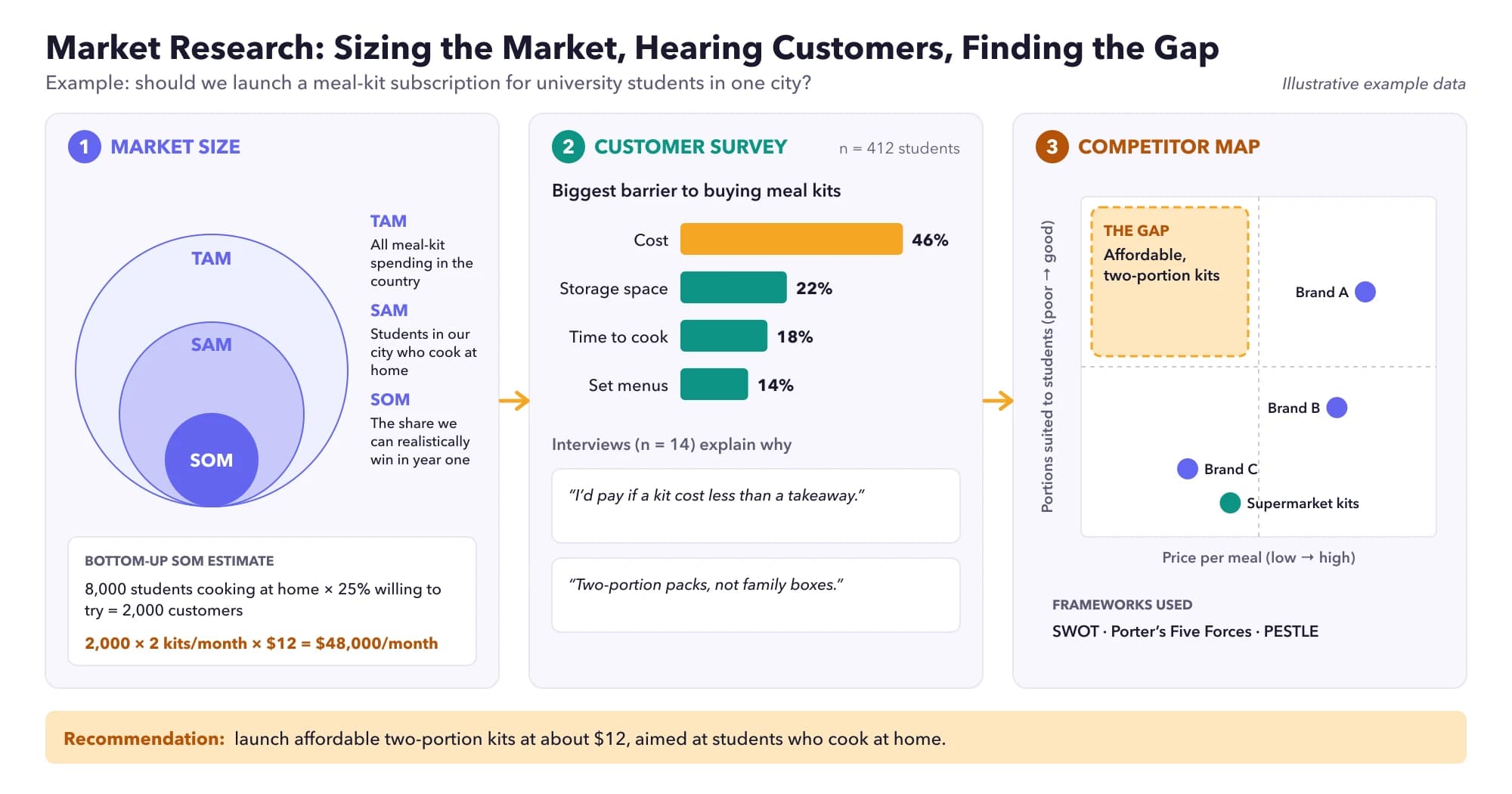
To do market research: (1) define the business decision and the questions you need answered; (2) start with secondary research, such as government statistics, industry reports and competitor websites, to understand market size, trends and competitors; (3) run primary research with your target customers, using surveys for numbers and interviews or focus groups for reasons and motivations; (4) segment the market and define your target customer; (5) analyse competitors' strengths, weaknesses and positioning; (6) analyse the data with appropriate statistics and qualitative methods; and (7) turn the findings into clear recommendations on product, price, place and promotion.
Need market data for a business plan? Our researchers can size your market and map competitors. Get a free quote →
What is market research?
Market research is the systematic collection and analysis of information about customers, competitors and markets, used to make better business decisions. It answers questions such as: Is there demand for this product? Who will buy it? How much will they pay? Who else is selling it, and how can we be different?
The US Small Business Administration (SBA, n.d.) describes market research as blending consumer behaviour and economic trends to confirm and improve a business idea, and notes that it helps reduce risk even before a business launches. Large companies use it to plan product launches and brand strategy; start-ups use it to test ideas and persuade investors; students use it in business plans, MBA projects and marketing dissertations.
Types of market research: primary vs secondary
| Secondary research | Primary research | |
|---|---|---|
| What it is | Analysing data that already exists | Collecting new data directly from customers or the market |
| Examples | Census data, industry reports, trade publications, academic studies, competitor websites and annual reports | Surveys, interviews, focus groups, observation, product tests |
| Strengths | Fast, low cost, good for market size, trends and demographics | Specific to your product and customers; answers "why" |
| Limitations | May be out of date or not specific to your audience | Takes time and money; quality depends on design and sampling |
| When to use | First, to understand the landscape and focus your questions | Second, to answer questions secondary data cannot |
Research can also be classified as quantitative (numbers from surveys, sales data or experiments, answering "how many" and "how much") or qualitative (interviews and focus groups, answering "why" and "how"). The strongest market research usually combines both, an approach researchers call mixed methods.
Step 1: Define the decision and research objectives
Market research should start with a decision, not a questionnaire. What will you do differently depending on the answer? Examples: whether to launch a product, which customer segment to target, what price to set, or which features to build first.
Decision: Should we launch a subscription meal-kit service for university students in our city?
Objective 1: Estimate the number of students who cook at home and would consider a meal kit.
Objective 2: Identify the price range students would accept.
Objective 3: Understand the main barriers (cost, storage, time) and motivators (health, convenience).
Objective 4: Profile existing competitors and their pricing.
Step 2: Start with secondary research
Secondary research is quicker and cheaper, so do it first. The SBA (n.d.) suggests gathering demographic information and answering questions about demand, market size, economic indicators, location, market saturation and pricing. Useful free sources include:
- Government statistics: for the US, the Census Bureau (including Census Business Builder; U.S. Census Bureau, n.d.), the Bureau of Labor Statistics and the Bureau of Economic Analysis; elsewhere, national statistics offices and central banks.
- Industry classification codes (such as NAICS) to find data about businesses in your sector.
- Trade associations, industry publications and market reports, some available free through university libraries.
- Academic literature on consumer behaviour in your sector, found through Google Scholar or business databases.
- Competitor websites, reviews, social media and annual reports.
- Search trend data to see how interest in a product or topic changes over time and by region.
Estimate market size: TAM, SAM and SOM
| Measure | Meaning | Meal-kit example |
|---|---|---|
| TAM (total addressable market) | Total demand for the product category | All spending on meal kits in the country |
| SAM (serviceable available market) | The part of TAM your business model can reach | Meal-kit spending by students in your city |
| SOM (serviceable obtainable market) | The share of SAM you can realistically win in the near term | The share of those students you could serve in year one |
Investors and markers look for a transparent, bottom-up calculation (number of potential customers × expected purchase frequency × price) rather than a large top-down number from a report.
Step 3: Collect primary data from customers
The SBA (n.d.) lists surveys, questionnaires, focus groups and in-depth interviews as the main methods of direct research, noting that it gives a nuanced understanding of your specific audience but can be time-consuming and expensive.
Surveys
Surveys measure how common opinions, behaviours and preferences are. Keep them short, ask one thing per question, avoid leading wording, and pilot them with a few people first. Use validated scales where possible, and include screening questions so only your target audience answers.
Sample size matters. To estimate a proportion with a margin of error of ±5 percentage points at 95% confidence in a large population, you need about 385 responses; for ±10 points, about 97. How you sample matters as much as how many: a convenience sample of friends and social media followers will not represent the wider market.
Interviews and focus groups
Interviews and focus groups explore why customers behave as they do: what problem they are trying to solve, what frustrates them about current options, and how they make choices. Focus on past behaviour ("Tell me about the last time you…") rather than hypothetical intentions ("Would you buy…?"), which people tend to overstate.
Observation and experiments
Watching how people use a product, testing landing pages, or running A/B tests on price or messaging can reveal what people actually do rather than what they say.
Step 4: Segment the market and define your target customer
Market segmentation divides a market into groups with similar needs or characteristics. Common bases for segmentation are:
- Demographic: age, gender, income, education, occupation, household size.
- Geographic: country, region, city, urban or rural.
- Psychographic: values, lifestyle, interests, attitudes.
- Behavioural: purchase frequency, brand loyalty, usage rate, benefits sought.
Choose segments that are measurable, large enough to be profitable, reachable through your channels, and different enough to need different marketing. Then build a customer persona, a short, research-based profile of a typical customer in your main segment, including their goals, pain points and buying behaviour.
Step 5: Analyse your competitors
The SBA (n.d.) recommends identifying competitors by product line or service and market segment, and assessing their market share, strengths and weaknesses, your window of opportunity to enter the market, the importance of your target market to them, barriers to entry, and indirect or secondary competitors.
| Framework | What it analyses |
|---|---|
| SWOT analysis | Your (or a competitor's) internal Strengths and Weaknesses, and external Opportunities and Threats |
| Porter's Five Forces | Industry attractiveness: rivalry among competitors, threat of new entrants, threat of substitutes, bargaining power of buyers, bargaining power of suppliers |
| PESTLE analysis | External Political, Economic, Social, Technological, Legal and Environmental factors |
| Competitor matrix | Side-by-side comparison of competitors on price, features, quality, channels and positioning |
| Perceptual (positioning) map | Where competitors sit on two dimensions customers care about, such as price and quality |
Porter's Five Forces framework, first published in Harvard Business Review in 1979 and updated by Porter (2008), remains the standard tool for judging how attractive and profitable an industry is.
Step 6: Analyse the data
Analysis turns raw responses into evidence. For quantitative survey data:
- Describe the sample and key results with percentages, means and confidence intervals.
- Compare segments with appropriate tests, for example chi-square tests for purchase intent by age group, or t-tests for spending by gender. Our guide on which statistical test to use will help.
- Explore relationships, such as whether price sensitivity is linked to income, with correlation or regression.
- Use cluster analysis for data-driven segmentation when you have many variables.
For qualitative interview and focus group data, use a structured method such as thematic analysis to identify recurring needs, frustrations and motivations, supported by quotes.
Step 7: Report findings and make recommendations
A market research report should lead with the answer to the business question, then the evidence. A typical structure:
- Executive summary: key findings and recommendations on one page.
- Background and objectives.
- Methods: secondary sources, primary methods, sample and limitations.
- Findings: market size, customer segments and personas, needs and pain points, competitor analysis.
- Recommendations: product, price, place (distribution) and promotion, the classic 4Ps of the marketing mix.
- Appendices: questionnaire, interview guide, detailed tables.
Use clear charts instead of long tables; see how to make figures for a scientific paper, whose principles apply equally to business reports.
Market research for a business plan, MBA project or dissertation
Academic market research is judged on method as much as on findings. Markers expect you to:
- Ground the work in literature: cite consumer behaviour and marketing theory, not just industry websites.
- Justify your design: explain why you chose a survey, interviews or both, and how you sampled.
- Use recognised frameworks critically: apply SWOT, PESTLE or Five Forces to your evidence rather than listing generic points.
- Report limitations honestly: small or convenience samples, self-reported intentions, and data that may date quickly.
- Reference every statistic to a credible, dated source.
For a dissertation, the structure follows a standard research format: introduction, literature review, methodology, findings, discussion and conclusion. Our guides on writing a research proposal and writing a literature review cover those sections in detail.
Ethics and data protection in market research
Tell participants who is collecting data and why, get consent, keep responses confidential, and store personal data securely and in line with data protection laws such as the GDPR in the UK and EU. Do not disguise sales as research. If the research is part of a university assignment or dissertation, check whether you need ethics approval before collecting data.
Common market research mistakes
- Starting with a survey before defining the decision it must inform.
- Asking leading or hypothetical questions ("Would you buy this amazing product?").
- Surveying friends and family and treating the results as representative.
- Confusing stated interest with actual purchase behaviour.
- Ignoring indirect competitors and substitutes.
- Presenting a huge top-down market size with no realistic path to it.
- Collecting data but not turning it into clear recommendations.
Getting help with market research
Whether you are validating a business idea, writing a business plan or completing a marketing dissertation, our market research service can design and analyse surveys, conduct competitor and industry analysis, estimate market size and turn the findings into a clear, evidence-based report.
Frequently asked questions
What are the steps in market research?
Define the decision and objectives, do secondary research, collect primary data from customers, segment the market, analyse competitors, analyse the data, and report findings with recommendations.
What is the difference between primary and secondary market research?
Secondary research uses existing data such as government statistics and industry reports. Primary research collects new data directly from customers through surveys, interviews, focus groups or observation.
How many survey responses do I need for market research?
To estimate a percentage within ±5 percentage points at 95% confidence in a large population, you need about 385 responses. For ±10 points, about 97. A representative sample matters as much as the number.
What are TAM, SAM and SOM?
TAM is the total addressable market for a product category, SAM is the part your business model can serve, and SOM is the share you can realistically obtain in the near term.
What is competitive analysis?
Competitive analysis identifies competitors and assesses their market share, strengths, weaknesses, positioning and pricing, to find an advantage for your business. SWOT and Porter's Five Forces are common frameworks.
Can I do market research for free?
Yes. Government statistics, trade associations, competitor websites, reviews, search trends and your own short surveys and interviews can provide a lot of useful evidence at little or no cost.