
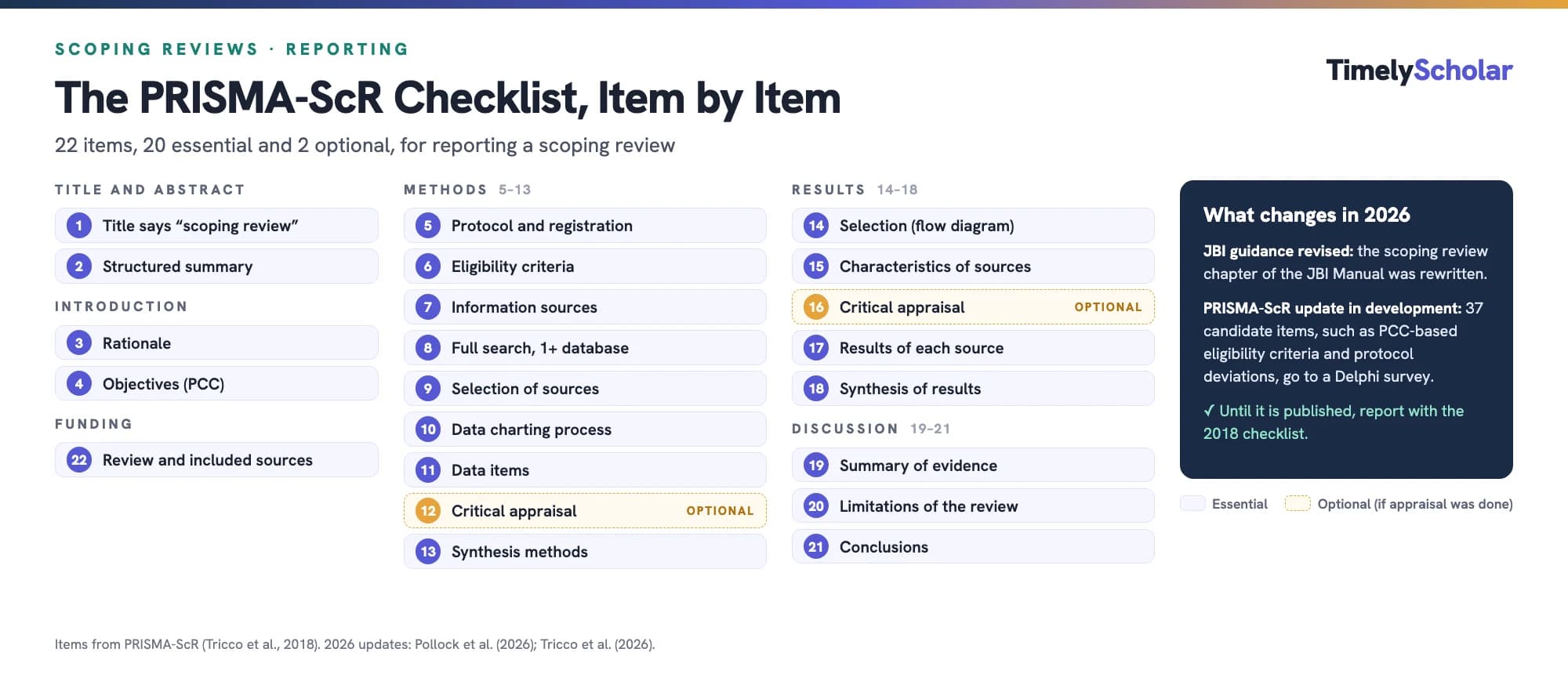
The PRISMA-ScR checklist is the reporting guideline for scoping reviews. It has 22 items, 20 essential and 2 optional, covering the title, abstract, introduction, methods, results, discussion, and funding [1]. To complete it, write the page or section where your manuscript reports each item, mark the two optional critical appraisal items (12 and 16) as not applicable if you did not appraise your sources, and submit the checklist with your manuscript. The 2018 version is still the current checklist; an update is in development [2].
Working on a scoping review? Our specialists follow JBI methods and PRISMA-ScR. Get a free quote →
What is the PRISMA-ScR checklist?
PRISMA-ScR (the Preferred Reporting Items for Systematic Reviews and Meta-Analyses extension for Scoping Reviews) was published in 2018. A 24-member expert panel and two research leads developed it following EQUATOR Network guidance, and the explanatory paper gives a rationale and an example of good reporting for every item [1]. The official checklist and the developers' tip sheets for each item are free on the PRISMA website [3].
PRISMA-ScR is a reporting guideline: it tells you what a finished scoping review should report, not how to conduct one. For the methods themselves, most authors follow JBI guidance, which was revised in 2026 [4], or the frameworks of Arksey and O'Malley and Levac et al. [5,6]. Our step-by-step guide to conducting a scoping review covers the conduct; this guide covers the reporting, item by item.
The 22 PRISMA-ScR items by section
| Section | Items | What they cover |
|---|---|---|
| Title | 1 | Identify the report as a scoping review |
| Abstract | 2 | Structured summary |
| Introduction | 3-4 | Rationale and objectives |
| Methods | 5-13 | Protocol, eligibility, sources, search, selection, data charting, data items, critical appraisal (optional), and synthesis methods |
| Results | 14-18 | Selection of sources, their characteristics, critical appraisal (optional), results of individual sources, and synthesis |
| Discussion | 19-21 | Summary of evidence, limitations, and conclusions |
| Funding | 22 | Funding of the included sources and of the review |
Because a scoping review can include qualitative research, expert opinion, and policy documents as well as studies, PRISMA-ScR uses the term sources of evidence rather than studies, and critical appraisal rather than risk of bias [1]. Using the same terms in your manuscript makes the checklist easier to match.
How to complete the PRISMA-ScR checklist
Download the official checklist in Word or PDF from the PRISMA website [3], or record the items with our free PRISMA-ScR checklist tool and copy it into Word.
Complete it when the manuscript is final. For each item, give the page number, or the section heading if the journal will repaginate the manuscript.
Point to supplementary files where an item is reported there, such as the full search strategy (item 8) or the list of sources excluded at full text with reasons.
Mark items 12 and 16 as not applicable if you did not appraise the sources, and say so in your methods so readers know it was a decision rather than an omission.
Cite PRISMA-ScR in your methods, for example: "This review is reported in line with the PRISMA extension for scoping reviews (PRISMA-ScR)."
Check every reference before you submit. Page numbers drift with each revision, and a checklist that points to the wrong page invites a reviewer query.
Example: part of a completed PRISMA-ScR checklist (hypothetical review of digital mental health tools for university students)
| Item | Topic | Reported on page | Note |
|---|---|---|---|
| 1 | Title | 1 | "... a scoping review" in the title |
| 5 | Protocol and registration | 4 | Protocol on OSF, with its DOI |
| 8 | Search | 5; Supplementary file 1 | Full MEDLINE strategy in the supplement |
| 12 | Critical appraisal of individual sources | 5 | Not done; rationale stated (not applicable) |
| 16 | Critical appraisal within sources | Not applicable | No appraisal was conducted |
| 22 | Funding | 14 | Funding of the review and of the included sources |
Title, abstract, and introduction (items 1-4)
Item 1: title
Identify the report as a scoping review in the title [1], so that it is indexed and found as one. Put the topic first and the design after a colon.
Example title (hypothetical review)
"Digital mental health tools for university students: a scoping review"
Item 2: structured summary
The abstract should cover, as applicable, the background, objectives, eligibility criteria, sources of evidence, charting methods, results, and conclusions that relate to the review questions [1]. Many journals set their own abstract headings; use the journal's headings and ensure each element appears under one of them.
Example structured abstract (hypothetical review)
Objective: To map the digital mental health tools evaluated with university students, the outcomes measured, and the evidence gaps.
Eligibility criteria: Sources of any design on digital tools for students in higher education, published from 2015.
Sources of evidence: MEDLINE, Embase, PsycINFO, CINAHL, and gray literature, searched in March 2026.
Charting methods: Two reviewers charted data independently using a piloted form; results were summarized with frequency counts and basic content analysis.
Results: Of 936 records screened, 55 sources were included. Mindfulness and CBT-based apps were the most studied tools, and anxiety and depression the most measured outcomes; costs were rarely reported.
Conclusions: Evidence is growing but concentrated in high-income countries; peer support platforms, chatbots, and costs need further research.
Items 3 and 4: rationale and objectives
The rationale should explain what is already known and why the question suits a scoping review approach [1]. Typical reasons are mapping a broad or emerging field, clarifying concepts or definitions, examining how research has been conducted, identifying gaps, or checking whether a systematic review is warranted [7]. Our comparison of systematic reviews, meta-analyses, and scoping reviews can help you justify the choice.
State the objectives and questions explicitly, with their key elements, usually the population, concept, and context (PCC) [1]. The same PCC elements should then reappear in your eligibility criteria and your data charting form. You can draft PCC criteria with our free eligibility criteria builder.
Methods (items 5-13): what to report
The methods items are where most reporting gaps occur, because each one asks for details that are easy to leave out of a word-limited manuscript. Put long material, such as search strategies and charting forms, in supplementary files and point to them from the checklist.
PRISMA-ScR methods items, with example wording (hypothetical review)
| Item | What to report | Example wording |
|---|---|---|
| 5. Protocol and registration | Whether a protocol exists, where to access it, and any registration number | "The protocol was registered on the Open Science Framework before screening began (DOI ...)." |
| 6. Eligibility criteria | Characteristics of eligible sources (years, language, publication status), with a rationale | "We included sources published from 2015, when app-based tools became widely available, in any language." |
| 7. Information sources | All sources searched, with dates of coverage, and the date of the most recent search | "MEDLINE (Ovid, 1946 onward) ... searched on March 14, 2026; reference lists of included sources were screened." |
| 8. Search | The full electronic strategy for at least one database, with any limits, so it could be repeated | "The full MEDLINE strategy is in Supplementary file 1." |
| 9. Selection of sources | The screening and eligibility process | "Two reviewers independently screened titles, abstracts, and full texts after a pilot on 50 records." |
| 10. Data charting process | How data were charted: forms, piloting, independent or duplicate charting, and contact with authors | "The form was piloted on five sources; two reviewers charted each source independently." |
| 11. Data items | All variables charted, with definitions, assumptions, and simplifications | "Charted items and definitions are in Supplementary file 2." |
| 12. Critical appraisal (optional) | If done: rationale, methods, and how results were used | "Consistent with the review's aim, sources were not critically appraised." |
| 13. Synthesis of results | How the charted data were handled and summarized | "We summarized data with frequency counts and basic qualitative content analysis." |
Item 5: protocol and registration
PRISMA-ScR asks whether a protocol exists, where it can be accessed and, if registered, the registration number [1]. JBI requires an a priori protocol and asks authors to report any deviations from it, with reasons, in the final review [4,8]. PROSPERO does not accept scoping reviews, so protocols are usually registered on the Open Science Framework (OSF) or Figshare; publishing the protocol in a journal is optional [4]. Our scoping review protocol template lists the headings to include.
Item 8: search
Report the full search strategy for at least one database, including limits, in enough detail to be repeated [1]. The developers' tip sheets also suggest stating who designed and ran the search (e.g., an information specialist), whether it was peer-reviewed with the PRESS checklist, and how you searched gray literature [3,9]. For a more complete search report, follow PRISMA-S [10]. When you search Google or Google Scholar, state in advance how many results you will screen [4].
Tip: Build and document the strategy with our free PubMed search strategy builder, then convert it for other databases with the search string translator.
Item 9: selection of sources of evidence
Describe the whole selection process: how many reviewers screened, whether they worked independently, any pilot or calibration exercise, and how disagreements were resolved [1,3]. JBI recommends that at least two people screen titles, abstracts, and full texts independently. If that is not feasible, one person can screen while a second checks a proportion of the decisions, or checks all the exclusions; single-reviewer screening is not recommended outside rapid scoping reviews [4].
JBI also asks for the reasons each full text was excluded, listed in a supplementary file, and for backward and forward citation searching of the included sources. If you could not search citations, acknowledge it as a limitation [4]. Record the number of duplicates removed, because item 14 needs it; our reference deduplication tool gives you that number.
Items 10 and 11: data charting and data items
Item 10 asks how data were charted: the form, whether it was calibrated or piloted, whether charting was done independently or in duplicate, and how data were obtained or confirmed from investigators [1]. Item 11 asks you to list and define every charted variable, with any assumptions or simplifications [1]. JBI recommends written guidance for the form, a pilot with everyone who will chart, and two people charting each source independently, or one charting and another checking all or part of the work [4,11].
Our guide to data charting in a scoping review includes a charting form template and worked examples, and the free data extraction form builder produces a Word or spreadsheet form you can attach as the item 11 supplement.
Item 13: synthesis of results
Describe how the charted data were handled and summarized [1]: for example, frequency counts of source characteristics, basic qualitative content analysis of text data, and how the results are presented, in tables, charts, or an evidence map, for each review question [11]. Avoid describing methods a scoping review does not use, such as pooling effect sizes.
Critical appraisal in a scoping review: items 12 and 16
Critical appraisal is optional in PRISMA-ScR. Item 12 applies only if you appraised the sources: give the rationale, the methods, and how the results were used in the synthesis. Item 16 asks you to present the appraisal results [1]. These are the two optional items; all the others are essential.
JBI does not advocate critical appraisal or risk-of-bias assessment in scoping reviews. Appraisal judges the validity of findings so that they can inform practice and policy recommendations, and a scoping review's questions do not usually need that [4]. JBI describes a few exceptions [4]:
Mapping the quality of a field, where describing the level of bias or quality across the evidence is part of the review's aim.
Equity questions, such as whether sources adequately addressed equity issues.
A request from a funder or decision-maker who wants to know both what evidence exists and its quality.
Even then, the appraisal results describe the evidence and should not be used to make recommendations for clinical or policy change [4]. If you do appraise, name a tool that matches each source type, say how many reviewers appraised each source and how they were calibrated, and explain how the results were used, for example charted and summarized descriptively [3]. Our free JBI critical appraisal checklists and AMSTAR 2 checklist record judgments and draw the summary plots.
Example wording for item 12 (hypothetical review)
Not appraised: "In line with JBI guidance and the aim of mapping the available evidence, we did not critically appraise the included sources."
Appraised: "Because the funder asked us to describe the quality of the evidence, two reviewers independently appraised each primary study with the relevant JBI checklist after calibrating on five studies. Appraisal results were charted and summarized descriptively and were not used to exclude sources."
Results, discussion, and funding (items 14-22)
PRISMA-ScR results, discussion, and funding items
| Item | What to report | Usual format |
|---|---|---|
| 14. Selection of sources | Numbers screened, assessed, and included, with reasons for exclusion at each stage | Flow diagram plus a short paragraph |
| 15. Characteristics of sources | The charted characteristics of each source, with its citation | Characteristics table, often a supplement |
| 16. Critical appraisal (optional) | Appraisal results, if appraisal was done | Table or short paragraph |
| 17. Results of individual sources | The charted data that relate to the review questions, for each source | Detailed table, usually a supplement |
| 18. Synthesis of results | A summary of the charting results for each question | Frequency tables, figures, and narrative |
| 19. Summary of evidence | The main results, including the concepts, themes, and types of evidence, linked to the questions and their relevance to key groups | First part of the discussion |
| 20. Limitations | Limitations of the scoping review process | Discussion |
| 21. Conclusions | A general interpretation for each question, with implications or next steps | Conclusions |
| 22. Funding | Funding of the included sources and of the review, and the role of the review's funders | Funding statement |
Item 14 asks for a flow diagram where possible [1]. PRISMA-ScR does not supply a separate template, so you can adapt the PRISMA 2020 flow diagram [12], using "sources of evidence" in place of "studies". Our free PRISMA flow diagram generator checks that the numbers add up and lets you title it as a PRISMA-ScR flow diagram. Items 15 to 18 are covered in detail, with example tables and wording, in our guide to the results section of a scoping review.
In the discussion, item 20 is about the limitations of the review process, such as language limits, sources that could not be retrieved, or citation searching that was not done, not only the limitations of the included sources [1,3,4]. Report any deviations from the protocol here or in the methods, with their likely effect on the results [3].
Tip: Item 22 includes the funding of the included sources, which is often missed. Add a funding field to your charting form so you can report it without returning to every source.
Reporting knowledge user engagement and ethics
Levac et al. recommended consultation with stakeholders as a stage of a scoping review [6], and JBI now encourages engaging knowledge users, such as patients, clinicians, and policymakers, at any stage, from developing the question to interpreting and sharing the results [4,13]. PRISMA-ScR 2018 has no item for this [4], so describe it in the methods: who was involved, at which stages, how, and what changed as a result. JBI's guidance gives specific advice on reporting and evaluating this engagement [13].
A review of published sources does not usually need ethics approval. US regulations, for example, define a human subject as a living individual from whom researchers obtain information through intervention or interaction, or about whom they obtain identifiable private information [14], and analyzing published documents does neither. Collecting data from knowledge users through interviews, surveys, or focus groups can be different, so check with your institution's ethics board before you start.
What is changing in 2026: JBI guidance and the PRISMA-ScR update
JBI revised its scoping review chapter in 2026 [4]. The revised chapter, by Pollock et al., follows the steps of a review: forming and managing the team, engaging knowledge users, software and automation, the protocol, and then searching, selecting, extracting, analyzing, presenting, and summarizing the evidence. It also notes that the PRISMA-ScR extension is being updated, with a new version due in 2026 [4].
The PRISMA-ScR update group published a scoping review in 2026 to identify candidate reporting items [2]. From 43 documents (13 overviews of scoping reviews and 30 guidance documents), it identified 37 potential new items, which will be evaluated in a Delphi survey. The additions most often related to objectives, eligibility criteria, the search strategy, the data collection process, and the results of the synthesis. New items included reporting the eligibility criteria with a framework such as PCC, reporting deviations from the protocol, and presenting results visually with supporting text [2]. The update also aims to align with PRISMA 2020 and to involve patients and public partners [2].
Tip: Until a new checklist appears on the PRISMA website, report with the 2018 checklist. Reporting PCC-based eligibility criteria, protocol deviations, and a narrative alongside every figure costs little now and anticipates the update.
Common PRISMA-ScR reporting gaps
A title that does not say "scoping review" (item 1).
No protocol statement, or a plan to register in PROSPERO, which does not accept scoping reviews (item 5).
Search terms listed but no complete strategy for at least one database (item 8).
Screening and charting described without the number of reviewers, piloting, or how disagreements were resolved (items 9 and 10).
Charted variables not listed or defined (item 11).
Items 12 and 16 left blank instead of being marked not applicable, with a statement in the methods.
Effect sizes, pooled estimates, or practice recommendations, which a scoping review cannot support (items 13, 18, and 21).
Limitations of the included studies only, with nothing on the review process (item 20).
No funding information for the included sources (item 22).
Checklist page numbers that no longer match the revised manuscript.
Getting help with your scoping review
If you would like experienced reviewers to check your manuscript against PRISMA-ScR, complete the checklist, draft the protocol, or build the flow diagram and evidence gap map, see our scoping review service. Every quote is itemized and you pay only after you accept it.
Frequently asked questions
What is the PRISMA-ScR checklist?
PRISMA-ScR is the PRISMA extension for scoping reviews, published in 2018. It lists the items a scoping review should report, from the title and abstract to the methods, results, discussion, and funding. Journals usually ask authors to submit it with the manuscript.
How many items are in the PRISMA-ScR checklist?
22 items: 20 essential and 2 optional. The optional items are 12 (critical appraisal of individual sources of evidence) and 16 (critical appraisal within sources of evidence).
Is critical appraisal required in a scoping review?
No. Critical appraisal is optional in PRISMA-ScR, and JBI does not advocate it in scoping reviews because their questions do not usually need it. If you do appraise, explain why, describe the methods, and present the results descriptively.
Where can I download the PRISMA-ScR checklist in Word or PDF?
The official fillable checklist is free in Word and PDF on the PRISMA website (prisma-statement.org/scoping), with a tip sheet for each item. You can also complete it with our free online PRISMA-ScR checklist tool and copy the result into Word.
Does a scoping review need to be registered?
PRISMA-ScR asks you to say whether a protocol exists, where it can be found, and any registration number. JBI requires an a priori protocol. PROSPERO does not accept scoping reviews, so register the protocol on the Open Science Framework or Figshare, or publish it in a journal.
Does a scoping review need two reviewers?
JBI recommends that at least two people screen titles, abstracts, and full texts independently, and that two people chart each source. If that is not feasible, a second person can check a proportion of the screening or charting. Report the approach under items 9 and 10.
Does a scoping review need ethical approval?
Usually not, because analyzing published sources does not involve human participants. If you consult knowledge users through interviews, surveys, or focus groups, check with your institution's ethics board, as that may count as research with human participants.
What is the difference between PRISMA-ScR and PRISMA 2020?
PRISMA 2020 is for systematic reviews and includes items on effect measures, risk of bias, and certainty of evidence. PRISMA-ScR adapts PRISMA for scoping reviews: it talks about sources of evidence and data charting, and it makes critical appraisal optional.
Is PRISMA-ScR being updated?
Yes. An update is in development: JBI says a new version is due in 2026, and a 2026 scoping review by the update group identified 37 potential new reporting items for a Delphi survey. Keep using the 2018 checklist until the new version is published.
How do I cite PRISMA-ScR?
Cite the explanatory paper: Tricco AC, Lillie E, Zarin W, et al. PRISMA extension for scoping reviews (PRISMA-ScR): checklist and explanation. Ann Intern Med. 2018;169(7):467-473. doi:10.7326/M18-0850.
References
- Tricco AC, Lillie E, Zarin W, O'Brien KK, Colquhoun H, Levac D, et al. PRISMA Extension for Scoping Reviews (PRISMA-ScR): checklist and explanation. Ann Intern Med. 2018;169(7):467-73. doi:10.7326/M18-0850
- Tricco AC, Robinson E, Straus SE, Colquhoun H, Godfrey CM, Moher D, et al. Updating the PRISMA reporting guideline for scoping reviews: a scoping review. J Clin Epidemiol. 2026;196:112314. doi:10.1016/j.jclinepi.2026.112314
- PRISMA Executive. PRISMA for scoping reviews (PRISMA-ScR): checklist, explanatory paper and tip sheets [Internet]. PRISMA Executive; [date unknown] [cited 2026 Oct 26]. Available from: https://www.prisma-statement.org/scoping
- Pollock D, Peters MDJ, Tricco AC, Munn Z, Jia RM, Alexander L, et al. Chapter 10: scoping reviews. In: Aromataris E, Lockwood C, Porritt K, Pilla B, Jordan Z, editors. JBI manual for evidence synthesis. Adelaide: JBI; 2026 [cited 2026 Oct 26]. Available from: https://jbi-global.atlassian.net/wiki/spaces/MANUAL/pages/355862497/10.+Scoping+reviews
- Arksey H, O'Malley L. Scoping studies: towards a methodological framework. Int J Soc Res Methodol. 2005;8(1):19-32. doi:10.1080/1364557032000119616
- Levac D, Colquhoun H, O'Brien KK. Scoping studies: advancing the methodology. Implement Sci. 2010;5(1):69. doi:10.1186/1748-5908-5-69
- Munn Z, Peters MDJ, Stern C, Tufanaru C, McArthur A, Aromataris E. Systematic review or scoping review? Guidance for authors when choosing between a systematic or scoping review approach. BMC Med Res Methodol. 2018;18(1):143. doi:10.1186/s12874-018-0611-x
- Peters MDJ, Godfrey C, McInerney P, Khalil H, Larsen P, Marnie C, et al. Best practice guidance and reporting items for the development of scoping review protocols. JBI Evid Synth. 2022;20(4):953-68. doi:10.11124/JBIES-21-00242
- McGowan J, Sampson M, Salzwedel DM, Cogo E, Foerster V, Lefebvre C. PRESS peer review of electronic search strategies: 2015 guideline statement. J Clin Epidemiol. 2016;75:40-6. doi:10.1016/j.jclinepi.2016.01.021
- Rethlefsen ML, Kirtley S, Waffenschmidt S, Ayala AP, Moher D, Page MJ, et al. PRISMA-S: an extension to the PRISMA Statement for reporting literature searches in systematic reviews. Syst Rev. 2021;10(1):39. doi:10.1186/s13643-020-01542-z
- Pollock D, Peters MDJ, Khalil H, McInerney P, Alexander L, Tricco AC, et al. Recommendations for the extraction, analysis, and presentation of results in scoping reviews. JBI Evid Synth. 2023;21(3):520-32. doi:10.11124/JBIES-22-00123
- Page MJ, McKenzie JE, Bossuyt PM, Boutron I, Hoffmann TC, Mulrow CD, et al. The PRISMA 2020 statement: an updated guideline for reporting systematic reviews. BMJ. 2021;372:n71. doi:10.1136/bmj.n71
- Pollock D, Alexander L, Munn Z, Peters MDJ, Khalil H, Godfrey CM, et al. Moving from consultation to co-creation with knowledge users in scoping reviews: guidance from the JBI Scoping Review Methodology Group. JBI Evid Synth. 2022;20(4):969-79. doi:10.11124/JBIES-21-00416
- US Department of Health and Human Services. Protection of human subjects: definitions for purposes of this policy (45 CFR 46.102) [Internet]. Washington (DC): Electronic Code of Federal Regulations; 2018 [cited 2026 Oct 26]. Available from: https://www.ecfr.gov/current/title-45/subtitle-A/subchapter-A/part-46/subpart-A/section-46.102

James has 7 years of experience in epidemiology, clinical research, public health, and evidence-based healthcare. He supports researchers and healthcare professionals through the whole evidence synthesis process, from refining a question and planning a protocol to reporting the results. Areas of expertise Systematic…