
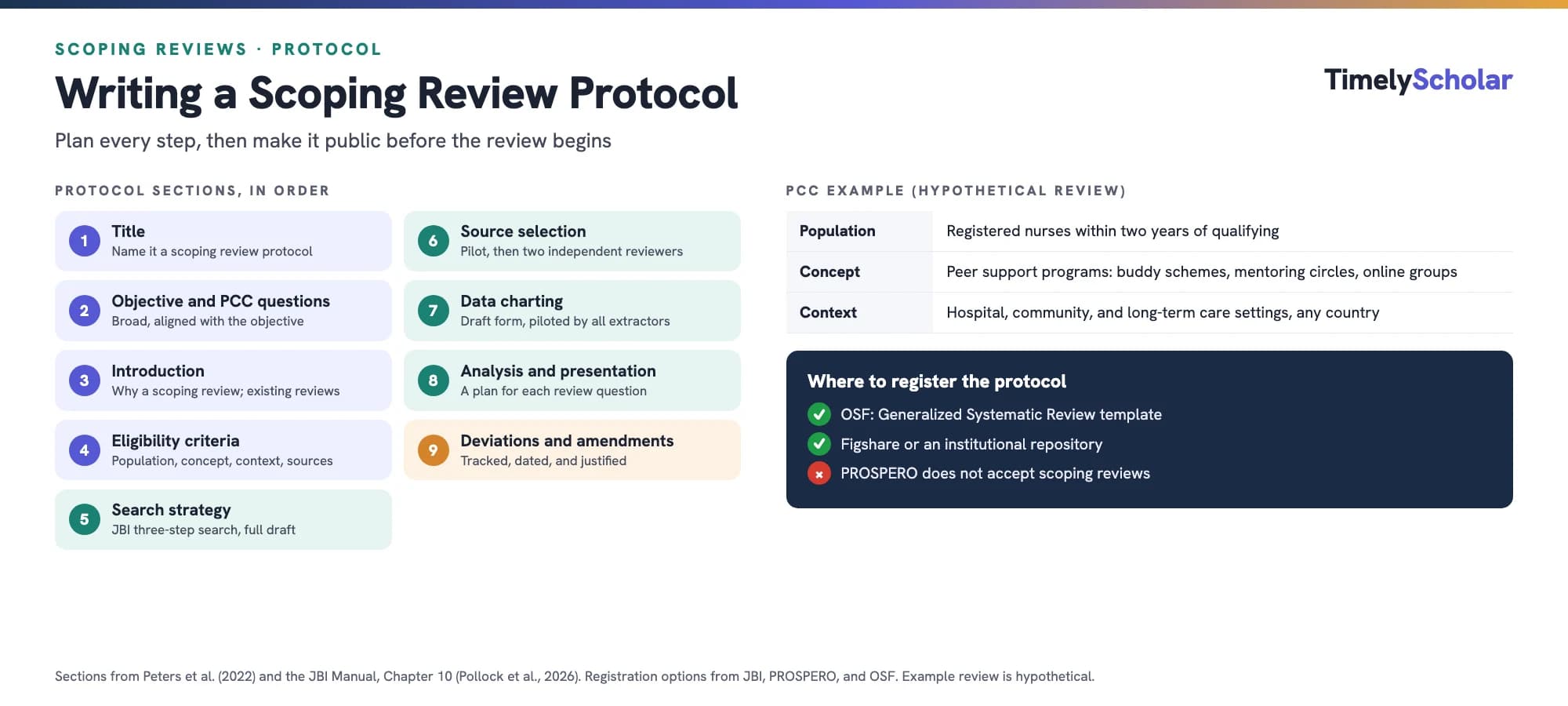
A scoping review protocol is the plan for your review, finalized and made public before the review begins [1]. JBI requires an a priori protocol for any scoping review that follows its methodology [2]. Following the JBI reporting items, a protocol covers the title (naming it a scoping review protocol), the objective and review questions framed with PCC (population, concept, and context), an introduction that justifies the scoping review, eligibility criteria, and the methods: search strategy, source selection, data extraction (charting), and data analysis and presentation, plus how you will handle deviations [1]. PROSPERO does not accept scoping reviews, so JBI suggests registering the protocol on the Open Science Framework (OSF), which offers a Generalized Systematic Review template, or posting it on Figshare [2,3].
Working on a scoping review? Our specialists follow JBI methods and PRISMA-ScR. Get a free quote →
What is a scoping review protocol, and do you need one?
A protocol is the plan for your review: what you will include, where and how you will search, and how you will select, chart, and present the evidence. Peters et al. describe it as a recipe that prespecifies the ingredients (the inclusion criteria), where and how to find them (the databases and search strategy), and the method [1]. Writing the plan first reduces ad hoc decisions that can introduce bias, helps you avoid duplicating an existing review, and lets readers detect selective reporting [1,2].
Do you need one? If you follow JBI methodology, yes: JBI requires an a priori protocol and treats it as a vital step before the review begins [2]. PRISMA-ScR, the reporting guideline for the finished review, encourages you to report whether a protocol exists, where it can be accessed, and its registration details, but does not make one mandatory [1,4]. Journals and supervisors vary, so check what yours expect [2]. Protocols have not always been the norm: a 2016 study cited by Peters et al. found that only 13% of published scoping reviews reported a priori protocol [1].
Start here: New to scoping reviews? Start with our step-by-step guide to how to do a scoping review, then come back here to write the protocol.
JBI, PRISMA-ScR, or PRISMA-P: which guidance should a protocol follow?
Three documents are often confused. They do different jobs:
Guidance for scoping review protocols and reviews
| Guidance | What it is for | When you use it |
|---|---|---|
| JBI Manual, Chapter 10 (2026) | How to conduct a scoping review, including the three protocol-development steps | Designing the protocol and the review [2] |
| Peters et al. (2022) | Reporting items for scoping review protocols, adapted from PRISMA-P, with a fillable checklist | Writing and checking the protocol [1] |
| PRISMA-ScR (2018) | Reporting items for the finished scoping review | Writing the final review; item 5 reports the protocol and registration [4] |
| PRISMA-P | Reporting items for systematic review protocols | Only when a journal asks for it, as some do for protocol submissions [5] |
In practice, design the review with the JBI Manual, write the protocol against the Peters et al. reporting items, and state in the methods that the final review will be reported with PRISMA-ScR [6]. Our guide to the PRISMA-ScR checklist explains every item of the final report.
Scoping review protocol template: what to write in each section
Use these headings in this order. They follow the sections Peters et al. discuss [1], with the details JBI asks for at the protocol stage [2]. Write in the future tense, because you are describing what you will do [6].
1. Title
Include the words scoping review and protocol, with keywords that match your PCC elements [1]. Don't phrase the title as a question [6]. For example: Peer support programs for newly graduated nurses: a scoping review protocol.
2. Objective and review questions
The objective is an active statement of what the review will do, and it must align with the review questions [2]. A vague or underspecified objective is a common problem in scoping review protocols [1]. Frame the questions with PCC: scoping review questions are broader than systematic review questions and generate rather than test hypotheses [2]. One PCC element can be dropped if it adds nothing, and PICO or PECO may be justified, for example when the scoping review will feed into a systematic review [2].
3. Introduction
Explain the topic, why it matters, and why a scoping review, rather than another type of evidence synthesis, is the right approach [1]. Then report whether similar scoping or systematic reviews already exist or are underway, ideally with the dates and the places you searched for them [1]. Our comparison of systematic reviews, meta-analyses, and scoping reviews helps with the justification.
4. Eligibility criteria
Break each PCC element into what you will include and exclude [2], without overlap or repetition between the elements [1]:
Population (participants): the important characteristics, such as age and any other qualifying criteria. JBI asks review teams to examine the PROGRESS-Plus framework for health equity [2].
Concept: the key issue or topic the review will explore [1], which may include interventions, phenomena of interest, or outcomes [2].
Context: the location or field of the concept or participants [1], such as acute care, primary health care, or the community, and any equity-related factors such as culture, geography, or gender [2].
Types of evidence sources: scoping reviews can include any relevant source, from primary studies to theses, reports, and websites, so state exactly which you will include. If you will include only empirical studies, call this section types of studies [2].
If you include both primary studies and reviews that already contain them, say how you will handle the duplicate data [1]. Our free eligibility criteria builder has a PCC mode for drafting this section.
5. Methods: opening statement
Open the methods by naming the methodology you will follow, such as the JBI methodology for scoping reviews [1], and the reporting guideline for the final review, PRISMA-ScR [6].
6. Search strategy
Who: involve a research librarian or information scientist in developing and running the search [1].
How: describe the JBI three-step search. First, an initial limited search, usually of MEDLINE and CINAHL, to find relevant articles and harvest their keywords and index terms. Second, a comprehensive search built from those terms in the key database, then translated for the other databases and gray literature sources. Third, supplementary searching of gray literature, reference lists, and citations [7]. JBI says backward and forward citation searching should be attempted in every scoping review [2].
Where: list the databases, search platforms, websites, and other sources you will search, and plan the gray literature search now [1,2].
When: give the earliest date your search will cover and justify it [1].
Show it: include a full draft search strategy for at least one database, usually as an appendix. JBI Evidence Synthesis requires one for protocol submissions [1]. You may note that the search could be refined during the review [1].
Our PubMed search strategy builder drafts the first database search, and the search string translator adapts it for other databases.
7. Source of evidence selection
State how many reviewers will screen, whether they will work independently, and how disagreements will be resolved [1]. JBI's ideal is at least two people independently screening every title and abstract; single-reviewer screening is not recommended except in rapid scoping reviews [2]. Describe the pilot. JBI suggests that the whole team independently screens a random sample of 25 titles and abstracts and starts full screening only when agreement reaches 75% or more [2]. Say that reasons for full-text exclusions will be recorded and reported [2] and that results will be shown in a PRISMA flow diagram [1].
Useful free tools at this stage: the reference deduplication tool, a Cohen's kappa calculator for pilot agreement, and the PRISMA flow diagram generator.
8. Data extraction (charting)
Include a draft data extraction form, usually a table, whose fields align with your review questions and go beyond the bare PCC elements [1,2]. For each item, JBI suggests recording its name, a description, the data format, and the possible values, such as study design as a nominal item [2]. Then describe:
Who extracts: best practice is two reviewers extracting independently; otherwise, one extracts and a second checks all or part of the work [2].
The pilot: everyone who will extract tests the form, each reviewer independently charting at least two to three sources of each type [2]. JBI advises limiting changes to the form to this piloting phase [2].
Missing data: a rule such as recording "not reported" or contacting authors [6].
Our guide to charting the data in a scoping review has a full charting form with worked examples, and our data extraction form builder creates a form you can export.
9. Critical appraisal (usually omitted)
Scoping reviews do not usually appraise the quality or risk of bias of included sources, and JBI does not advocate it, though exceptions exist, for example when a funder asks for it [2]. If you plan an appraisal, justify it and describe it in the extraction section, and do not use its results to decide which sources are included [1].
10. Data analysis and presentation
Don't stop at "descriptive statistics, tables, and a narrative summary." JBI asks for an analysis plan for each review question and extraction item [2]. Most scoping reviews count frequencies and report percentages [1,2], and text items can be analyzed with basic qualitative content analysis [8]. The JBI reporting items advise against thematic analysis, which ideally follows a methodological appraisal [1]. If a question needs a meta-analysis, it may be better suited to a systematic review [2].
Say how you will present the results: tables, bar charts, line or dot charts, world maps, or an evidence and gap map, each with a supporting narrative [2]. You only need to indicate the plan, because presentation may change as the review proceeds [1]. Our guide to the scoping review results section shows each format, and our evidence gap map generator draws one.
11. Consultation, deviations, funding, and conflicts of interest
If you will consult stakeholders, such as patients, caregivers, health care providers, or policymakers, describe when and how; JBI recommends consultation throughout the review, and their involvement must be acknowledged [9]. State whether ethics approval is needed [6]. Explain how you will record amendments, which should be tracked and dated [1], and that any deviations will be reported with reasons in the final review [2]. Finish with funding and the role of any funder [1], and conflicts of interest [6].
Scoping review protocol example (hypothetical)
Here is how the core sections read for one review question. The topic is invented to illustrate the structure; adapt every detail to your own review.
Worked example (hypothetical review)
Title: Peer support programs for newly graduated nurses: a scoping review protocol.
Objective: to map the types of peer support programs offered to newly graduated registered nurses, how they are delivered, and which outcomes have been evaluated.
Review questions: (1) What peer support programs have been described for newly graduated nurses? (2) How are they delivered (format, duration, facilitator)? (3) Which outcomes have evaluations measured?
Population: registered nurses within two years of qualifying; nursing students and experienced nurses are excluded.
Concept: peer support programs, such as buddy schemes, peer mentoring circles, and online peer groups; formal one-to-one preceptorship by senior nurses is excluded.
Context: hospital, community, and long-term care settings in any country.
Types of evidence sources: primary studies of any design, program evaluations, theses, and gray literature reports, in any language the team can translate, from a start date justified in the protocol.
Search: developed with a health sciences librarian using the JBI three-step search; full draft MEDLINE search in Appendix 1; backward and forward citation searching of included sources.
Selection: pilot on 25 random records until agreement reaches 75%, then two independent reviewers at both stages, with a third reviewer resolving disagreements.
Charting: draft form in Appendix 2 (citation, country, setting, source type, program name and format, duration, facilitator, outcomes measured, author-reported gaps), piloted on three sources of each type; two independent extractors.
Analysis and presentation: frequency counts by program type, setting, and outcome; a table of programs and an evidence and gap map of programs against outcomes, each with a narrative summary.
Registration: OSF, using the Generalized Systematic Review template, after the screening pilot and before full screening begins; the final review will be reported with PRISMA-ScR.
Where do you register a scoping review protocol?
Not on PROSPERO. PROSPERO lists scoping reviews among the reviews it does not register; its registration form returns the message "PROSPERO does not currently accept scoping reviews" if the title or review question contains the word, and it points authors of out-of-scope reviews to the Open Science Framework [10]. JBI and the protocol reporting guidance give the same advice [1,2].
On OSF. OSF Registries offer a Generalized Systematic Review template designed for systematic reviews, scoping reviews, and meta-analyses [3]. The form was built to work across disciplines and review types, including scoping reviews, and asks for the review type, background and goals, search strategy, screening, extraction, and synthesis plan [11]. Other options are Figshare, ResearchGate, or an institutional page, where a library or repository may be able to assign a DOI [1,2].
How to register a scoping review protocol on OSF, step by step
From My Registrations, click Add a Registration, and choose whether to start from scratch or from an existing OSF project [3].
Choose the Generalized Systematic Review template and select Create Draft. Drafts save automatically as you move between sections, so the team can return to it [3].
Complete every item. All items on the form are mandatory, so if one does not apply to your scoping review, say so and give the reason [11]. Keep your full protocol with the registration so readers can compare it with the final review.
On the Review page, check your answers and select Register. Make it public now or place it under an embargo of up to four years [3].
Admin contributors have 48 hours to approve or cancel, after which the registration is approved automatically. A public registration receives a DOI, which serves as your registration number [3].
Once registered, the record is frozen: it can't be edited or deleted. To change the plan, you submit an update with a written justification. Withdrawing a registration can't be undone, and the withdrawal stays visible [3].
When to register: after the protocol is final and before the review starts [1]. Lely et al. suggest making the protocol public, ideally after piloting your methods [6]. Registering before full screening shows that your criteria and methods were fixed before you screened the evidence.
Should you publish your scoping review protocol in a journal?
Publication is optional. JBI notes that it costs money, that many journals do not accept protocols, and that responding to reviewers can add substantial time before the review begins [2]. A registered protocol on OSF meets JBI's requirement. If you do want a journal, check its protocol rules before you start screening:
Systematic Reviews (BMC) publishes protocols only if the review has not reached the final data extraction stage, requires a completed PRISMA-P checklist, and asks for your registration number as the last line of the abstract [5].
JMIR Research Protocols is where JMIR Publications sends protocol submissions, and it prefers protocols to be published before data collection starts. Protocols must use Introduction, Methods, Results, and Discussion headings, with a short Results section giving the study's status and timeline [12,13].
JBI Evidence Synthesis requires one full search strategy as an appendix to a submitted protocol [1].
How do you report deviations from your protocol?
Scoping reviews are iterative, so some changes can't be avoided. What matters is transparency: deviations must be justified and reported in the final review [2]. Track and date every amendment as you go [1], record a justification when you update an OSF registration [3], and in the final report state where the protocol can be accessed and its registration number under PRISMA-ScR item 5 [4]. A short table of what changed, when, and why is the clearest way to report it.
Scoping review protocol checklist
Before you register, check the protocol against this list, condensed from the JBI reporting items for scoping review protocols [1]. Their full fillable checklist is published as an appendix to the guidance.
Scoping review protocol checklist (condensed from Peters et al. [1])
| Section | Check that the protocol |
|---|---|
| Administrative information | Identifies itself as a scoping review protocol; gives registration details, contacts, contributions, an amendment plan, and funding sources and roles |
| Rationale and objectives | Justifies a scoping review over other synthesis types and states the questions with reference to the eligibility criteria |
| Eligibility criteria | Defines population, concept, context, and types of evidence sources |
| Information sources and search | Lists sources and dates and presents a draft search strategy for at least one database |
| Selection process | Describes screening at each stage, the number of reviewers, and how disagreements are resolved |
| Data collection | Includes a draft charting form and describes piloting and independent or checked extraction |
| Appraisal | States that no appraisal is planned or justifies and describes it |
| Analysis and presentation | Describes the planned analysis and indicates how results will be presented |
Our free PRISMA-ScR checklist tool tracks the matching items when you write the final review.
Common scoping review protocol mistakes
A vague objective, or questions that don't match it [1].
Using PICO without a reason when PCC fits the broad question better.
No draft search strategy, or a search with no librarian involved.
Planning a risk-of-bias assessment without justification, or using it to exclude sources.
A charting form that only repeats PCC instead of answering each review question.
An analysis plan that says only "descriptive statistics" with no plan for each question.
Trying to register on PROSPERO, or registering after screening has started.
Silent deviations: changes made during the review but never reported.
Getting help with your scoping review protocol
If you would like help shaping a PCC question, drafting and peer reviewing the search strategy, building and piloting the charting form, or registering the protocol on OSF, see our scoping review service. Our PhD-led reviewers screen independently in duplicate, and you keep ownership of your question and conclusions.
Frequently asked questions
Do scoping reviews need a protocol?
If you follow the JBI methodology, yes: JBI requires an a priori protocol before the review begins. PRISMA-ScR asks you to report whether a protocol exists and where to find it, but it does not require one.
Can you register a scoping review on PROSPERO?
No. PROSPERO does not accept scoping reviews and directs authors to the Open Science Framework. Register the protocol on OSF, which offers a Generalized Systematic Review template for scoping reviews, or post it on Figshare.
What should a scoping review protocol include?
A title naming it a scoping review protocol, the objective and PCC review questions, an introduction justifying the scoping review, eligibility criteria, and methods covering the search strategy, source selection, data charting, and analysis and presentation, plus how deviations will be handled.
How do you register a scoping review protocol on OSF?
In OSF, choose Add a Registration, select the Generalized Systematic Review template, complete every item, and register it publicly or under embargo. A public registration receives a DOI, which serves as the registration number.
Can I change my scoping review protocol after registering it?
Yes, but transparently. An OSF registration can't be edited, so you submit an update with a justification, and every deviation must be reported with reasons in the final review.
Does a scoping review protocol need a critical appraisal section?
Usually not. Scoping reviews do not normally appraise included sources. If you plan an appraisal, justify it and make sure its results do not decide which sources are included.
Should a scoping review protocol be written in the future tense?
Yes. The protocol describes what you will do, so write it in the future tense, then switch to the past tense in the final review.
Do I have to publish my protocol in a journal?
No. Journal publication is optional; registering the protocol on a public platform such as OSF meets JBI's requirements. If you choose a journal, check its rules, because some only accept protocols before data extraction starts.
References
- Peters MDJ, Godfrey C, McInerney P, Khalil H, Larsen P, Marnie C, et al. Best practice guidance and reporting items for the development of scoping review protocols. JBI Evid Synth. 2022;20(4):953-68. doi:10.11124/JBIES-21-00242
- Pollock D, Peters MDJ, Tricco AC, Munn Z, Jia RM, Alexander L, et al. Chapter 10: scoping reviews. In: Aromataris E, Lockwood C, Porritt K, Pilla B, Jordan Z, editors. JBI manual for evidence synthesis. Adelaide: JBI; 2026 [cited 2026 Oct 26]. Available from: https://jbi-global.atlassian.net/wiki/spaces/MANUAL/pages/355862497/10.+Scoping+reviews
- Center for Open Science. Welcome to registrations & preregistrations! [Internet]. Charlottesville (VA): OSF Support; 2026 [cited 2026 Nov 14]. Available from: https://help.osf.io/article/330-welcome-to-registrations
- Tricco AC, Lillie E, Zarin W, O'Brien KK, Colquhoun H, Levac D, et al. PRISMA Extension for Scoping Reviews (PRISMA-ScR): checklist and explanation. Ann Intern Med. 2018;169(7):467-73. doi:10.7326/M18-0850
- Systematic Reviews. Submission guidelines: protocol [Internet]. London: BioMed Central; [date unknown] [cited 2026 Nov 14]. Available from: https://link.springer.com/journal/13643/submission-guidelines/protocol
- Lely J, Morris HC, Sasson N, Camarillo ND, Livinski AA, Butera G, et al. How to write a scoping review protocol: guidance and template [Internet]. OSF Registries; 2023. doi:10.17605/OSF.IO/YM65X
- Aromataris E, Lockwood C, Porritt K, Pilla B, Jordan Z, editors. JBI manual for evidence synthesis [Internet]. Chapter 2, Methodological considerations: 2.4.2 The JBI 3-step search process. Adelaide: JBI; 2024 [cited 2026 Oct 26]. Available from: https://jbi-global.atlassian.net/wiki/spaces/MANUAL/pages/653099013/2.4.2+The+JBI+3-Step+Search+Process
- Pollock D, Peters MDJ, Khalil H, McInerney P, Alexander L, Tricco AC, et al. Recommendations for the extraction, analysis, and presentation of results in scoping reviews. JBI Evid Synth. 2023;21(3):520-32. doi:10.11124/JBIES-22-00123
- Pollock D, Davies EL, Peters MDJ, Tricco AC, Alexander L, McInerney P, et al. Undertaking a scoping review: a practical guide for nursing and midwifery students, clinicians, researchers, and academics. J Adv Nurs. 2021;77(4):2102-13. doi:10.1111/jan.14743
- Centre for Reviews and Dissemination. PROSPERO: international prospective register of systematic reviews [Internet]. York (UK): University of York; [date unknown] [cited 2026 Oct 19]. Available from: https://www.crd.york.ac.uk/prospero/
- van den Akker OR, Peters GJY, Bakker CJ, Carlsson R, Coles NA, Corker KS, et al. Increasing the transparency of systematic reviews: presenting a generalized registration form. Syst Rev. 2023;12(1):170. doi:10.1186/s13643-023-02281-7
- JMIR Publications. What are the article types for JMIR Publications journals? [Internet]. Toronto: JMIR Publications; 2026 [cited 2026 Nov 14]. Available from: https://support.jmir.org/hc/en-us/articles/115004950787-What-are-the-article-types-for-JMIR-Publications-journals
- JMIR Publications. When should I publish my protocol/proposal/methods paper? Is there a policy against publishing a protocol after data collection? [Internet]. Toronto: JMIR Publications; 2026 [cited 2026 Nov 14]. Available from: https://support.jmir.org/hc/en-us/articles/115000415652

Emily brings 12 years of experience in higher education. She provides senior-level oversight for complex research projects, helping teams clarify scope, align research questions with methods, and strengthen the logic and reporting of their work. Areas of expertise Oversight of institutional research and research…