
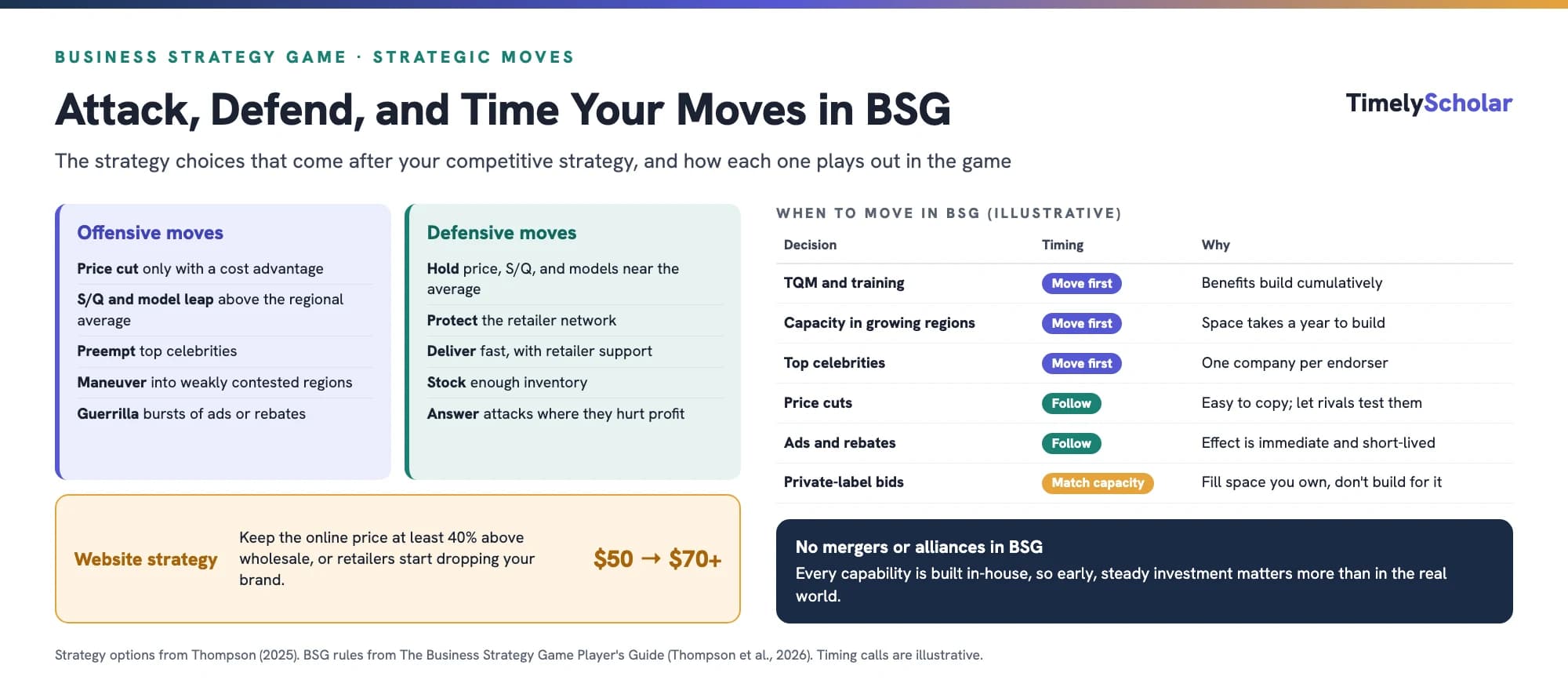
After choosing a competitive strategy, a Business Strategy Game (BSG) team still has to decide how to attack rivals, how to defend its position, what role its website plays, which activities to keep in-house, and when to move. In BSG, offensive moves include targeted price cuts, S/Q and model leaps, celebrity bids, and pushes into regions where rivals are weak. Defensive moves keep your price, S/Q rating, models, and retailer support close to or above the regional average so challengers gain little. Online sales should support, not undercut, your retailers: keep the online price at least 40% above your wholesale price. Timing matters most for investments that accumulate or take a year to arrive, such as TQM, training, celebrity contracts, and new plant capacity (Thompson, 2025; Thompson et al., 2026).
Playing the Business Strategy Game? Get coaching on strategy and the reports. Get a free quote →
Beyond the generic strategy: the full menu of strategy choices in BSG
Picking low-cost, differentiation, best-cost, or a focus strategy is only the first strategic choice. Thompson (2025) describes a menu with three further layers: complementary strategic moves (offensive and defensive actions, a website strategy, outsourcing, vertical integration, alliances, and mergers or acquisitions), functional-area strategies that support those moves, and decisions about timing. A strategy is complete only when all of these layers point the same way.
The Business Strategy Game does not offer every option on that menu. Your footwear company cannot buy a rival or form a joint venture, and it makes its shoes in company-operated plants rather than outsourcing production to contract manufacturers (Thompson et al., 2026). Even so, every item on the menu has a counterpart in the decisions you enter each year, and thinking in these terms helps your team explain why it made each decision, not just what it entered.
The strategy menu and its counterpart in BSG (Thompson, 2025; Thompson et al., 2026)
| Strategy option | What it means | Counterpart in BSG |
|---|---|---|
| Offensive moves | Actions to gain share or narrow a rival's advantage | Regional price cuts, S/Q and model leaps, celebrity bids, advertising pushes, aggressive private-label bids |
| Defensive moves | Actions to block or discourage attacks | Staying near or above the regional average on key factors, retailer support, a reliable record of answering price cuts |
| Website strategy | The role of online sales relative to retail partners | Online price, search engine ads, and free shipping on the Internet Marketing page |
| Outsourcing | Buying activities from outside specialists | Buying materials from outside suppliers; chain retailers outsource private-label pairs to you |
| Vertical integration | Running more stages of the industry value chain | Company-operated plants, distribution centers, and websites |
| Alliances, mergers, and acquisitions | Partnering with or buying other companies | Not available; celebrity endorsement contracts are the closest contractual partnership |
| Functional strategies | How each department supports the strategy | Production, compensation, marketing, private-label, CSR, and finance pages |
| Timing | First mover, fast follower, or late mover | When to invest in TQM, training, capacity, celebrities, and regional pushes |
If your team has not yet settled on a generic strategy, start with our guide to BSG competitive strategy: low-cost, differentiation, and best-cost. The moves below only work when they reinforce that choice.
Offensive strategies in BSG: how to attack rivals and win market share
Offensive strategies aim to gain profitable market share at rivals' expense, chip away at a stronger rival's advantage, or seize a new opportunity before others do. The best offensives share a pattern: they build on a real competitive advantage, use the element of surprise, hit rivals where they are least able to defend, and move decisively rather than in small, predictable steps (Thompson, 2025). Research on competitive dynamics adds a practical point: an attack pays off only if rivals are slow or unwilling to respond, so the likelihood and speed of a counterattack should shape every offensive (Chen & Miller, 2012).
Attack from strength, not weakness
Thompson (2025) warns that an offensive powered by weak resources rarely succeeds. A high-cost company that starts a price war is attacking with its weakest weapon, because its rivals can match the cut and still earn more per pair. In BSG terms, check your cost per pair against the industry figures in the Footwear Industry Report before cutting price. A company with an above-average S/Q rating and cumulative quality investment is better placed to attack on quality and selection, while a company with low costs per pair can attack on price. Our BSG internal analysis guide shows how to identify which of your resources can carry an attack.
The main offensive options and how they look in BSG
Offensive strategy options applied to BSG (Thompson, 2025; Thompson et al., 2026)
| Offensive option | BSG move | When it works |
|---|---|---|
| Equal or better product at a lower price | Cut the wholesale or online price in a region while holding S/Q and models | You already have a cost advantage, and the extra pairs outweigh the thinner margin |
| Leapfrog with next-generation technology | Jump well above the average S/Q, for example with new equipment or production improvement options | You can fund the investment and sustain the higher rating |
| Continuous product innovation | Steadily raise S/Q and models offered year after year | Your plants can absorb the set-up and quality costs |
| Attack a rival's profit sanctuary | Push hardest in the region where the leader earns most of its profit | The leader has visible weaknesses in that region |
| Attack competitive weaknesses | Target regions where rivals lag on S/Q, models, delivery time, or retailer support | Your strengths line up with their gaps |
| Maneuver around rivals | Build share in regions or segments where the average competitive effort is low | Rivals are concentrating on other regions |
| Guerrilla (hit-and-run) tactics | A one-year burst of rebates or advertising, or a sharp private-label bid | You are a smaller company and rivals are complacent |
| Preemptive strike | Win the top celebrity contracts or build capacity ahead of demand | The asset is scarce and hard for rivals to replicate |
Two of these options fit BSG especially well. The first is the preemptive strike. Each celebrity signs with only one company, at the highest annual offer, so winning a high-appeal celebrity both boosts your demand and denies that endorser to every rival for the length of the contract (Thompson et al., 2026). The second is maneuvering around rivals. Because demand in each region depends on your gap from the all-company average, a region where rivals underinvest lets you gain share at a lower cost than a region where everyone competes hard. Our guide to how to increase demand and market share in BSG explains the gap rule in detail.
Check the price-cut math before you attack on price
A price cut raises total profit only if the extra volume outweighs the lower margin on every pair (Thompson, 2025). The example below uses hypothetical figures for one region.
Illustrative price-cut break-even for one region (hypothetical figures)
| Scenario | Wholesale price | Cost per pair | Margin per pair | Pairs sold | Total margin |
|---|---|---|---|---|---|
| Before the cut | $60 | $42 | $18 | 1,000,000 | $18.0M |
| After a $4 cut, same volume | $56 | $42 | $14 | 1,000,000 | $14.0M |
| Volume needed to break even | $56 | $42 | $14 | 1,286,000 | $18.0M |
Here a 6.7% price cut needs about 29% more pairs just to stand still. A meta-analysis of price elasticities found an average of about −2.6 (Bijmolt et al., 2005), which would suggest a gain of roughly 17% from this cut, well short of break-even, and less still if rivals match the cut. In BSG the Wholesale Marketing page projects the effect instantly, so run the numbers before treating a price cut as an attack.
Attack on more than one front: The best BSG offensives combine factors. A modest price cut plus an S/Q increase and extra models in one region usually gains more profitable share than a deep price cut alone, because rivals find a multi-factor gap harder to close in a single year.
Choosing which rival to attack
Thompson (2025) names four kinds of targets: market leaders with clear weaknesses, runner-up firms that are weak where you are strong, struggling companies close to collapse, and small rivals with limited resources. In BSG, the Footwear Industry Report and the Competitive Intelligence Report show each rival's regional prices, S/Q ratings, models, and marketing spending. Look for a rival whose S/Q is falling, whose delivery times are slow, or whose image rating is slipping, and concentrate your effort in the regions where that rival depends most on sales. A successful attack does not have to make you the leader; becoming a much stronger runner-up can be enough to beat investor expectations.
Is a blue ocean strategy possible in BSG?
A blue ocean strategy creates a new market space where competition is irrelevant, instead of fighting over existing demand (Kim & Mauborgne, 2015). BSG's industry structure is fixed: every company sells branded footwear through wholesale and online channels and bids for private-label contracts in the same four regions. So a true blue ocean is not available. What you can do is find uncrowded space within the existing market, such as being the only company with a very high S/Q rating and a wide model line in a region, or the dominant private-label supplier in a region rivals ignore. That is a positioning move rather than a new market, and rivals can follow once they see your results.
Defensive strategies in BSG: how to protect your market position
Every company in a competitive market will be attacked at some point. Defensive strategies lower the chance of an attack, weaken the attacks that do happen, and push challengers toward other targets. They rarely create a competitive advantage, but they protect the one you have (Thompson, 2025). Thompson (2025) describes two kinds of defense: blocking the routes challengers could use, and signaling that an attack will be answered.
Blocking the routes challengers use
In the real world, a defender closes gaps by adding models, offering budget versions for price-sensitive buyers, improving service, and tying up distributors. BSG has close parallels:
Keep S/Q and models at or above the regional average. Because sales depend on gaps from the average, a challenger gains most where you have fallen below it. Holding your key factors near the average removes the easiest openings. See our BSG S/Q rating guide for what each extra star costs.
Protect your retailer network. Retail outlets carrying your brand grow only slowly, over several years, and depend on market share, S/Q rating, delivery time, retailer support, and an online price that does not undercut retailers (Thompson et al., 2026). A large network is hard for a rival to copy quickly.
Use delivery time and retailer support. Shorter delivery times and above-average retailer support make retailers less willing to switch their merchandising effort to a rival brand.
Bid for celebrities even when defending. Winning an endorser you do not strictly need can stop a rival from adding a high-appeal celebrity to its lineup, as long as the contract still pays for itself.
Hold inventory to fill demand. A stock-out hands your buyers to rivals; enough inventory to meet your delivery-time commitment keeps them.
Signaling that retaliation is likely
Signals work only if challengers believe them (Thompson, 2025). In BSG, rivals see your decisions mainly through the industry reports, so your signal is your track record. A team that has answered every regional price cut within a year, and that keeps cash and borrowing capacity in reserve, teaches rivals that attacking it is expensive. A team that never responds invites further attacks. Any arrangement with rival teams to fix prices or divide regions, however, would mirror illegal collusion in real markets, so check your instructor's rules on communication between companies.
Defend selectively: Respond to an attack where it hurts your profit, not everywhere. Matching a rival's price cut in every region can cost more than the share you would lose by holding your price in the one region where the attack happened.
Website strategy in BSG: online sales without channel conflict
Thompson (2025) describes five possible roles for a company website: an information-only site that sends buyers to retailers, a minor sales channel, one of several important channels, the primary channel, or the only channel. The central risk is channel conflict: when a manufacturer pushes online sales at low prices, it competes with its own retailers, who may respond by promoting rival brands instead. Research on omnichannel retailing reaches a similar conclusion: channels should be managed together so they reinforce rather than cannibalize each other (Verhoef et al., 2015).
BSG builds this trade-off directly into the game. Every company sells branded footwear both to retailers and online at its regional websites. Online sales start at 15% of branded sales in each region and are expected to rise by about one percentage point a year to 25% by Year 20 (Thompson et al., 2026). You set three online decisions per region: the online retail price (up to $200 per pair), search engine advertising, and whether to charge buyers $12.50 per pair for shipping or offer free shipping. Entering an online price of $0 withdraws from online sales in that region.
The 40% rule
Retailers treat your website as a direct threat whenever your online price is less than 40% above your wholesale price to them. The further your online price falls below that line, the more retailers decline to stock your brand the following year (Thompson et al., 2026). This is channel conflict in numbers.
Minimum online price under the 40% rule, with and without free shipping (illustrative)
| Wholesale price | Minimum online price | Online price if you also recover the $12.50 free-shipping cost |
|---|---|---|
| $50 | $70.00 | $82.50 |
| $55 | $77.00 | $89.50 |
| $60 | $84.00 | $96.50 |
| $65 | $91.00 | $103.50 |
Free shipping is very attractive to online buyers, but it costs $12.50 per pair, so most companies raise the online price to recover some or all of it. The right column shows the price if you recover the full amount; you can recover less if the extra volume justifies it.
Which website strategy fits your BSG company?
Retailer-first (minor online channel). Price online well above the 40% line and spend modestly on search ads. This fits a company with a large retail network to protect, often a broad differentiator.
Balanced brick-and-click. Keep the online price just above the 40% line, offer free shipping, and invest in search ads so online sales grow with the market. This suits most strategies and matches the industry's shift online.
Online-led in one region. Push online harder in a region where your retail network is small, accepting some channel conflict where you have little to lose. This is a focused, region-by-region choice, not a company-wide one.
Whatever you choose, set the online price region by region and recheck it every time you change a wholesale price, because a wholesale price increase can quietly push your online price under the 40% line.
Outsourcing and vertical integration in BSG
Outsourcing hands value chain activities to outside specialists; vertical integration does the opposite, bringing more stages of the industry value chain inside the company. Thompson (2025) argues that outsourcing makes sense when an outsider can do the job better or more cheaply and the activity is not critical to competitive advantage, while vertical integration is worth its extra investment only if it lowers costs, strengthens differentiation, or both.
What your BSG company outsources and what it owns
Materials are outsourced. Hundreds of suppliers worldwide sell all the materials needed to make athletic footwear, and buying them is much cheaper than making them in the small volumes a footwear company needs (Thompson et al., 2026). That is a textbook case against backward integration: suppliers have scale, and you do not.
Production is integrated. Unlike many real footwear brands, which design and market shoes but contract out manufacturing, your BSG company makes its shoes in its own plants (Thompson et al., 2026). You control quality through S/Q decisions, but you also carry the capital cost and the risk of idle capacity.
Distribution and online sales are integrated forward. Your company runs regional distribution centers and its own websites, which gives it direct access to online buyers, the forward-integration benefit Thompson (2025) describes.
Private label makes you the outsourcing partner. Chain retailers outsource their private-label footwear to manufacturers through competitive bids. When you win a contract, you are the contract manufacturer, filling spare capacity at a low price (Thompson et al., 2026).
Integration lessons for capacity decisions
Thompson (2025) lists the main drawbacks of vertical integration: higher capital investment and business risk, reluctance to abandon assets once they are built, slower adjustment to change, and the difficulty of matching capacity across stages. Owning plants in BSG exposes you to the same risks. New facility space takes a year to build, is paid for in full in the year you order it, and is depreciated over 40 years. The board allows up to 21 million pairs of facility space worldwide, and adding more is restricted: no more than 4 million pairs in a single year, and none in a region with 3 million or more pairs of unequipped space (Thompson et al., 2026).
The practical lessons are to build capacity in step with your demand projections, not ahead of hopes, and to use private-label contracts to fill capacity you already own rather than as a reason to build more. Our Year 11 strategy guide covers private-label bidding in the first decision round.
Private-label contract rules that shape your bid (Thompson et al., 2026)
| Rule | What it means for your bid |
|---|---|
| S/Q requirement | 1 star below last year's worldwide average branded S/Q, up to a maximum requirement of 5.0 stars |
| Models | 100 models (your instructor can change this) |
| Set-up costs | 25% of branded set-up costs, because retailers order easy-to-make styles |
| Award order | Lowest price first, until regional demand is met |
| Tie-breaker | Higher prior-year image rating wins |
| Minimum offer | 100,000 pairs per region |
Strategic alliances, mergers, and acquisitions: what BSG teaches without them
Real companies use alliances to fill capability gaps quickly and mergers or acquisitions to cut costs, add capabilities, widen geographic coverage, or extend product lines (Thompson, 2025). Both carry heavy risk. Thompson (2025) reports alliance failure rates in the range of 60% to 70%, and estimates of merger and acquisition failure rates range from 70% to 90%. A large review of the research confirms that many acquisitions fail to create value for the buyer's shareholders, with outcomes depending heavily on price paid, integration, and governance (Renneboog & Vansteenkiste, 2019).
BSG gives you no way to merge with a rival, buy one, or form a joint venture. Your company must build every capability internally: quality through TQM and Six Sigma spending, a skilled workforce through compensation and training, and market reach through retailers and online sales. That makes the internal capability lessons sharper. A team cannot buy its way out of a weak S/Q rating or a small retailer network, so early, steady investment matters more.
Celebrity endorsement contracts are the closest thing to a partnership in the game. Like a real alliance, they bring in an outside asset (an endorser's appeal) for a fixed term of two or three years, at an annual fee between $500,000 and $30 million, and they can be cancelled at a cost of the current year's fee plus 10% of each remaining year (Thompson et al., 2026). And like real alliances, they are worth keeping only while the extra sales cover the fee. Research on endorsements supports this caution: a meta-analysis of 46 studies found that endorsements help most when the celebrity fits the product and can backfire when the match is poor (Knoll & Matthes, 2017), much as alliances work best when partners bring complementary strengths.
Functional-area strategies in BSG: making every decision page support the strategy
Functional strategies describe how each part of the business supports the competitive strategy. Thompson (2025) notes that their content follows mainly from the higher-level choice: a low-cost provider needs efficient production and lean marketing, while a differentiator needs production built around quality and marketing that promotes its distinctive features. In BSG, each decision page is a functional strategy.
Functional strategies by competitive strategy in BSG (illustrative)
| Function and BSG page | Low-cost provider | Differentiator | Best-cost provider |
|---|---|---|---|
| Production (Branded Production) | Standard materials, fewer models, high capacity use | Superior materials, styling spending, more models | Above-average S/Q at a controlled cost per pair |
| HR (Compensation and Training) | Productivity incentives to cut labor cost per pair | Training to cut reject rates and support quality | Steady training to build cumulative capability |
| Marketing (Wholesale and Internet) | Below-average prices, modest ads | Premium prices, strong ads and celebrities | Prices just below rivals with similar S/Q |
| Private label (Private-Label Operations) | Fill spare capacity with low bids | Bid only if capacity is truly idle | Selective bids where margins are healthy |
| Finance (Finance and Cash Flow) | Low debt and steady buybacks | Funding for quality investments and celebrity fees | Balanced borrowing, buybacks, and dividends |
The test is consistency. A team that claims differentiation but bids aggressively for low-priced private-label volume, cuts training, and posts a below-average S/Q rating has functional strategies that pull against its competitive strategy. For how these choices show up in your scores, see how to increase EPS, ROE, and image rating in BSG.
Timing your strategic moves: first mover, fast follower, or late mover in BSG
When you make a move can matter as much as what the move is. First-mover advantages come from three main sources: technological leadership, including moving down the learning curve ahead of rivals; preempting scarce assets; and buyers' switching costs (Lieberman & Montgomery, 1988). Later research shows these advantages are far from automatic: followers can learn from a pioneer's mistakes, avoid its costs, and catch up when the pioneer's position is easy to copy (Zachary et al., 2015). Thompson (2025) adds that the real prize goes to the first company to assemble the right combination of features, value, and economics, not simply the first to act.
Where moving first pays off in BSG
Cumulative quality and training. S/Q ratings and reject rates respond to cumulative spending on TQM/Six Sigma and best-practices training, so a company that starts early builds an advantage that late starters must pay more to match (Thompson et al., 2026).
Capacity in growing regions. New space takes a year to build, so a company that adds capacity before demand arrives can serve that demand when rivals cannot. Timing it too early, though, leaves idle space and depreciation costs.
Celebrity contracts. Endorsers start the year after you sign them, and each endorser goes to only one company, so the best celebrities are a preemptive asset. Odd-number offers help you avoid ties (Thompson et al., 2026).
Retail networks and image. Retail outlets and image rating build over several years, so early investment compounds.
Where following pays off
Price wars. Letting a rival cut price first, then judging from the industry report whether the cut gained profitable share, avoids paying for someone else's experiment.
Uncertain investments. Production improvement options and large CSR programs are expensive; if a rival's results show the payoff, a fast follower can adopt the idea at lower risk.
Marketing levels. Because effects depend on the regional average, it often pays to see where the averages settle before committing heavy spending.
A simple rule works well: move first on investments that accumulate or that a rival can lock up (quality, training, capacity, celebrities), and follow on spending whose effect is immediate and easy to copy (price, advertising, rebates).
Worked example: one company's complementary strategy for a decision year
The plan below shows how the pieces fit together for a hypothetical best-cost company. The figures are illustrative, not recommendations for your industry.
Hypothetical example
Competitive strategy: best-cost provider, above-average S/Q rating at a price just below rivals with similar quality.
Offensive move: in Latin America, where the regional average S/Q rating and advertising are both low, raise S/Q by half a star, add models, and lift advertising to win share.
Defensive move: in North America, hold price and S/Q at last year's levels, keep delivery at two weeks, and increase retailer support to protect a large retail network.
Website strategy: keep online prices just above 40% over wholesale in every region, offer free shipping, and increase search engine ads where online share is lowest.
Capacity and private label: add 1 million pairs of space in the Asia-Pacific for next year, and bid for private-label pairs only up to current spare capacity.
Timing: keep TQM and training spending steady every year to build cumulative quality; bid for one high-appeal celebrity with an odd-number offer.
Each line answers one of the strategy-menu questions and supports the same competitive strategy. That consistency is what lets a team explain its decisions to an instructor or board and adjust them when results come in.
Common mistakes with offensive, defensive, and timing decisions in BSG
Starting a price war without a cost advantage. Rivals with lower costs can match the cut and still earn more per pair.
Attacking everywhere at once. Spreading extra effort across four regions rarely opens a gap large enough to matter in any of them.
Undercutting your own retailers online. An online price below the 40% line shrinks your retail network the following year.
Overbuilding capacity. Space is paid for in full when ordered, so excess space drags down profit and ROE for years.
Ignoring rival responses. Last year's successful attack may be matched this year; update your competitive assumptions before repeating it.
Cutting cumulative investments to hit a short-term target. Pausing training or TQM saves cash now but slows quality gains that compound.
Letting functional decisions drift from the strategy. Every page should support the same competitive approach.
For the bigger picture of how these choices add up to a winning strategy, see how to win the Business Strategy Game, and check that your moves match your team's vision, mission, and objectives. To judge which regions are most attractive to attack, use our BSG industry analysis guide.
Getting help with your BSG strategy decisions
If you would like a strategy specialist to talk through your offensive and defensive moves, online pricing, capacity plans, or timing, see our Business Strategy Game coaching. We explain the reasoning so your team makes its own decisions, in line with your course's rules.
Frequently asked questions
What are offensive strategies in BSG?
Moves that aim to gain market share at rivals' expense: targeted price cuts backed by a cost advantage, raising S/Q and models above the regional average, winning high-appeal celebrities, advertising pushes, aggressive private-label bids, and concentrating effort in regions where rivals are weak.
What are defensive strategies in BSG?
Moves that make attacks less likely or less damaging: keeping price, S/Q rating, and models close to or above the regional average, protecting your retailer network with good delivery times and retailer support, holding enough inventory, and responding consistently when rivals cut price.
What is channel conflict in BSG?
It happens when your online price competes with your own retailers. Retailers see your website as a threat when your online price is less than 40% above your wholesale price, and the further below that line you go, the more retailers drop your brand the next year.
Should you offer free shipping in BSG?
Usually yes, because online buyers find it very appealing, but it costs $12.50 per pair. Most companies raise the online price to recover some or all of that cost while keeping it at least 40% above the wholesale price.
Can you merge with or acquire another company in BSG?
No. BSG has no merger, acquisition, or joint venture options. Your company builds capabilities internally through quality, training, marketing, and capacity decisions, and celebrity endorsement contracts are the closest thing to a partnership.
Is it better to be a first mover in BSG?
Move first on investments that accumulate or can be locked up, such as TQM, training, capacity in growing regions, and top celebrities. Follow on spending that works immediately and is easy to copy, such as price cuts, advertising, and rebates.
How do you choose which rival to attack in BSG?
Use the Footwear Industry Report and Competitive Intelligence Report to find rivals with falling S/Q ratings, slow delivery, weak image ratings, or high prices, and attack in the regions where those rivals depend most on sales and your own strengths are greatest.
Can you use a blue ocean strategy in BSG?
Not in the full sense, because every company competes in the same channels and regions. You can find uncrowded positions within the market, such as a very high S/Q and wide model line in one region, but rivals can follow once they see your results.
References
- Bijmolt, T. H. A., van Heerde, H. J., & Pieters, R. G. M. (2005). New empirical generalizations on the determinants of price elasticity. Journal of Marketing Research, 42(2), 141–156. https://doi.org/10.1509/jmkr.42.2.141.62296
- Chen, M.-J., & Miller, D. (2012). Competitive dynamics: Themes, trends, and a prospective research platform. Academy of Management Annals, 6(1), 135–210. https://doi.org/10.5465/19416520.2012.660762
- Kim, W. C., & Mauborgne, R. (2015). Blue ocean strategy: How to create uncontested market space and make the competition irrelevant (Expanded ed.). Harvard Business Review Press.
- Knoll, J., & Matthes, J. (2017). The effectiveness of celebrity endorsements: A meta-analysis. Journal of the Academy of Marketing Science, 45(1), 55–75. https://doi.org/10.1007/s11747-016-0503-8
- Lieberman, M. B., & Montgomery, D. B. (1988). First-mover advantages. Strategic Management Journal, 9(S1), 41–58. https://doi.org/10.1002/smj.4250090706
- Renneboog, L., & Vansteenkiste, C. (2019). Failure and success in mergers and acquisitions. Journal of Corporate Finance, 58, 650–699. https://doi.org/10.1016/j.jcorpfin.2019.07.010
- Thompson, A. A. (2025). Strategy: Core concepts and analytical approaches (8th ed.). McGraw Hill.
- Thompson, A. A., Stappenbeck, G. J., & Reidenbach, M. A. (2026). The Business Strategy Game player's guide (2026 ed.). GLO-BUS Software. https://www.bsg-online.com
- Verhoef, P. C., Kannan, P. K., & Inman, J. J. (2015). From multi-channel retailing to omni-channel retailing: Introduction to the special issue on multi-channel retailing. Journal of Retailing, 91(2), 174–181. https://doi.org/10.1016/j.jretai.2015.02.005
- Zachary, M. A., Gianiodis, P. T., Payne, G. T., & Markman, G. D. (2015). Entry timing: Enduring lessons and future directions. Journal of Management, 41(5), 1388–1415. https://doi.org/10.1177/0149206314563982